


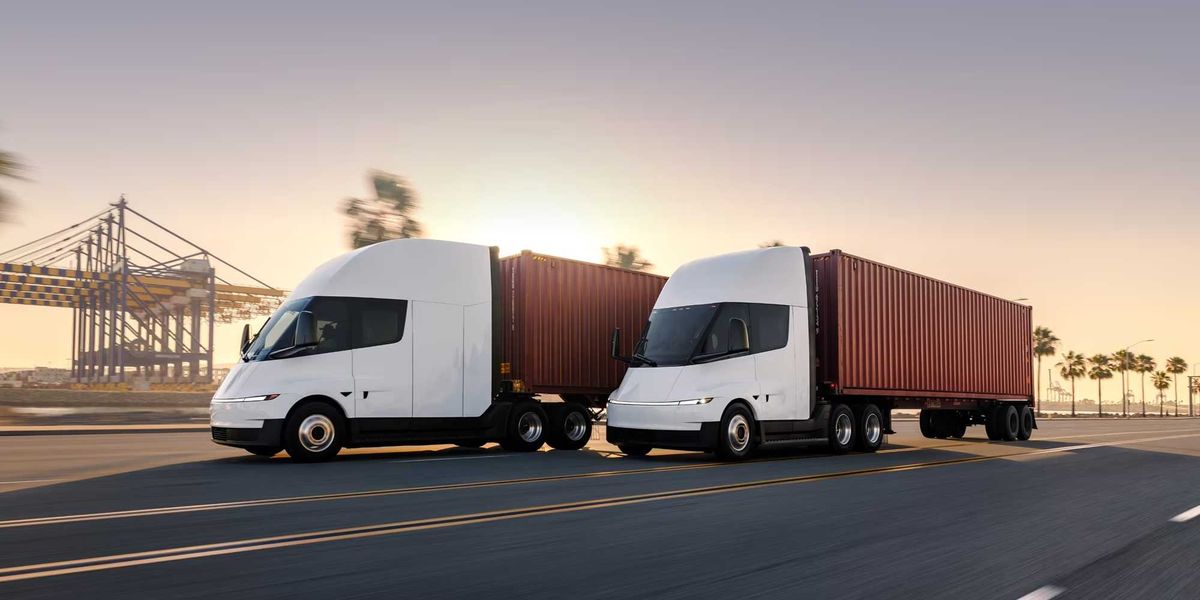
A huge order this week for Tesla Semi vehicles will nearly double the fleet of Class 8 electric trucks on U.S. highways, according to Catalyst Mobility, the clean transportation nonprofit formerly known as CALSTART, and the Smart Freight Centre, an international non-profit organization focused on reducing the emission impacts of global freight transportation.
The deal comes as a coalition of the world’s largest cargo-owning shippers have enabled the largest electric truck order to date in the United States — 2,500 battery-electric Class 8 trucks — a single deal that nearly doubles the U.S. electric Class 8 fleet.
Specifically, the order was organized by Catalyst Mobility and the Smart Freight Centre through their joint program called the Zero-Emission Truck Shipper-Carrier Alliance Leading Electrification (ZET SCALE). According to the partners, ZET SCALE aggregates freight demand at a scale no single company could reach on its own, thus building a market for electric trucks that did not exist before.
That aggregated shipper demand has reduced electric truck prices through large-scale volume orders, they say. ZET SCALE selected Tesla as its primary original equipment manufacturer (OEM) for the initial 2,500 trucks, after evaluating price, range, charging capability, and production capacity, the group said. It also listed Kenworth, RIDE, and Volvo as secondary OEMs that carriers can utilize as additional options that may meet their specific operational needs.
The group did not provide a schedule for when the trucks will be provided. Tesla launched its Tesla Semi in 2017, but has struggled to ramp up production levels despite attracting initial demand and reservation deposits for the models.
However, when they are delivered, ZET SCALE said the new trucks will run primarily from freight hubs located in 10 places: Southern California/Los Angeles, Northern California/Stockton, Central California/Bakersfield, Seattle/Tacoma, Houston, Dallas, San Antonio, the Chicago area, Atlanta, and Northern New Jersey/Newark/New York City. Those locations satisfy ZET SCALE’s strategy of concentrating deployments in high-density freight hubs with the strongest initial routes and economics, driving up utilization of both the trucks and the charging infrastructure they depend on, and reducing total cost of ownership.
“You can have good technology and still not have a market,” said Catalyst Mobility’s President and CEO, Michael Berube. “What is different about ZET SCALE is that the demand was organized so manufacturers could price at scale. That is how costs move, and that is how clean trucks leave the pilot phase.”
