

Climate Change Triggered Over 8,800 Additional Preterm Births in India During April 2024 Heatwave: Study – Indian PSU

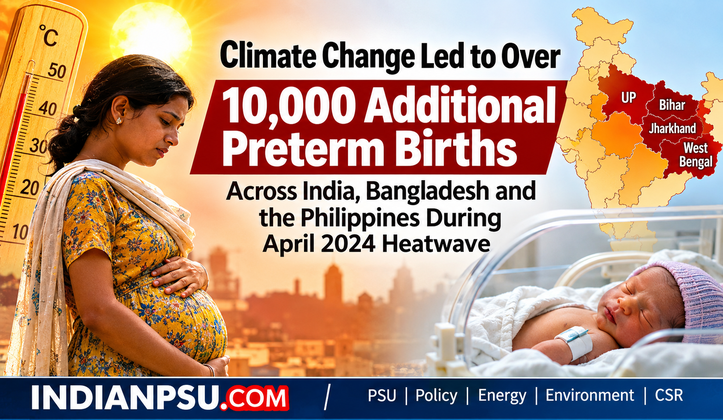
Human-induced climate change contributed to an estimated 8,830 additional preterm births in India during the extreme heatwave of April 2024, according to a new analysis published by Zero Carbon Analytics (ZCA).
The study, which examined India, Bangladesh and the Philippines, estimates that climate change was responsible for approximately 10,600 additional preterm births across the three countries during the month. The April 2024 heatwave was made at least 45 times more likely by human-caused climate change.
The findings highlight the growing threat of rising temperatures to maternal and neonatal health, particularly in developing countries where healthcare infrastructure and access to climate adaptation measures remain uneven.
Preterm birth, defined as childbirth before 37 completed weeks of pregnancy, is the leading cause of neonatal mortality worldwide. Babies born prematurely face increased risks of death, long-term physical disabilities, neurodevelopmental complications and other health challenges.
Bihar, UP among worst-affected states
The study’s subnational analysis reveals that the impact of extreme heat was unevenly distributed across India.
Bihar, Uttar Pradesh, West Bengal and Jharkhand together accounted for approximately two-thirds of India’s excess preterm birth burden during the April 2024 heatwave.
The research also warns that the situation could deteriorate significantly over the coming decades as temperatures continue to rise.
Under projected moderate and higher warming scenarios, India could experience more than 15,000 excess preterm births during an ordinary April by the middle of this century.
Uttar Pradesh is projected to carry the highest absolute burden, followed by Bihar and Rajasthan.
This suggests that the health impact of climate change could become substantially more severe even without an exceptional heatwave, making maternal healthcare preparedness an increasingly urgent priority.
More than 16,000 excess births across three countries
The research presents two separate estimates of the impact of the April 2024 heatwave.
Compared with a typical April in recent decades, the extreme heat was associated with approximately 16,150 additional preterm births across India, Bangladesh and the Philippines.
The increase was estimated at:
- India: 3.6%
- Bangladesh: 11.9%
- Philippines: 10%
Of these additional births, approximately 10,600 were specifically attributable to human-induced climate change, compared with a hypothetical world without human-caused global warming.
The country-wise climate-attributable estimates were 8,830 in India, 1,479 in Bangladesh and 263 in the Philippines.
Climate change emerging as a maternal health emergency
Dr Joanne Bentley-McKune, Lead Author of the report and Senior Research Analyst at Zero Carbon Analytics, said extreme heat was increasing the risk of preterm births and exposing babies to potentially lifelong health consequences.
She warned that the impact would intensify as global temperatures rise, with an ordinary April in India potentially witnessing an even greater preterm birth burden by mid-century than the exceptionally hot April of 2024.
The analysis also highlights the unequal distribution of climate risks. India, Bangladesh and the Philippines have contributed relatively little to historical greenhouse gas emissions but are disproportionately exposed to climate-related extreme weather.
AIIMS Guwahati expert calls for stronger maternal healthcare preparedness
Dr Rashmi Agarwalla, Nodal Officer for Climate Change and Associate Professor in the Department of Community and Family Medicine at AIIMS Guwahati, described climate change as a public health emergency, with pregnant women and newborns among the most vulnerable.
She pointed out that anaemia, poor nutrition and prolonged outdoor working hours further increase the risks faced by pregnant women, particularly those belonging to vulnerable communities.
Dr Agarwalla stressed that maternal heat protection must become an integral part of healthcare preparedness, antenatal care and community-based maternal health services.
Heat action plans need to address pregnancy risks
The report identifies significant gaps in existing maternal health policies and heat action plans in India, Bangladesh and the Philippines.
It recommends strengthening antenatal healthcare, improving access to cooling facilities and establishing effective early warning systems to protect pregnant women and newborns during extreme heat events.
However, the researchers caution that adaptation measures alone cannot eliminate the growing health burden associated with rising temperatures.
They emphasise that reducing greenhouse gas emissions, phasing down dependence on fossil fuels and increasing international climate finance for developing countries are essential to limit further warming and protect vulnerable populations.
With maternal and child health emerging as an important issue ahead of COP31, the findings underline the need to integrate climate change considerations into India’s public health planning, particularly in highly vulnerable states such as Uttar Pradesh, Bihar, Jharkhand and West Bengal.
The writer of this article is Dr. Seema Javed, an environmentalist & a communications professional in the field of climate and energy
