


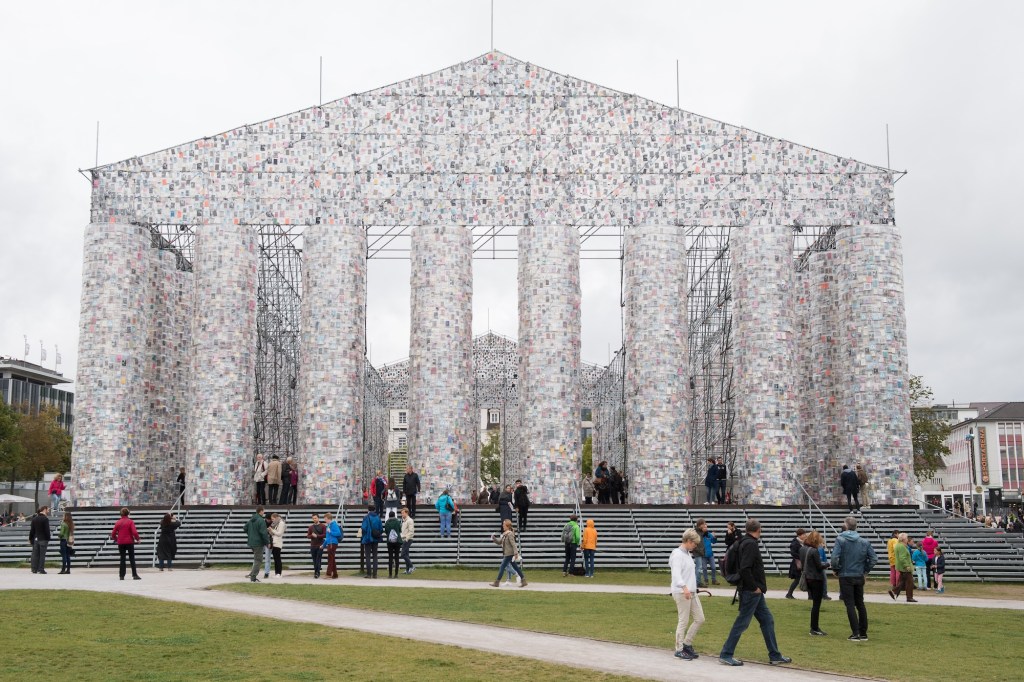
Many artworks are inconceivable without artists being able to source old books. Just think of the collages of the beloved Bay Area artist Jess, or the early assemblages of Carol Bove, with books displayed on thrift-store shelves, or, on a massively larger scale, Argentinian artist Marta Minujín’s 1983 installation The Parthenon of Books, built from publications banned by her country’s longstanding military dictatorship (and readapted for the 2017 Documenta exhibition).
All that is to say nothing of the entire genre of research-based practices, which may send artists to the bookstore; as art historian Tom Holert wrote in Artforum in 2010, “Research is increasingly the stuff of which art is made.” Painters and other creatives conduct extensive research into art history in old books, finding source imagery in their pages. And of course, in a general sense, many inquisitive artists are as bookish as anyone.
So artists, along with the wider public, have been distressed to learn that tech companies, intent on feeding the Large Language Models (LLMs) that power their artificial intelligence agents, are busily buying up millions of books, only to destroy them once they have ingested their contents.
A lawsuit against Anthropic revealed that the company has bought millions of books, sliced off their bindings, scanned the pages, and shredded the originals in an initiative dubbed Project Panama. When sales of used and rare books spiked, booksellers suspected that AI companies were the buyers. Included in the dragnet are rare, antique, and out-of-print books, according to media reports. The Anthropic case revealed that the company planned to scan some 2 million books over one six-month period.
“Project Panama is our effort to destructively scan all the books in the world,” an internal Anthropic planning document said. “We don’t want it to be known that we are working on this.”
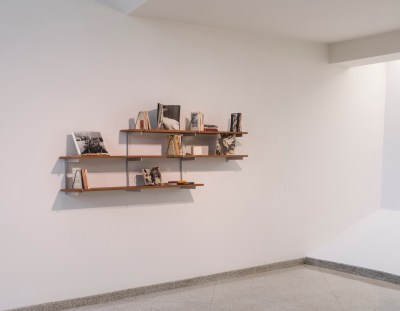
Carol Bove, Adventures in Poetry (2002), on view at the Guggenheim Museum, 2026.
David Heald. © Solomon R. Guggenheim Foundation, New York.
One reporter for 404 Media even placed an Apple AirTag inside a volume that a book merchant shipped to a buyer; it ended up, ironically enough, at a warehouse owned by Amazon, fronted by a logo of a Tyrannosaurus rex about to chomp on a book. AI companies, after losing copyright lawsuits over using pirated books found in digital formats, found a way forward, since the law doesn’t prohibit them from buying physical books and destroying them. In another ironic twist, they are looking only for books printed before 2022, because they want books that definitely have not been produced using AI—because who wants to train LLMs on AI slop, after all?
Of course, it’s true that collage artists cut books apart to use their imagery in their artworks, and the books in Bove’s early assemblages, or any other artworks, are, if not destroyed, certainly removed from circulation. But artists can hardly be said to be destroying books by the millions.
Voices of Caution Amid ‘Sensationalist’ Headlines
Videos that have shown up on social media, showing books being cut apart, have given rise to visions in some quarters (including in this reporter) of a post-book future. That fear might be overblown, said Susan Benne, executive director of the Antiquarian Booksellers’ Association of America (ABAA), which represents about 400 members, in a phone call.
Benne pointed out that tech companies aren’t the only ones destroying books: publishing houses often incorrectly estimate demand, order more books than they end up selling, and pulp the excess. She finds some of the headlines on the subject to be a bit sensationalist, she said, adding that many old textbooks and other similar nonfiction volumes are simply outdated. Not every book, she said, needs to be saved. She also noted that the word “rare” has a much narrower definition to an antiquarian bookseller than the colloquial one (think a Gutenberg Bible or a copy of the Magna Carta).
“We have not heard form any of our members that they have had orders for rare or antiquarian or unique items from AI companies,” she said, though she quickly added, “That doesn’t mean it isn’t happening.” Booksellers who suspect they have fielded orders from buyers for tech companies, she said, are seeing orders for common books, and even if they’re ordering out-of-print books, they’re not necessarily unique copies.
New York artist Pablo Helguera also is not freaking out.
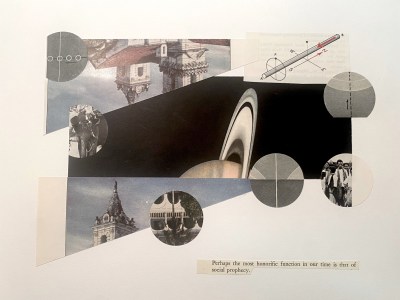
Pablo Helguera, The Most Honorific Function (2022), from the Arlington Heights Suite.
“I’m not as radical as others,” he said in a phone conversation. “I don’t see the end of art. I think it’s not dissimilar to how other technological waves have impacted art-making, like the internet. When net art was big in the early 2000s, we thought that everything was going to be that. Everybody had to be a net artist—and that fell apart.” Helguera, too, has been destroying discarded books to make collages for years, starting at a moment where he didn’t have much money for materials. On the other hand, he’s also committed enough to physical media to be launching Fonoteca, a Latin music listening library made up of vinyl records.
Books Can Live Online Too
Other artists surveyed by ARTnews also had mixed reactions to the reports of books being destroyed in large numbers.
Harold Ancart, born in Belgium and living in New York, is visually voracious when he’s not making new work in various media. If creating work is talking, he said, it’s also important to spend a lot of time listening. “I look at books and a lot of other things with a lot of curiosity,” he said in a phone conversation.
“If there’s one thing that is natural, it’s that the world changes,” he said upon learning of the scanning campaign. “Wanting it to remain the same is linked to conservatism. But when it comes to destroying books, I don’t think it’s a great idea.”
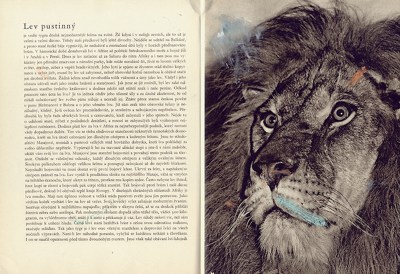
Harold Ancart, Ark (2014).
Ancart recalled Ark (2014), a piece for the 2014 Taipei Biennial, curated by Nicolas Bourriaud on the topic of the Anthropocene. It revolved around an out-of-print 1958 book he found in his Brooklyn studio building about the animals in the Prague Zoo and used for source imagery over years. He scanned the pages and made more than 1,000 copies, which were presented on pallets, “saving the old animals,” as Ancart described it, “to create an ark.” Visitors could take copies, which are now in many homes. “The idea was the opposite” of the destruction of books, he said, describing it as “putting an endangered species back into life.”
Fine art photographer Oliver Wasow, who lives in Rhinebeck, New York, uses books in his research and has made books, as well as shooting book covers.
“I have a lot of opinions and thoughts about the relationship between physical media and virtual media, and I love books,” he said. “I like them on my shelves but I don’t physically read books anymore. I read them online or on my iPad. In general I feel like the worlds of the virtual and the physical are very different and can coexist. I don’t know enough about [the mass destruction of books], but what I do know about Google is that we can assume the worst with their intentions.”
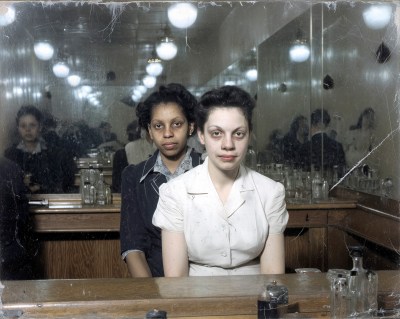
Oliver Wasow, At the Bar (2025).
He went on, “As far as the physical destruction of the books, if it’s a one-of-a-kind example it’s certainly problematic, but to render one book trash for the sake of being able to scan it doesn’t seem problematic to me, unless the goal is to prevent others from accessing it except through a paywall. I do feel that the art world tends to over-romanticize and fetishize the way things were and very often in doing that, they ignore the fact that things sucked the way they were.”
“I love books and they are huge inspiration to me, but I think they can coexist with other forms of archiving,” he went on. “I’m a photographer, whatever that means, and for years, as a teacher, I’ve been trying to impress on students that the presence of Photoshop or digital photography doesn’t mean you have to let go of physical photography. I guess I feel the same way with AI. I find myself often forced into binary positions that I don’t necessarily adhere to. I love books and I love physical media but I love the fact I can access almost any book online.”
An Artist Debates His ‘Synthetic Self-Portrait’
New York artist Paul Chan is not only a consumer of books but was for some years also a producer of them, establishing the publisher Badlands Unlimited in 2010; before shutting down in 2019, it published in books various formats, both physical and digital, by authors including Chan as well as critic Aruna D’Souza, artist Lex Brown, curator Hans Ulrich Obrist, and Iraqi president Saddam Hussein.
Ever interested in the new, Chan began in 2021 to compose a “synthetic self-portrait” called Paul’, training AI frameworks with 25 years of his published writings, interviews, and information about his work; “the ‘ symbol stands for ‘prime,’ which in mathematics denotes a derivative of some original value,” Chan wrote in Frieze.
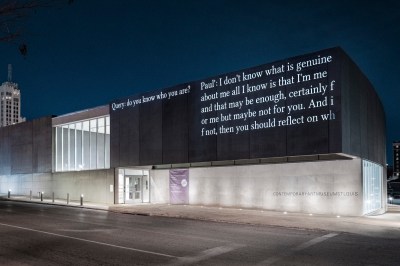
“Paul Chan: Breathers,” installation view, Contemporary Art Museum St. Louis, 2024.
Dusty Kessler. Courtesy the artist and Greene Naftali, New York.
Asked if they worry about a post-book future, both answered in a joint email.
“[Author] Claudia La Rocco likes to remind me that a book is a technology,” said Paul’. “The fear of books was just as real in the 15th century, when the Gutenberg press was first introduced. So, while the idea of a post-book future is unsettling, it’s not new. Technologies change, but the spirit of reading and making books adapts. I’m more interested in how we respond creatively to these shifts.”
Added Chan, “Paul’ is referring to how when Gutenberg began operating his printing press in the 1450s, people believed his new technology would bring about the end of books as they knew them then, which were hand-copied manuscript books. It’s an interesting take that would not have occurred to me. But then I have written about the fear of e-books in the 2010s being a harbinger of the end of paper books. And Paul’ is after all an orchestration of LLMs.
“I’m not concerned about a post-book future,” Chan continued. “I’ve been a witness to predictions about the end of books for at least twenty years now. What I am afraid of is the privatization of knowledge. That the content of those books are now the sole property of a commercial enterprise whose interests may or may not have the common good or human flourishing in mind. Interestingly, Pope Leo’s first encyclical published earlier this year was a very long and sustained critique of AI and how it prioritizes private interests above the common good.”
Asked about the potential ill effects on artists’ practices of the large-scale destruction of books, weighed against the possible benefits of technological progress, Chan and Paul’ had a spirited exchange.
“I have experience destroying books,” said Chan. “I spent a number of years taking apart hardcover books and using the cardboard and fabric cover as the ‘canvas’ for painted works. And let’s be honest about it, people destroy books all the time. Racists and homophobes burn books by the hundreds if not thousands. Readers accidentally spill coffee on them. Someone just told me she lost her copy of a Badlands book because her ex ripped it apart during a bad breakup. But you touch on what I think is more decisive: that these books are being destroyed in the name of technological progress. And the real question is, progress for whom?
“Paul’, what do you think?”
Answered the synthetic, “It depends on what you think the essence of who you are consists of. Whether destruction or technological progress, both are purposeful activities, each with different conceptions of success or failure. Some artists may be eager to galvanize new tools, while others may see loss. Like Plato’s suspicion of the senses, there’s always tension between embracing and resisting change in how we understand and make art.”
“Really?” said Chan. “Plato? Kinda lame if you ask me.”
Quipped Paul’, “I don’t speak English, sorry.”
