


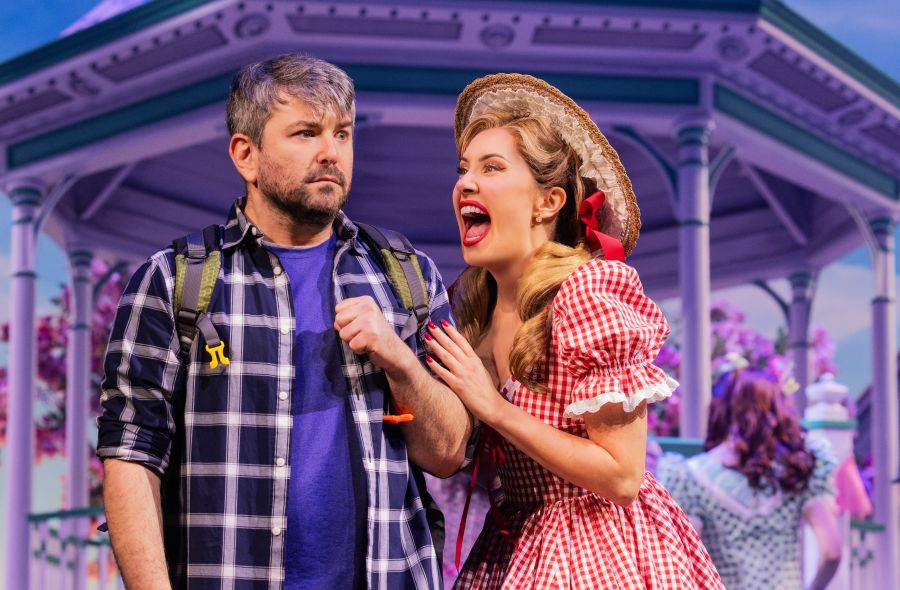
By my count, there are only three songs in the Broadway’s new Schmigadoon! that can be heard as direct lifts from the Golden Age tuners the show is riffing on, with its everyday-people-trapped-in-an-old-timey-musical premise: the sex-education ditty, originally called “Va-Gi-Na,” now called “Baby Talk,” that’s just a few notes away from “Do-Re-Mi”; the moral-panic patter song “Tribulation,” a clear analogue for The Music Man’s “Ya Got Trouble”; and a brief new funeral dirge, “When the Night Is Darkest,” that steals a few cadences from Carousel’s “You’ll Never Walk Alone” (with the inspiring words “Pretend it’s all okay” in the same slot as that title line).
Of course, if it feels like Schmigadoon! contains many more quotes and references than that, that is hardly a mistake. As the show’s book writer-composer-lyricist Cinco Paul showed me in a recent interview at the piano, the songs for his score—much of it originally concocted for the Apple+ TV series he co-created with Ken Daurio and wrote with a roomful of writers—are deftly gene-spliced from a wide variety of classic songbooks, just as the show’s script is a topsy-turvy flipbook of musical-theatre tropes.
Take “What’s the Matter With Men?,” one of 11 new songs Paul has written for the stage version. A duet between two women lamenting unresponsive romantic partners (albeit for very different reasons), it kicks off with a jagged two-chord vamp that evokes “Marry the Man Today” from Guys and Dolls. Then the six notes of the title line run up a scale to the same dissonant note that Sinatra hit on “Love and mar-riage.” The rest of the song unspools like a sampler of female duets, from Woman of the Year’s “The Grass Is Always Greener” to Mame’s “Bosom Buddies.” (Attentive ears may also notice a passing blue chord straight out of Music Man’s “Iowa Stubborn.”)
Or consider “Lovers’ Spat,” a chorus number in both the TV and stage versions, in which a break-up argument between the contemporary couple, Josh (Alex Brightman) and Melissa (Sara Chase), is framed by a quaint gaggle of Schimadoonians as a rousing mating dance. As with so many of the show’s numbers, you may think of some antecedents (How to Succeed in Business Without Really Trying‘s “It’s Been a Long Day,” for instance), but for the most part this one rests in some uncanny valley between “This is just like…” and “…but what?”
“That’s music to my ears,” said Paul (who, full disclosure, I’ve known since we were kids; we had the same piano teacher). “That’s the thing I was going for—for it to feel like, ‘Oh, that sounds like something, but what is it?’ It feels authentic but it really doesn’t exist; it just feels like it would be in an old musical.”
With one song, he said he even had a version of the anxiety of influence Paul McCartney experienced when he woke from a dream with the tune of “Yesterday” in his mind. “When I wrote ‘Suddenly,’” said Paul, describing a yearning second-act love ballad from Schmigadoon!, “I was like, ‘This must be a song, right? I’m stealing this from something.’ I haven’t found anything yet.”
There are so many other examples, as Paul showed me: The flirtatious farmer’s daughter tune “Not That Kinda Gal” may suggest Oklahoma!‘s “I Cain’t Say No,” but the tune owes more to Wonderful Town‘s “A Little Bit in Love”; “You Can’t Tame Me,” though sung by a Carousel-esque carny, is closer to Annie Get Your Gun‘s “I’m a Bad, Bad Man” than anything crooned by Billy Bigelow; and the tap-happy “With All of Your Heart,” though belted by a single schoolteacher in the mold of Marion Paroo or Anna Leonowens, sounds a lot like the Charles Strouse of “You’re Never Fully Dressed Without a Smile” (and the 1930s antecedents that inspired him). Paul thinks of this mix-and-match approach as pastiche rather than parody, but admitted that he started out in a jokier place.
“I made the mistake a lot of parodists make: You sort of find one thing, and then you really exaggerate it,” said Paul, who played me an early version of the opening number that chugged along in a mildly ragtimey way. “Horrible, right?” he said. “That was what I sang to Apple when we pitched it, but then I realized, ‘This is garbage; I need to really be rigorous about this, really hard on myself.’”
The key, he said, was to write these songs for real, leaning into “musical theatre’s greatest power: sincerity.” Maybe that’s why the through-the-looking-glass moment that unlocked the show for me happens to be “Tribulation.” On its surface, you think: Oh, I get it, it’s “Ya Got Trouble.” But think again about its placement and context: This gospel-esque patter song about the supposed decline of the small town’s virtues comes late in the show out of the sour puss of Mildred Layton (Ana Gasteyer), the town’s reigning scold. So it’s not the opening bid of a cynical huckster, a la Music Man’s Harold Hill, but the earnest (if comically exaggerated) jeremiad of Schmigadoon!’s full-throated villain. Layton, in other words, is precisely the kind of character that a con man like Hill would have based his spiel on.

Once I clocked that bit of intertextual retconning, I saw and heard it everywhere in the unreal pop-up world of Schmigadoon!, not only in its repurposed story beats but, more crucially, in its convincingly mid-century sound. It’s as if Paul’s score had somehow drilled down to the sources of the musical language that flowered on U.S. stages from roughly the 1930s the ’70s, from the Americana of Rodgers & Hammerstein to the sassy crackle of Frank Loesser, from the hearty directness of Adler & Ross to the sunny tunefulness of Charles Strouse to the jaded strut of Kander & Ebb. It’s a rich, evocative language that musicals have mostly been running away from in the decades since (and with plenty of reason), and perhaps can only return to it in period pieces or quotation marks. (I take seriously, by the way, the objection, best voiced by Jackson McHenry, that the great American musicals were always about more than romance—though I hardly think that element is incidental to their appeal, or that the subject of how and why people couple is inherently a trivial matter, a little sugar to help musicals’ real social or political ambitions go down more easily.)
But in the hands of a true believer like Paul, a loving confection can feel like the real thing.
“Even if we don’t know music or understand all the theory behind it,” Paul said, “you associate certain feelings with certain chord progressions. That’s what I think a lot of what Schmigadoon! is doing—not only referencing the character tropes but the musical tropes. They make you feel things.”
Rob Weinert-Kendt is the editor-in-chief of American Theatre. He also reviews theatre and culture for America magazine.
Source link
