


You know an Anish Kapoor work when you see it. His mesmerizing optical illusions and reality-distorting monuments have propelled him to global art stardom. Yet, over his four-decade career, the British-Indian artist has continued to captivate new audiences with the sheer variety, quantity, and scale of his output.
“I don’t care to work on one thing,” Kapoor said during a studio visit in March. “I’ve got lots and lots going on all the time, because things grow out of other things.”
At the artist’s sprawling, 33,000-square-foot complex of studios in southeast London, I went looking for where the magic happens and found that Kapoor’s workshop is no mere hit factory—though great works are in no short supply—but a place of relentless experimentation, brimming with surprises that speak to his growing ambitions.
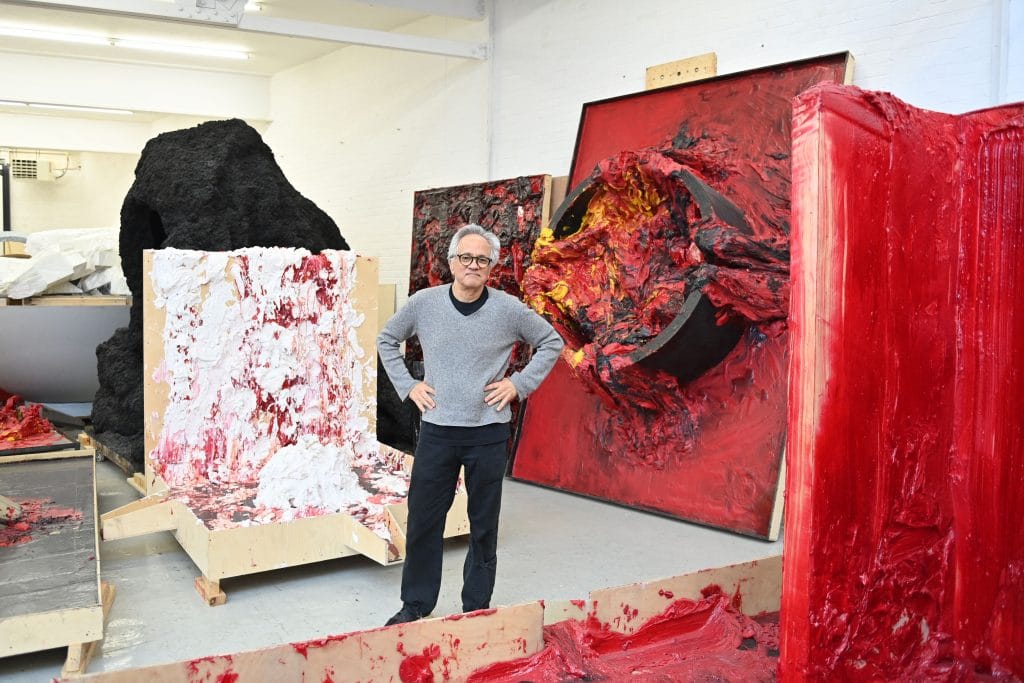
British contemporary artist Anish Kapoor poses for a photograph during a tour of his studio in London in 2022. Photo: Justin Tallis/AFP via Getty Images.
Some of the most impressive works were receiving finishing touches ahead of an acclaimed blockbuster exhibition of new material at the Hayward Gallery in London that is on view through October 18. Critics have praised both Kapoor’s sustained interest in optical illusions—his “eye-melting visual tricksiness,” in the words of the Telegraph‘s Alastair Sooke—and his more recent forays into disturbingly visceral, bodily work, which Guardian critic Jonathan Jones called “a divine bloodbath.”
One of the show’s centerpieces is Ha Makom (2026). When I saw the work it had already taken the form of a rocky, extraterrestrial terrain crowned by an ambiguous doorway—a portal to where? But the all-over application of a deep, wine-red paint—a Kapoor trademark that always packs a punch—was still in progress. The artist noted there were various complexities in getting this “vital” hue just right.
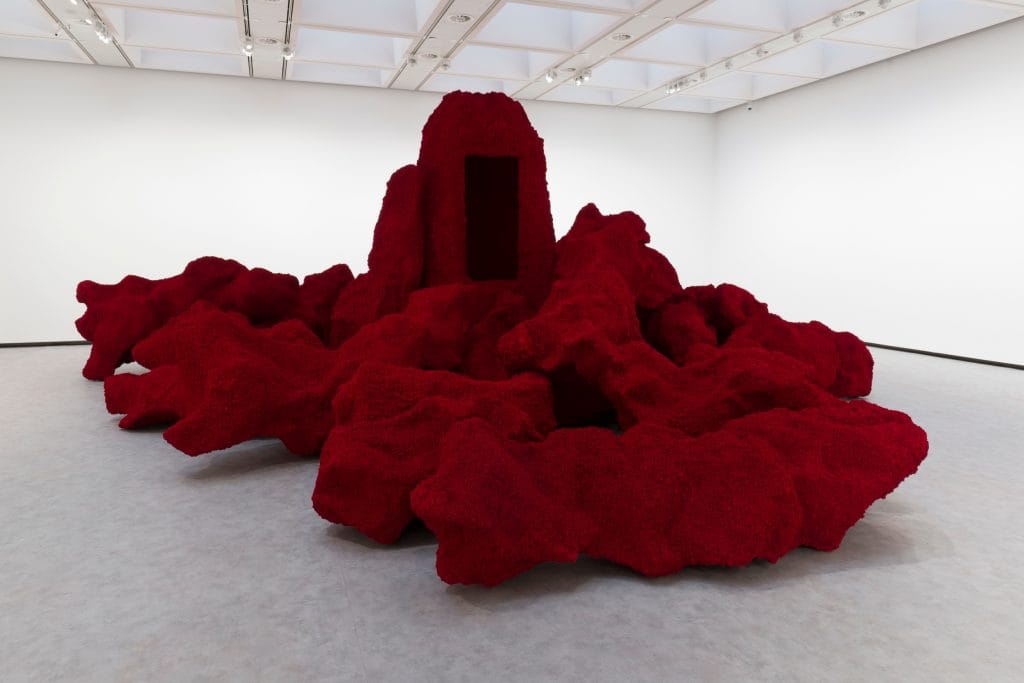
Installation view of “Anish Kapoor” featuring Ha Makom (2026). Photo: Dave Morgan, courtesy of the Hayward Gallery and the artist. © Anish Kapoor. All rights reserved, DACS, 2026.
The aim is to “have weight and glow at the same time,” he said, a complex task when you are working with such a coarse, porous surface, which he achieves by mixing wood pulp with fiberglass and resin. “It almost doesn’t want to happen,” he added, yet it is this very pitted texture that makes the finished work, crucially, “full of dark spaces.”
The effect is that, although richly detailed up close, the object begins to “fuzz a little bit” as it recedes into the distance. “It has a certain immateriality,” Kapoor said. “One of the things I’m after is that in-between state.”
A Bumper Year
Even by Kapoor’s standards, 2026 has been a bumper year. Additional exhibitions recently closed at the Jewish Museum in New York and SCAD Museum of Art in Savannah, Georgia, while two more are ongoing through the summer at Palazzo Manfrin in Venice and the Lehmbruck Museum in Duisburg, Germany. Another show at the Serlachius, in Mänttä, Finland, runs until April 4, 2027.
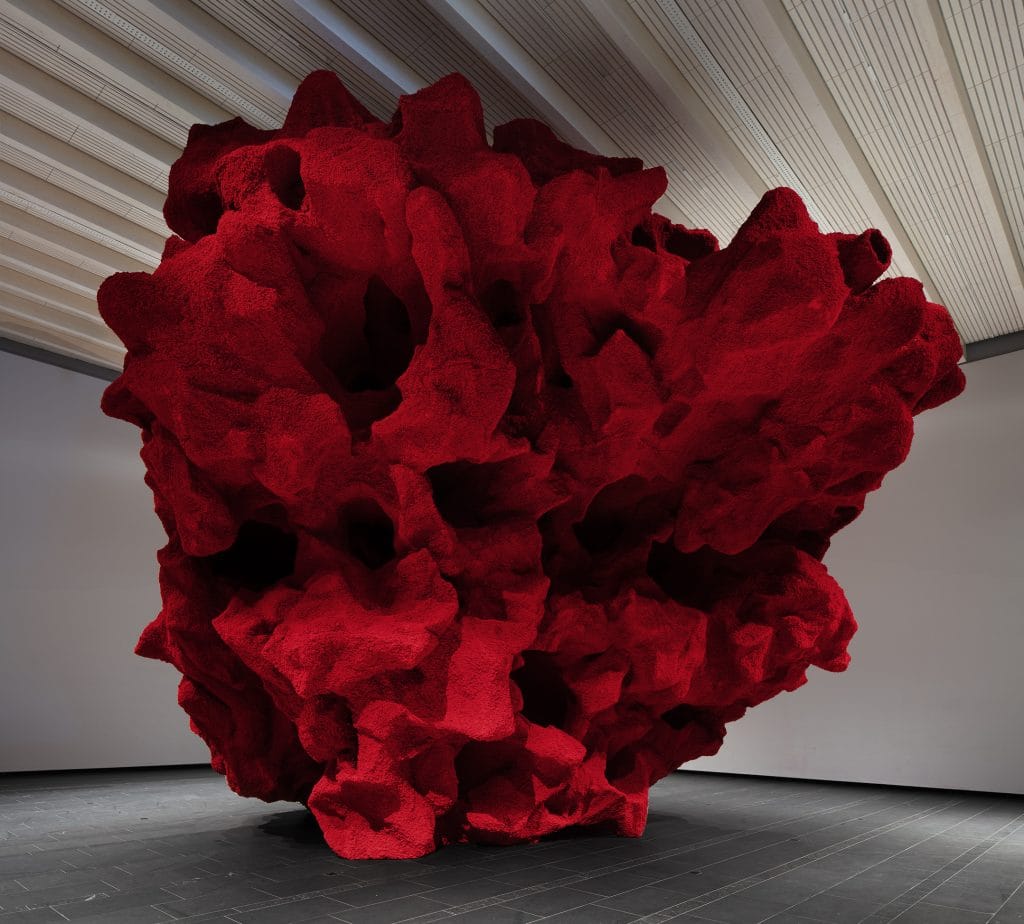
Installation view of Ancestors at Anish Kapoor’s exhibition at Serlachius, 2026. Photo: Jussi Tiainen. ⓒ Anish Kapoor. All rights reserved, DACS/Kuvasto 2026.
In March, he was still working on a piece for the Serlachius show, Ancestor (2026), which he said would have a similar texture to Ha Makom, “almost like a meteorite.” Then, it was still in a skeletal state with its clunky wooden frame exposed, its impossible weightlessness still in his mind’s eye. This stage is all about “inventing the form, getting the form to be complex enough,” Kapoor explained of the highly irregular structure.
“It should be full of adventure,” he said, adding that repeated forms are rearranged together in ever-novel ways, echoing the unpredictable improvisations of the natural world. Constructed in parts, it was barely able to fit in the 23-foot-high studio space. Assembled on site at the museum, it has ballooned to 30 feet in both height and width and grazes the ceiling.
“Traditionally in the art world, we think of scale as a problematic subject,” Kapoor said. “Why is it so big? It has to do with what that does to your body. If it’s just big to be big, who cares.”
Transcending Matter
The artist has tricks up his sleeve that don’t rely on scale. One whole room of his expansive studio was full of podiums carrying little optical illusions made with Vantablack, an ultra-absorptive shade of black used in scientific instruments that Kapoor bought the exclusive rights to use artistically a decade ago. Each work shape-shifts in unexpected ways—from flat to concave, for example—as the viewer moves around them. They were made in tribute to the early modernist Kazimir Malevich, who made his radical Black Square in 1915.
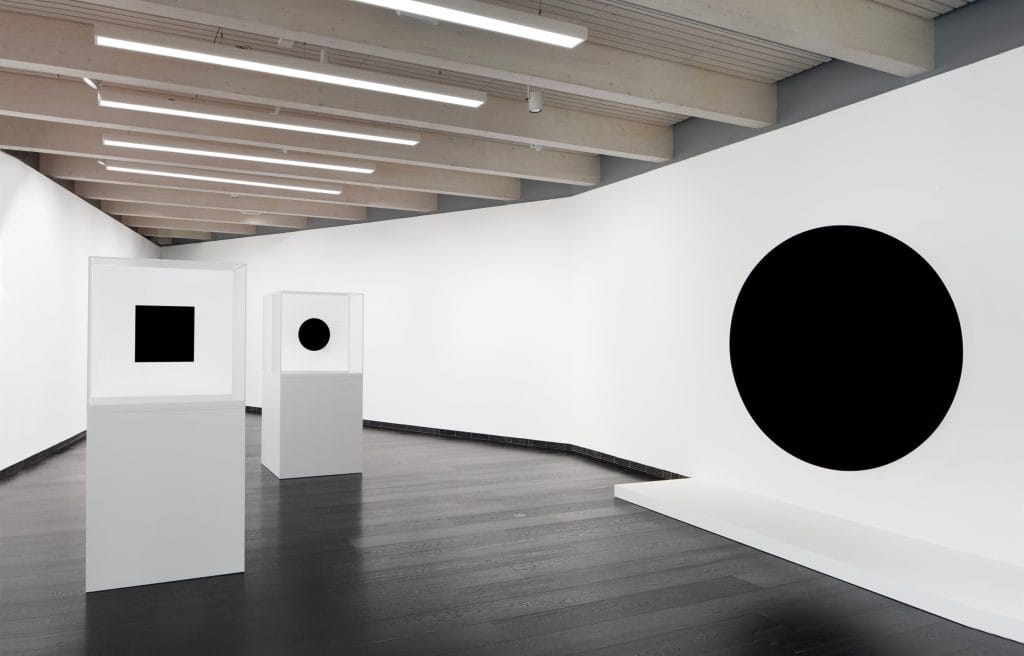
Installation view of Anish Kapoor’s exhibition at Serlachius, 2026. Photo: Jussi Tiainen. ⓒ Anish Kapoor. All rights reserved, DACS/Kuvasto 2026.
“What a naughty, powerful, simple, stupid thing to do,” said Kapoor. “A black square.” But it was Malevich’s belief that objects “go beyond,” or that feeling transcends matter, that so strongly resonates with Kapoor’s own spiritual inclinations. “Where was I before I was born? Where do I go after I die?” the artist asked, his voice trailing off as he briefly paused to wipe away tears. “Malevich pointed at a fourth dimension of the object, for me a very wonderful, vital thing.”
With Vantablack, which absorbs 99.9 percent of visible light to make depth disappear, Kapoor is able to hide three-dimensional projections or folds in plain sight. “My contention, like Malevich’s, is that this takes the object beyond being. Of course, it’s a fiction, a kind of fantasy, but that’s exactly what art is about.”
Elsewhere, larger “voids,” or bowls drenched in pigment, bloom out from the studio walls. When Kapoor first made one of these works in Prussian blue, he was stunned to find “it wasn’t an empty space painted blue,” he said. “It was full of blueness or, as I say, darkness. What was empty became full. How can that be?” As I leaned into a black version, now on view at the Hayward, my head felt like it was being swallowed into a bottomless pit that distorted all surrounding sound.
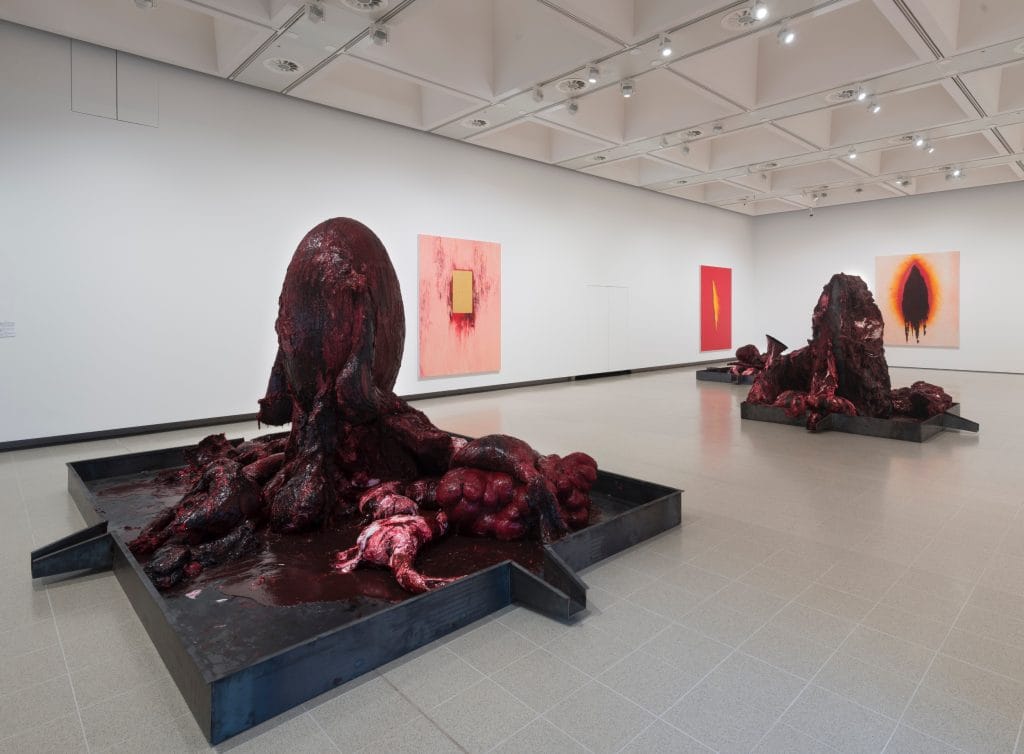
Installation view of “Anish Kapoor,” 2026. Photo: Dave Morgan, courtesy of the Hayward Gallery and the artist. © Anish Kapoor. All rights reserved, DACS, 2026.
In recent years, Kapoor has been experimenting with much messier, unflinchingly gory works. For the London show, he has prepared the visceral Ritual Expiation (2025–26) series of soft silicone masses that drip pink and deep maroon paint like the entrails spilling out from a massacred animal. A viscous, bloody liquid pools out, spread over the clinical metal tray beneath. Although the work is essentially descriptive, Kapoor connects it to the great Abstract Expressionist painter Jackson Pollock, whose work, he said, “is cosmic.”
Pollock’s “action” paintings result from a series of impulsive rhythms, while his paint has been compared to bodily fluids. But by putting such an unruly scramble on a wall, Pollock “turns Earth and blood and body into cosmos,” Kapoor said. “That’s the fundamental alchemical transformation.” In other words, art.
“Anish Kapoor” is on view at the Hayward Gallery in London through October 18. “Anish Kapoor” is on view at Serlachius in Mänttä, Finland through April 4, 2027. “Anish Kapoor” is on view at Lehmbruck Museum in Duisburg, Germany through August 30. “Anish Kapoor” is on view at Palazzo Manfrin in Venice through August 8.
