


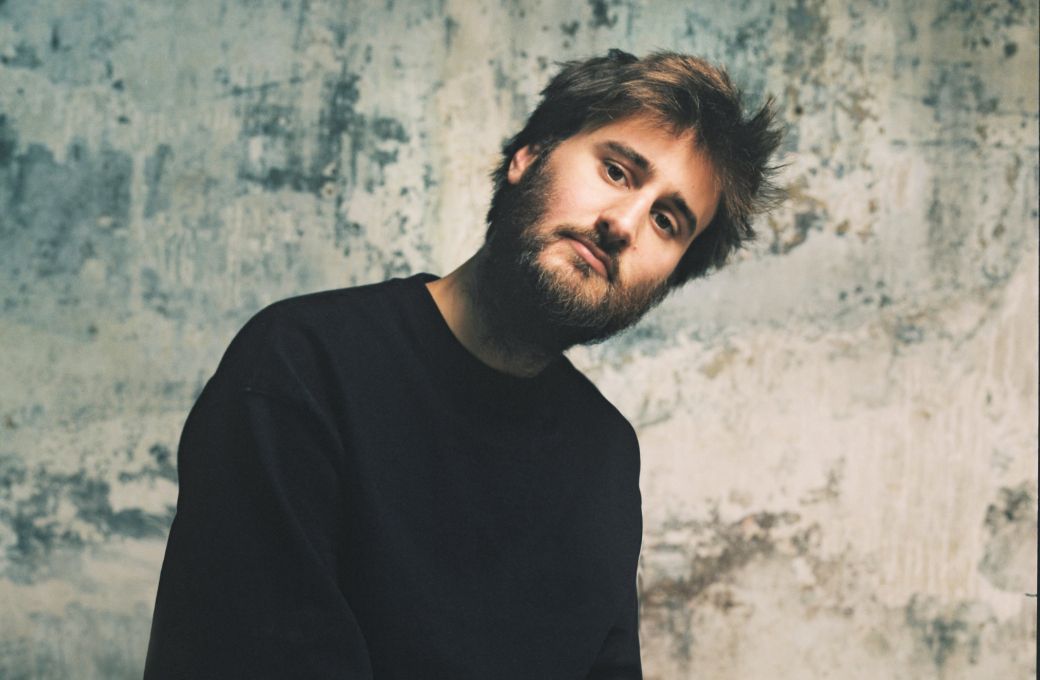
When does Bach cease to be Bach? This year harpsichordist Jean Rondeau is taking an unusual approach to the Goldberg Variations at Bachfest Schaffhausen. He will perform the cycle three times – once in a historically informed manner on harpsichord, once rearranged as a Baroque chamber work for keyboards, traverso flute and strings, and once as a new contemporary composition, UNDR for piano, percussion and electronics.
Jean Rondeau
© Clément Vayssières
Why take such an unusual approach to Bach’s well-known variation cycle? Does Bach’s music withstand such major transformations?
The musical power of the Goldberg Variations is such that they naturally invites multiple perspectives. The harpsichord version is, of course, the original one. It is worth noting that Bach explicitly specified the instrumentation for this piece – the harpsichord – which is not always the case in his output.
The ensemble version situates itself firmly within the stylistic language of the period. It gains particular relevance when considered alongside the trio sonatas and quartets written by Telemann during the same years.
UNDR, however, belongs to a different category. It is essentially a new contemporary work whose formal architecture is inspired by the Goldberg Variations. One does not encounter direct quotations of the original material, but rather a large-scale form composed of thirty successive tableaux.
This new work UNDR is more than an arrangement – it is a composition that deconstructs Bach, with percussion by Tancrède Kummer and sound design by Silouane Colmet Daâge. You leave the harpsichord, switch to the piano. But is this still Bach? Are you here no longer an interpreter but a composer?
To expand on my previous answer, UNDR involves both the interpretation of music that Tancrède and I have written, and a mode of interpretation that integrates improvisation.
Within this project, we therefore assume the roles of composers, performers, and improvisers simultaneously. These are, in my view, three facets of the same geometric form, each offering a different perspective on a shared musical material.
An excerpt from Jean Rondeau and Tandrède Kummer’s UNDR filmed on Super8 by Céline Lixon.
In creating UNDR, you worked backwards through Bach’s Goldberg Variations, deconstructing and reassembling them. What did you learn about Bach’s compositional technique that would have remained hidden without looking at the music in this way?
The challenges that arise when writing music on paper are fundamentally different from those encountered when performing the same notes. The initial idea was to immerse myself in the compositional constraints Bach imposed upon himself – even if the resulting musical language differs greatly – in order to disrupt my own compositional habits and to frame, through this exercise, an alternative musical gesture.
You describe UNDR as a deliberately “unfinished” work. Bach, by contrast, signed his scores Soli Deo Gloria and rarely if ever left works unfinished. Is this deliberate incompleteness a commentary on Bach’s perfectionism – or a suggestion that Bach cannot be completed?
From this perspective, it would be both impossible and absurd for me to compare myself to Bach. What drives me is the idea that a work should reflect the living nature of music – music that only truly comes into being through performance, and whose written form might, in turn, be re-experienced anew.
Leaving space for renewal and evolution within each tableau is therefore essential. One might imagine a museum room containing thirty paintings, some of which are occasionally replaced, corrected, modified by their creators, or illuminated differently over time.
Jean Rondeau performs JS Bach’s Goldberg Variations.
In the third program, the Goldberg Variations are arranged for a Baroque ensemble with traverso flute, violin, viola da gamba, harpsichord and organ. Bach wrote the cycle for a solo harpsichord. Why, then, an orchestration? What does the work gain – and what does it lose?
I would argue that the work gains a great deal. We – since this transcription was created collectively by all members of the ensemble Nevermind – were genuinely surprised by how naturally this version came to life and by the way it illuminated textual elements that can remain more concealed in the solo harpsichord version.
This is a profoundly contrapuntal work, particularly in its canons, which appear every third variation. Performing it as an ensemble allows each voice to be highlighted individually, and at times the singing quality of the flute or violin brings particular narrative elements of certain variations into sharper focus.
Jean Rondeau and Nevermind perform their arrangement of the Goldberg Variations Aria.
Bach himself arranged works by other composers – for example, Vivaldi’s Violin Concertos for organ or harpsichord. In transforming the Goldberg Variations, are you adopting this same artistic freedom – or are you crossing a line?
Bach did not hesitate to reuse and transform his own material. A concerto might become a cantata sinfonia; an organ piece might reappear as a trio sonata for two violins.
Engaging in transcription is therefore a way of aligning oneself with an established compositional practice of the eighteenth century. In our ensemble version, our intention was to remain as faithful as possible to the original text and to render the musical substance with the greatest honesty.
Rather than taking creative liberties, we pursued a rigorous approach in search of musical accuracy.
This year’s festival’s motto is ‘Bach Timeless’. Presenting Bach in three different forms – historically informed, newly orchestrated and deconstructed – which of these versions feels the most timeless for you?
The original version and the Nevermind arrangement are both strongly stylistically defined and immerse the listener in the late Bachian German idiom. UNDR, by contrast, is unequivocally a contemporary work. It reflects our present musical moment while inviting a sonic experience whose codes are not entirely fixed.
What this diversity ultimately demonstrates is that Bach’s music – which he himself did not necessarily consider personal – possesses a strength that transcends instrumentation, interpretation, and time itself. Bach’s music finds its rightful place regardless of instruments, eras, or performance practices. That is where its unparalleled power lies.
Jean Rondeau performs the Goldberg Variations and UNDR on 15th, 16th and 17th May at Bachfest Schaffhausen.
See upcoming events at Bachfest Schaffhausen from 13th–17th May 2026.
This article was sponsored by Internationales Bachfest Schaffhausen.
