


Support CleanTechnica’s work through a Substack subscription or on Stripe.
Or support our Kickstarter campaign!
Twice, the seven states which rely heavily on the Colorado River for drinking water and irrigation have been given deadlines by the federal government to find a solution to the chronic lack of fresh water in the river and twice the states have failed to do so. Now it is up to the feds to impose a solution and it is pretty damn certain no one will be pleased with the result.
The issue is simple — the states are taking more water out than nature is putting in. The two human-made lakes built decades ago — Lake Powell and Lake Mead — are at historically low levels while demand for fresh water from the river goes up every year.
To fix the problem, experts say the states need to find a way to reduce their demand for fresh water by up to four million acre-feet a year. An acre-foot is the amount of water needed to cover a typical football field in water one foot deep — 326,000 gallons, to be precise. Do the math — figure, figure, scribble, carry the one — and the answer is…a whole heckuva lot of water.
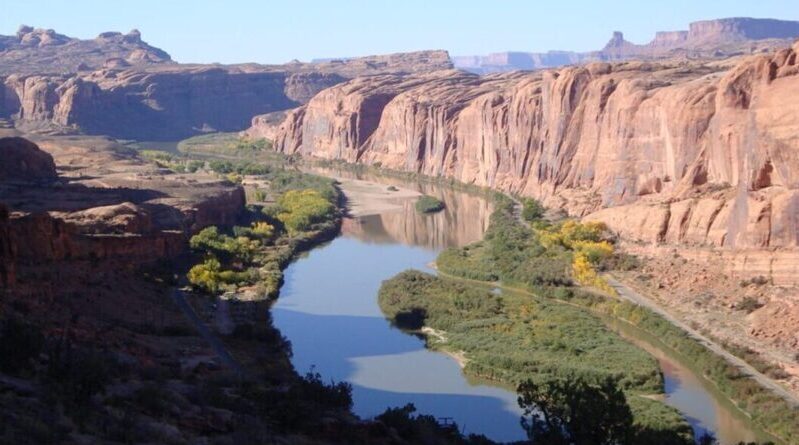
The Colorado starts in the Rocky Mountains and wends its way west 1,450 miles through Colorado, Wyoming, Utah, and New Mexico before continuing on through Nevada, Arizona, and California and ending in Mexico. Along the way, it supplies roughly 40 million people which drinking water, and irrigates 5.5 million acres of farmland.
The waters from the Colorado River are responsible for $1.4 trillion in economic activity, and are essential to life in Los Angeles, Phoenix, and Las Vegas. The Colorado River basin is home to many diverse ecosystems and provides cateritical habitat for more than 150 threatened or endangered species.
First In Time
At issue are legal arguments that basically come down to “first in time, first in right.” Historically, Colorado, Wyoming, Utah, and New Mexico had agreements in place for how to divvy up the water when Arizona, Nevada, and California were little more than desert outposts. They have been intransigent about relinquishing any of their claims to the river, even though those “lower basin” states say they have made significant concessions to the “upper basin” states.
Those upper basin states maintain that any shortage of water is entirely the fault of the lower basin states, which have failed to address the explosion in population following World War II, when millions of people relocated to those states in search of the life in the Golden West. Figures from the city of Las Vegas show the population of the city increased from around 60,000 in 1959 to 648,000 in 2017. In 2025, the number had ballooned to 2.4 million.
If you fly into Sky Harbor airport, which serves the Phoenix area, you can look down and see hundreds of thousands of homes spreading from horizon to horizon, virtually all of them built since Eisenhower was president. The same can be said of southern California, which used to be a dusty area at the end of Route 66 after it passed through Barstow and San Bernardino.
Beyond the need for all those millions of homes to have running water, the water from the Colorado has made the deserts bloom. Arizona and California in particular grow much of the fruits and vegetables Americans rely on every day.
An Ultimatum
The states were given an ultimatum to come up with a solution by last November. They didn’t. Then the drop dead date was moved to last week, but still no agreement was reached. In a joint statement on February 13, the governors of the California, Arizona, and Nevada insisted that “all seven basin states must share in the responsibility of conservation.”
“This is the second time the Bureau of Reclamation has given us a deadline without a consequence,” Rhett Larson, a professor of water law at Arizona State University told The Guardian. “A deadline without a consequence is just a date.”
What happens next? No one knows. The federal government could impose a solution, which would probably make no one happy. Four draft proposals released for public comment in January include severe reductions in the amount of water the lower basis states would be allowed to use. But if that leads to higher grocery prices, it could have significant political ramifications.
A Thelma & Louise Moment
“Everyone agrees we have to use less water. The problem is states look at each other and say you should use less,” said Dr Jack Schmidt, the director of the Center for Colorado River Studies at Utah State University. “Seven people have their hands on the steering wheel driving toward the edge of a cliff — and no one is working the brakes.”
Right on cue, the amount of snow in the Rocky Mountains this year has been far less than normal, which means less water in the Colorado River later this year. “There needs to be unbelievably harsh, unprecedented cuts” that will affect water users in major ways, said Dr Brad Udall, senior water and climate research scientist at Colorado State University’s Colorado Water Center. “Mother Nature is not going to bail us out.”
“We know temperatures are going up — and going up quite rapidly,” he said. Actually, the official position of the United States government is that concerns about a warming environment are a hoax that is part of a “green new scam.” Water flow in the Colorado River has declined by 20% over the last century and rainfall has decreased by about 7%.
Send In The Lawyers!
Lawsuits are expected to flourish as the supply of water decreases, but it is unlikely the courts can make water appear on demand. Dr John Berggren, regional policy manager at Western Resource Advocates, said, “[Litigation] kind of freezes everything, and environmental values are one of the first things to go. They’ll protect the reservoirs as best they can, but they’re probably not going to be able to consider environmental flows and things that actually benefit the river itself.”
He added that the waterway needs flexibility, especially during dry years. Emergency actions — especially those governed by courts and not experts — cannot account for things like timing and temperature that are so vital to protecting the river’s ecosystems. “It’s not just a pipeline,” he said, “it’s a living river.”
Before the negotiators ended their talks on Friday, Matt Rice, the southwest regional director for American Rivers, said he was clinging to hope that something would come out of the negotiations. He said he has seen year after year of crisis management play out on the river, but lessons continue to go unlearned. “The positive thing is we know what to do,” he said.
Conservation efforts across the Colorado River basin have been partially successful. Cities in the region have reduced water use by 18% over the last two decades, despite population growth. Farmers have adopted more efficient irrigation systems, infrastructure has be updated for better efficiency, and conservationists are working to restore watersheds.
But Rice says there needs to be a new approach, framed not as emergency cuts that go from crisis to crisis, but an adaptation to an arid future. For that, the deadline isn’t coming from the federal government, it’s being imposed by the waterway itself. “We are facing a system crash,” he said. “The river is not going to wait for process or politics.”
Known Unknowns
Readers may find some interesting parallels between this story, which is just a small part of the climate change narrative, and the larger inability of nations to craft effective policies to manage a rapidly overheating planet. We are all so interested in defending our little bit of turf that we are unable to see the bigger picture. It doesn’t help that the political process in the US is now in the hand or people who are proud of their ignorance and celebrate their intransigence.
The US, with malice aforethought, is deliberately making the climate crisis worse. What is happening in the Colorado River basin is a warning, one unheeded by our so-called leaders.
There will be consequences for our gratuitous ignorance and those consequences are not down the road in a century or two. They are here now, today, yet we refuse to see them. The epitaph for the human race may well be, “Too stupid to live.”
Support CleanTechnica via Kickstarter

Sign up for CleanTechnica’s Weekly Substack for Zach and Scott’s in-depth analyses and high level summaries, sign up for our daily newsletter, and follow us on Google News!
Have a tip for CleanTechnica? Want to advertise? Want to suggest a guest for our CleanTech Talk podcast? Contact us here.
Sign up for our daily newsletter for 15 new cleantech stories a day. Or sign up for our weekly one on top stories of the week if daily is too frequent.
CleanTechnica uses affiliate links. See our policy here.
CleanTechnica’s Comment Policy
