

Bilbao Fine Arts Museum gains new €45m Norman Foster-designed wing – The Art Newspaper

The industrial port city of Bilbao in northern Spain’s Basque Country may be most famous for Frank Gehry’s Guggenheim Museum but a major new Norman Foster-designed expansion to the nearby Museo de Bellas Artes (Fine Arts Museum) opens to the public today (6 October).
The striking, €45m project in which Foster + Partners has worked with the eminent Basque architect Luis María Uriarte, has been described as a “floating pavilion” and will double the current exhibition space in the museum, to around 6,000 sq. m, and will also remodel 8,000 sq. m of existing galleries.
Reuniting two buildings
Until now, the museum’s collections, which include works by Lucas Cranach the Elder, El Greco, Zurbarán, Goya, Mary Cassatt, Gauguin, Bacon and Richard Serra, as well as oriental art, archaeological treasures and decorative and applied arts, have been split across two spaces. The two buildings: one Neo-Classical built in 1945, the other a Modernist, Mies van der Rohe-influenced 1970 expansion, were both renovated and remodelled in 2001 by Uriarte.
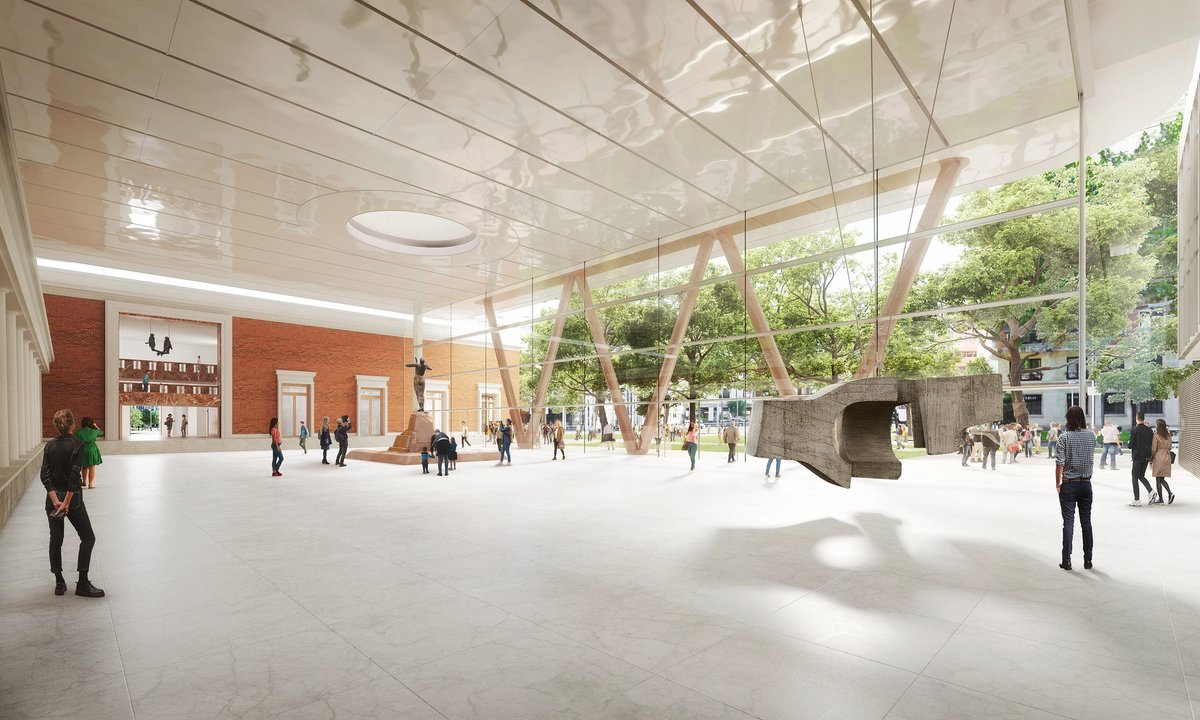
The new Foster and Uriarte extension, which The Art Newspaper viewed, links the existing buildings while adding two new, curved, light-flooded upper storeys. In keeping with the “floating pavilion” moniker, these sit above the existing buildings, overhanging the front façade, and are cleverly held up by a series of giant, V-shaped supports.
The uppermost floor will hold temporary exhibitions as well as a viewing terrace and restaurant with views of the city and surrounding hills, while there will also be a space dedicated to architecture and design, a new documentation and research centre, offices, services and facilities.
The museum’s original entrance in the red brick 1945 building—a classical-style rectangular archway flanked by twin statue-filled arched alcoves, will also be restored and reinstated.
But the experience of entering the museum will be transformed by a new 1,000 sq. m light-drenched atrium, which will operate as a visitor’s centre while also providing access to both the existing and new galleries.
The expansion will provide new gallery spaces for the permanent collection, which comprises around 2,000 paintings, 500 sculptures and an 800-strong collection of decorative arts. The collection will be presented both chronologically and thematically.
There will also be new spaces for the museum’s ongoing programme of temporary exhibitions, as well as a new educational centre, a space for family activities and workshops and, on the upper level, a restaurant overlooking the park.
A new “floating pavilion”, on top of the original building, is part of the Bilbao museum’s expansion Courtesy of Museo de Bellas Artes de Bilbao
The new extension is funded by the Basque government (one of Spain’s semi-autonomous regional governments), the regional government, the provincial council and Bilbao city council in conjunction with the privately-owned BBK Banking Foundation.
Foster and Uriarte’s design was the winner of an open competition and was chosen partly for its respect for the existing buildings.
“What appealed to us about the Foster and Uriarte proposal was that it didn’t interfere with the existing architecture,” says Miguel Zugaza, the museum’s director. “It enhanced it and offered a new dimension to the museum, integrating the two earlier styles of architecture—the 1945 building and the 1970 building—and uniting them in a very ingenious manner. It also fulfilled several different requirements: not only the physical expansion of the museum but also reorienting the museum towards a different side of the city—not towards the river but towards the Guggenheim [museum].”
The Fine Arts Museum sits less than ten minutes’ walk from the Guggenheim and the banks of Bilbao’s Nervión River. Only one large building between the museum and the Guggenheim prevents a direct view between the two.
To reposition the Fine Arts Museum as a key part of Bilbao’s cultural offering, Foster + Partners have pedestrianised the centre of the roundabout in front of the museum and reduced traffic lanes.
“The great good fortune of a city like Bilbao is that we have two museums so close to each other,” Zugaza says. “We’re only 500 metres from the Guggenheim but we’re not in competition with each other. We have very different offers and different histories. The Fine Arts Museum can be seen as effectively the Basque Country’s national gallery and I think this new stage in our history will extend what we can offer visitors, not only to Bilbao but to the whole of the Basque Country.”
