


Sign up for the Slatest to get the most insightful analysis, criticism, and advice out there, delivered to your inbox daily.
Christopher Nolan’s blockbuster film adaptation of The Odyssey may be a movie about “a complicated man,” but its resounding success has been anything but ambiguous. The picture has crushed box-office projections by earning more than $264 million worldwide in its opening weekend, has been largely hailed by critics, and is now celebrated for breaking the record to become not just Nolan’s biggest hit ever at $1.1 billion globally, but the highest-grossing IMAX release of all time. It has achieved these feats not without a little controversy (hey, complicated man, complicated feelings!), but the movie’s impact remains undeniable. Nolan’s Odyssey is a certified cinematic achievement—and, even better, a massive boon to those who care about literature and the written word.
Book versions of Homer’s epic poem have been selling like hotcakes in the wake of the film’s release. Just days after the film premiered, Wall Street Journal film critic Kyle Smith noted that translations of the story had reached Nos. 4, 8, and 49 on Amazon’s bestsellers list, with a translation of the Iliad at No. 61. Variety reported that Nolan’s film “boosted sales” of the book enough to net a sales increase of 76 percent “across all editions,” including both text and audio versions of the tale, as Spotify revealed to Variety that listens to the audiobook on the streaming platform “jumped more than 240 percent” weeks before the premiere and were “up roughly 680 percent” in the time after the blockbuster’s release. The BBC reported that in the U.K., print sales of the classic epic had risen “by 700 percent” in the week following the film’s release when compared to the same period in 2025; meanwhile, the audiobook narrations of the poem by Sirs Stephen Fry and Ian McKellen had entered both the Spotify U.K. and U.S. Top 10 lists, respectively. Even now, after the Odyssey hype has settled down a touch, Emily Wilson’s translation sits at No. 14, and Robert Fagles’ at No. 19, on Amazon’s bestsellers list; Wilson’s translation has also captured the No. 2 spot on USA Today’s bestseller list. And let’s not forget the libraries: The New York Public Library and Brooklyn Public Library both confirmed to me that there has been a spike in demand for the Odyssey, with the NYPL citing a “338 percent increase” last month. Madison Stoneburner, a marketing specialist for OverDrive (the company behind the digital library app Libby), told me that following The Odyssey’s release, “ebooks and audiobooks on Libby saw a 1,005.93 percent increase in checkouts compared to the same period in 2025.”
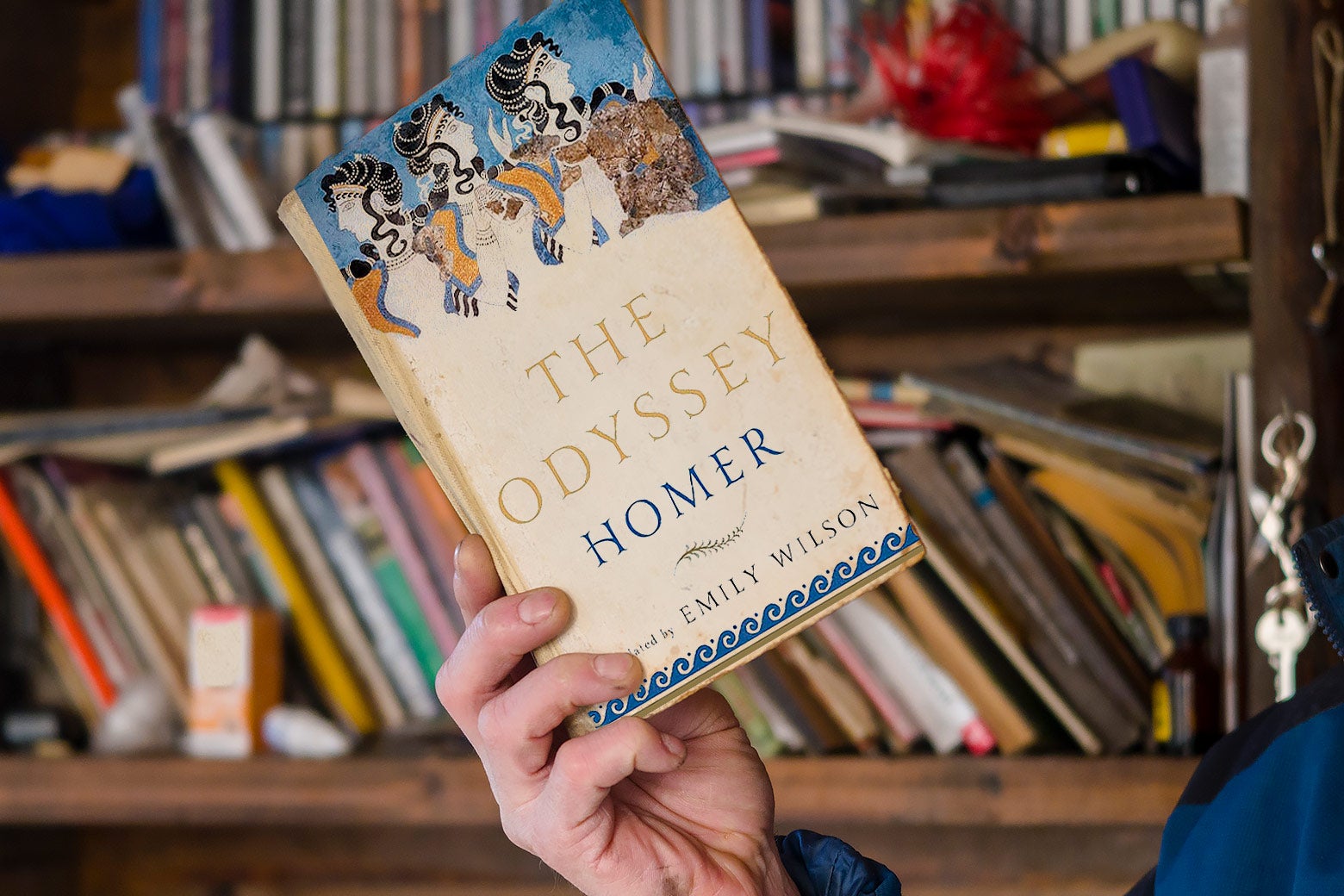
While Odyssey editions across the board are enjoying a resurgence, one translation in particular has emerged the winner of this boom in popularity: Wilson’s. In 2017 the classicist made waves when she became the first woman in history to publish a complete translation of the Odyssey into English verse. Depending on whom you asked, Wilson’s translation of Homer’s Greek into more modernized English was either an achievement or a travesty, with the latter opinion often coming from blatantly misogynistic trolls. Still, Wilson’s version quickly became a bestseller and was embraced in classrooms by teachers hoping to interest their students in a more accessible text. Nolan himself has cited Wilson’s translation when talking about his cinematic interpretation of the story’s central hero, a nod that didn’t stop Wilson from absolutely trashing the film twice in separate reviews that have since sparked massive debate across both the literary and classics worlds.
But, as the age-old saying goes, all publicity is good publicity. Jack Kyono, director of marketing for the indie New York–based bookstore chain McNally Jackson, noted that between June and July, its sales of Emily Wilson’s translation “tripled” at “virtually every store.” Yeshim Kayim-Yanko, a marketing and events coordinator for Books Are Magic, a Brooklyn-based bookstore chain, echoed Kyono, noting that its increased sales (nearly 100 copies for the month, compared to its usual 10 or so) highly favored Wilson’s translation. The same is likely true across the U.S.: In late July, Publishers Weekly reported that Wilson’s Odyssey was the second-bestselling book in the country.
Book sales surging following the release of a new film or TV adaptation is not a new phenomenon—just look at recent examples, such as Wuthering Heights, Dune, Frankenstein, Game Changers (aka Heated Rivalry), and Nolan’s last film before The Odyssey, Oppenheimer. But there is something particularly delightful about a nearly 3,000-year-old epic enjoying this current turn in the spotlight. I’ve come across all sorts of people—from a 19-year-old from France to a 56-year-old program analyst from Alabama—who have picked up the Odyssey thanks to Nolan’s movie.
“I love to read. I love Greek mythology. I love the movie. Why don’t I read the book?” is how Manon Spadoni, the reader from France, outlined her thought process to me. Spadoni, a self-described “Greek mythology nerd” and “Percy Jackson stan,” has been running a reading-themed TikTok account, which is how I found her video about struggling to get past Wilson’s infamously long introduction, which consists of 90-ish pages (or three-ish narrative audio hours) of maps, notes, and historical and geographical context for what is already a fairly lengthy journey.
There were parts of the book that some new readers were surprised to learn that Nolan had left out of his adaptation. Case in point: the scene in which the clever Odysseus practically trolls the gods by telling Polyphemus that his name is “Nobody” to avoid the repercussions of blinding the cyclops. “I was like, ‘Oh my God, he’s going to say that his name is Nobody—he’s so iconic,’ ” Spadoni said. “And then he left the cave, and I was like, ‘Girl, you need to go back to the cave! You didn’t say that your name was Nobody!’ ”
Meanwhile, Ed Killingsworth, the program analyst from Alabama, was surprised by how much of the gods’ direct interference was omitted in Nolan’s film, which somewhat controversially depicts the gods primarily through natural elements—well, the omission of that and “all the sex” in the Odyssey, which Killingsworth sheepishly said he had “forgotten about” since reading the book in college. (Maybe Wilson had a point when she scoffed, for the London Review of Books, “There are no sex scenes, and all the food looks horrible.”)
Both Spadoni and Killingsworth went with Wilson’s translation for their fresh read, but that isn’t the only version of the epic that Nolan’s fans are picking up. Kiran, a 20-year-old from India who was inspired by the film to read the story, chose Stephen Fry’s retelling, “as it’s said to be the most modernized form of the story,” which suits him better. Kiran said he doesn’t usually read books after watching adaptations but was drawn to this one because of the worldbuilding, which he likened to that of Game of Thrones.
Adrian, a 16-year-old from the Netherlands who hadn’t yet read any version of the tale, was inspired by Nolan’s picture to read novelist Madeline Miller’s Song of Achilles, a retelling of the Trojan War, with plans to get Wilson’s or Fagles’ translation of the Odyssey next. He’s not the only new reader to land on a Miller title; according to McNally Jackson’s Kyono, Miller’s books, which include Song of Achilles and Circe, are “perpetual sellers” for the bookstore chain, but they’ve definitely experienced a boost since Nolan’s epic. Other retellings written by and/or centering women have also experienced a bump in interest, with Kayim-Yanko highlighting two additional titles: Emily Hauser’s Penelope’s Bones, which Kayim-Yanko describes as “a new history of Homer’s world through the women written out of it,” and Mara Gold’s Ancient Myths and Legends Without Men, a reclamation of mythological stories from the perspective of the women in them.
“These texts belong to all of us.”
No matter which interpretation of these ancient stories new readers are flocking to, though, that there even are new readers feels like something to be thankful for. “We need people, fresh eyes. We need fresh versions. We need more conversations,” said Karen Klaiber Hersch, the chair of religion and ancient Mediterranean studies (and former chair of Greek and Roman studies) at Temple University.
“Even in antiquity, there were multiple versions of Odysseus’ story,” she said. The beauty of every version of the story, in her opinion, is that they all reveal new things about the text. That is what makes Nolan’s film, and the increased interest in classics in general, exciting for her: “These texts belong to all of us.” Hersch was delighted by a student who likened all of the debates surrounding the merit of Nolan’s interpretation to the feelings many fans have about adaptations of Jane Austen’s work, where “people will fight to the death for their version.” The fact that people want to see the film indicates to Hersch—and, more importantly, to her students—that “this stuff is worth studying.”
One of those students, Tom, put it best when he told her: “The film is a three-hour-long demonstration that Greece and Rome are cool.” That, at least, we can all agree on.
