


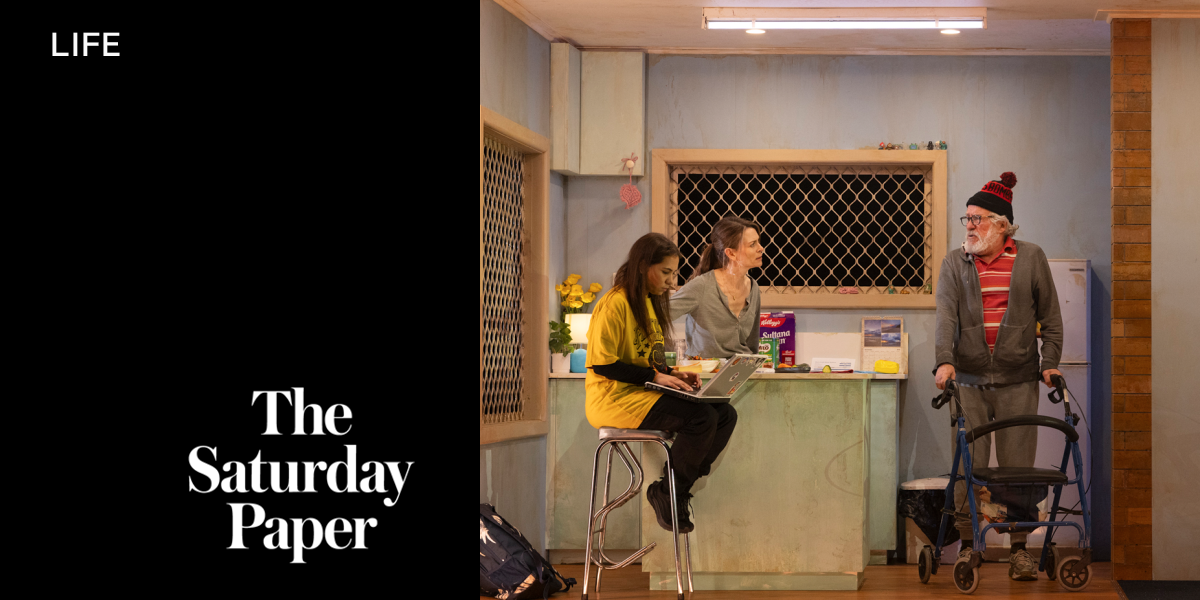
La Mama Theatre in Carlton recently displayed a collection of artists’ manifestos. One of them read, “Art helps us notice what we have learned not to see.” That feels like a daily challenge. The polycrisis is in full swing and there is no talk of a polysolution. Australian politics is now mainly symbolic. Inquiries, reports and expressions of outrage are followed by minimal action and few results, until the problem itself – failing aged care, underfunded public schools, accelerating global warming – becomes worse than insurmountable. It becomes boring. Why go on about what we cannot change? Steve Rodgers’ play Break of Day, which ran at the Malthouse in August, has as its target one of these seemingly intractable issues: entrenched economic inequality.
The unfashionable phrase for the clusterfuck now tearing Europe and the United States apart and coming for Australia like a sniper’s bullet is “class struggle”. Break of Day is about class, the reality of it, the intergenerational legacy of it, in a country that once thought of itself as classless. Now that is demonstrably untrue, it prefers not to use the word at all.
The play follows the classic unities of time, place and action. It compresses its story into a single night in the fictional Burra Creek, a depressing, out-of-sight, out-of-mind satellite town where you need three buses to get to your low-paying service job, if you’re lucky enough to have one. Pam is a single mum working in an online retail warehouse, where she packs consumer goods in 12-hour night shifts that leave her drained and numb. Her daughter, Rae, is a gifted Year 12 student. She’s trying to finish a crucial English extension essay on Vladimir Nabokov’s Lolita, and submit it by the following morning. As is the way in drama, everything goes wrong: frozen computer, distracting boyfriend, invasive grandfather. In a moment of madness, Pam steals a MacBook from the warehouse and is caught on camera. She has to answer to her supervisor, Sanjeeva, who must decide what to do about a lose–lose situation he is caught in as much as Pam.
It’s not that these characters don’t have choices. It’s just that the choices are shitty, and the consequences of making the wrong one irreversible. If Rae doesn’t get her essay in by 9am, her future is stuffed. She knows this vaguely. Her mother knows it as a matter of lived experience. Existentially as well as economically, there is no safety net.
Whether or not the major parties are complicit in this hijack, they will be held responsible for its consequences.
From 1900 until the 1990s class politics is all over Australian drama. This makes sense when you think about our post-Federation history of labour conflict. While British writers were trying to escape the strictures of the “Loamshire” play and its endless bourgeois dinner parties, Australian theatre was staging Steele Rudd’s On Our Selection (1912), Henrietta Drake-Brockman’s Men Without Wives (1938), and Alan Seymour’s The One Day of the Year (1960).
Of course, every character in a drama has a class, just like they have a head, but these plays involve class as a mode of understanding. For the playwrights of the New Theatre League – Oriel Gray, Susannah Prichard, Mona Brand – class was the overriding theme in their work.
In my view, this makes 20th century Australian drama uniquely concerned with class politics and putting working-class characters onstage. Some key plays come in trilogies, such as Ray Lawler’s The Doll Trilogy – which Red Stitch Theatre staged this year – Peter Kenna’s The Cassidy Album, Jack Davis’s The First Born Trilogy and Janis Balodis’s The Ghosts Trilogy. None of these dramas is class reductive. Kenna was gay, Davis a Noongar man, and Balodis a second-generation Latvian Australian. None can be understood without a class analysis.
In 1962 the theatre critic Harry Kippax complained, “Why are our playwrights so ill at ease with middle-class educated characters? … In our contemporary affluent society, with its energetic social mobility, it is the middle class, not the working class, which gives Australia its character and flavour. The middle class is absorbing the working class – or rather the working class, riding high on the high standard of living and monetary credit, is invading the middle class. In that movement alone there are rewarding subjects for dramatists.”
Kimberlé Crenshaw coined the term “intersectionality” in 1989, the same year the Berlin Wall came down and Marxism lost its place as a dominant explanatory theory. Since then, more critical categories of discrimination have entered everyday circulation: gender, race, religion, age. In this multifactorial rubric, class softens to socioeconomic status. After 2000, you have to look hard to find class politics in Australian drama, and often it is interpreted in another, albeit related, intersectional way. Plays such as Patricia Cornelius’s SHIT and Daniel Keene’s Mother are prominent counter-examples in a thinning field.
Yet class remains a stubborn, complex concept, with both ascriptive and functional features. Less something you are born with, than born into. Less something you choose, than chooses you. You can leave it, but it will mark you nevertheless. It is a quintessential example of what Émile Durkheim called “a social fact” – an invisible, coercive force that indwells and shapes the individual even though it exists beyond the individual, externally and structurally.
Break of Day is the opposite of didactic. It explores a milieu Janet McCalman called Struggletown, full of dreams, backchat, smarts and humour. There are some big moments. Like many dramas adopting a class lens, they are also the most ordinary. In the middle of the night Rae’s foul-mouthed grandfather, Pops, falls over and shits himself. She finds him hours later lying in the dark and gently leads him to the bathroom to wash him clean. The director of the Malthouse production, Sarah Goodes, did not abbreviate this action, and it played out in near-real time. The evening I went, I felt the audience around me stiffen, confronted by something so simple, so intimate, so devastatingly human.
How did disadvantage become difference? How did class war become culture war? How did poverty become a lifestyle choice? The disappearance of class as a concept is especially weird in the economic literature. The 2024 HILDA report on household income and labour dynamics doesn’t mention class. Unsurprisingly, nor does the Productivity Commission’s 2024 Snapshot of Inequality in Australia. Even Oxfam’s 2026 Resisting the Rule of the Rich uses “class” only six times, half in relation to a “billionaire class” who are not by any standard definition a class at all. They are a clique positioned in the lucrative juncture between economic and political power who have entrenched a corporatist logic justifying the conversion of public assets into private wealth.
Whether or not the major parties are complicit in this hijack, they will be held responsible for its consequences. Victoria is weeks away from an election, and the air crackles with a mood of angry resentment found in Burra Creek. One of the jobs of art, and drama in particular, is to cut through the policy bullshit, the News Corp dog whistles and the Canberra bloviation, and return our attention to what as a nation we must address lest it undo us.
