


The story of New College of Florida “merits attention . . . if only to record the perseverance of those who, for more than three decades, struggled to overcome numerous and daunting difficulties to help keep the institution alive.” So wrote Furman C. Arthur, the school’s first employee, in his introduction to New College: The First Three Decades. Founded in 1960 as a private school modeled in part on the Oxbridge tutorial system, the college offered a liberal arts education that valued independent thought and freedom of inquiry. In a still segregated South, it was also steadfastly “open to all races,” as a New York Times headline underscored in 1961. New College was a precarious project from the start—a beautiful idea, but always fragile. The school’s academic excellence—by the 2010s, NCF graduates would go on to earn PhDs at a higher rate than any other public university—has always been threatened by fiscal mismanagement, official austerity, and most recently and direly, political sabotage.
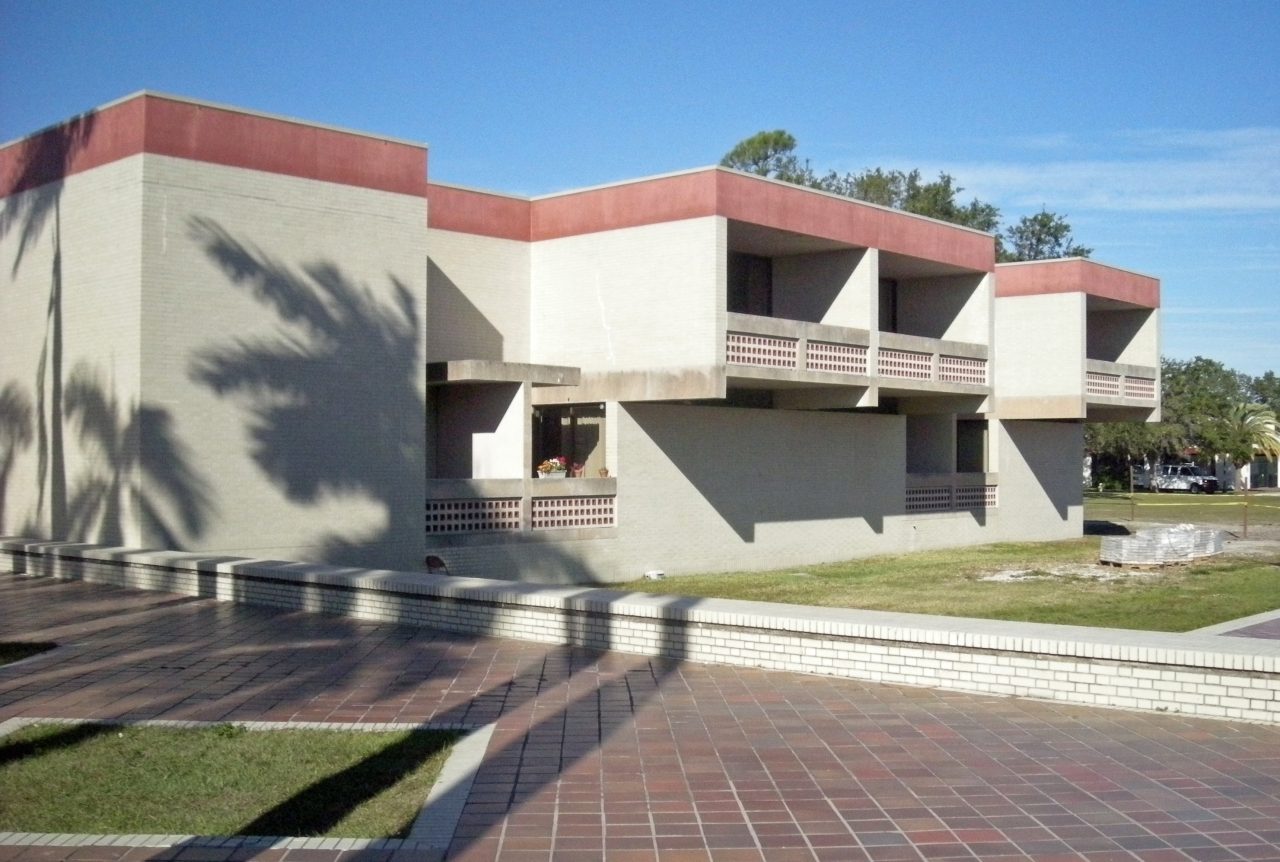
Its first few years were rocky. There were no dormitories, but thanks to the school’s acquisition of the lavish estate of circus magnate Charles Ringling, students took classes in an elegant complex of pink Mediterranean Revival buildings facing the Sarasota Bay. Soon NCF commissioned the not-yet-renowned architect I. M. Pei to design dorms on the east side of campus. The resulting brutalist buildings, with their shared courtyards and inward-facing entrances, spoke to both the college’s communal spirit and its academic intensity. With the music of the neighboring Circus Hall of Fame calliope drifting over their classrooms, students engaged in expansive modes of instruction, much of it individualized: tutorials, seminars, and independent research. In the early 1970s, New College established a program in environmental studies, one of the first in the country, in a city deeply vulnerable to climate change.
But also in the early 1970s, in part due to the Pei dorms’ construction, New College was $3.9 million in debt and on the brink of insolvency. In 1975, the University of South Florida swooped in and took over the troubled school’s assets; as part of the merger, NCF became an eccentric Sarasota outpost an hour’s drive from the USF main campus in Tampa. One of the plan’s key players, local Republican state representative Bob Johnson, later recalled to the New College student newspaper that the “first thing I saw in New College’s place was 18-story condos right next to the Ringling Museum,” the sprawling Italianate arts complex just to the south. “I resolved to save the school, the museum, and the city from that.”
The next turning point came in 2001, when NCF broke away from USF during a major reorganization of Florida’s public colleges to become an independent institution and the state’s honors college. On its face, independence had many advantages: greater autonomy, simplified admissions, increased visibility. Yet almost as soon as the school struck out on its own, it faced new obstacles. That year, as part of a billion-dollar budget-slashing, the state’s Republican governor, Jeb Bush, vetoed $1.2 million in new funding that NCF had requested to support the transition, ultimately agreeing to provide only $500,000 for the academic year. Instead of granting it a new freedom, independence had left the school a sitting duck in the deep crimson lake of Florida politics. Still, for two decades, New College muddled through, its funding and governance in a state of constant uncertainty.
Then, in 2023, everything changed. The money, a whopping $52.7 million, finally poured in from the state—at a terrible cost. That January, Governor Ron DeSantis declared he was making NCF his pet project and promptly began to fabricate brazen lies about a leftist ideological environment that he claimed had taken hold at the institution. (Anyone who actually worked or studied there knew that conservative views were never shut out; I recall one student’s Fine Arts thesis from 2008, a pro-life sculptural installation depicting embryos and fetuses.) DeSantis appointed a new board of politically compliant trustees—including MAGA operator and anti-woke crusader Christopher Rufo—as well as a new president, Richard Corcoran. Even as taxpayer dollars flowed in, faculty were denied resources and tenure, historic buildings were left to decay, and students were ignored. Alumni and community supporters protested, but no one in power was listening.
Still, the money had to be going somewhere. The best insight comes, ironically enough, from a 2025 report to the Florida DOGE, DeSantis’s state-level version of Elon Musk’s federal pseudo-agency. The report shows that NCF, with about eight hundred students, had both the largest administrative personnel and the highest operating expenses of any public college in Florida. In 2023, NCF admitted 115 mostly male student athletes—including seventy baseball players—even though the campus had no sports facilities. That, too, soon changed. Trees were cut down, playing fields were prepared—on land laden with lead particulates expelled by planes leaving and entering the neighboring airport—and almost overnight, an expensive athletics program became the focus of the bizarro new New College. Student athletes were given full scholarships, free laptops, and dorm rooms, while students admitted based merely on academic ability had to survive in expensive, mold-ridden off-campus hotel rooms. (After decades of neglect by the state, Pei’s celebrated modernist dorms fell into disrepair and were closed indefinitely.) In early 2026, rather than build new dorms or renovate the Pei facilities—at a school designated by state statute as residential college—the new NCF leadership moved $2.5 million from its housing fund to pay for yet more athletics.
Post-takeover, New College makes virtually no money from tuition and requires massive ongoing handouts from the legislature to stay open—and, as one faculty member told me, once DeSantis leaves office at the end of this year, “there is no guarantee the money faucet will stay on.” Among the top expenses are the rising administrative salaries stemming from redundant and often nepotistic positions of questionable value. “People can’t afford gas and groceries,” another professor told me, “but we just approved a $600,000 salary increase for the president of the school so that now he makes $1.2 million a year. I guess this is what ‘winning’ the war on woke looks like.” (Corcoran’s predecessor, Patricia Okker, made $305,000 and was actively improving NCF; one of the new trustees’ first acts after assuming their posts was to fire her.)
Of course, it didn’t have to be this way. There was always room at NCF for athletic programs appropriate to the school’s resources. The money spent since 2023 could have focused on much-needed facilities renovation, curriculum expansion, and student and faculty support. The school could have even hired more conservative professors. But DeSantis and his henchmen wanted a messy, expensive, punitive culture war, and New College became the prime battle front.
The nationwide assault on universities by Republican lawmakers and the Trump Administration has been years in the making. In 1971, the conservative Supreme Court Justice Lewis Powell authored the famous Powell Report, which denounced university campuses as subversive centers of anti-American radicalism; the following year, Richard Nixon told his advisors that “the professors are the enemy.” As a Senate candidate in 2021, JD Vance—who has spoken openly of his fondness for Nixon—gave a speech titled “The Universities Are the Enemy,” in which he suggested that the federal government might “seize the endowments, penalize them for being on the wrong side of some of these culture war issues.” Last year, Trump declared that American colleges were being run by “Marxist maniacs and lunatics.”
DeSantis—who made the invasion of higher ed a key talking point of his 2024 presidential bid—claims, without evidence, that New College “indoctrinated” students. “If you’re a professor in like, you know, Marxist studies, that’s not a loss for Florida,” he joked, when asked about the mass exodus of New College faculty. A 2023 Florida statute bars state schools from awarding general education credit for classes that “teach identity politics” or are based on “theories that systemic racism, sexism, oppression, and privilege are inherent in the institutions of the United States.” The law also requires that general education courses “promote and preserve the constitutional republic.” At NCF and across the state, sociology and anthropology classes have been shifted out of the general education curriculum; gender studies programs have been eliminated, syllabi altered, readings scrapped, and beloved professors pushed out.1
Students have also been silenced, often through the destruction of their school-sponsored artwork. In 2023, the college painted over student murals on the walls of NCF’s Fine Arts Complex, presumably because some were inspired by students’ non-American cultural and ethnic backgrounds. Earlier this year Adam Schrader, a reporter for the arts website Urgent Matter, asked New College spokesperson Jamie Miller for comment on this and a similar incident from 2025. Miller replied that the school holds “no records” of the murals’ destruction, and that Schrader was “trying to create a story that doesn’t exist.” His comment is telling. If the new New College doesn’t keep records of its own destruction of the old New College, would the administration like us to believe that the university I went to simply didn’t exist?
When I was a student at New College in the early 2000s, I often felt as though I was receiving an Ivy League education basically for free. (Many in-state students attend with a full or partial ride, thanks to merit-based state scholarships.) Upon first arriving at New College, I was assigned a poli-sci professor as my advisor, who quickly mansplained to me how our political views differed, and that we would hash things out in the classroom, which we did. Most classes were like that; we were encouraged to critically analyze everything, to form our own conclusions. Because, as the school’s motto still—ironically—states: “In the last analysis, every student is responsible for his or her own education.”
This year I’ve returned twice to New College to document the destruction of that ethos—to remember what it was, and why it mattered. In May I spoke to a professor who described two schools at NCF. One is loud, issues nonstop press releases and op-eds, and requires a constant political audience; the other is quietly keeping the spirit of the college alive through tutorials and baccalaureate defenses, and by documenting the other side’s meetings, memos, and emails—all of which are corroding the school’s once excellent, nationally recognized academic program. NCF has dropped seventy-four places in the U.S. News rankings since 2023. For many years New College produced more Fulbright scholars than any university in Florida; since 2024 there have been none. In a recent interview, Corcoran suggested that students would be allowed to use AI to research and write their senior theses.
Further eroding the school’s academic ethos is a new grading system. Since its founding, New College has forgone letter grades and GPAs in favor of holistic student evaluations. But in fall 2025, under pressure from the administration, faculty voted to begin using a tiered evaluation system (strong satisfactory, satisfactory, marginal satisfactory, and unsatisfactory), which the administration then hastily translated to letter grades (A, B, C, and F) without faculty endorsement. (“They don’t wait for approval,” one professor said. “They just do things.”) Many students were left with terrible GPAs, from a college that they were originally told didn’t calculate GPAs at all.
The grading system is only the latest move toward homogenization. The school’s freshly revamped general education curriculum boasts course titles such as “HUM 2380: How Can I Survive, Reproduce, and Flourish?” and “IDS 2161: What Is a Good Life?” All focus narrowly on America’s founding and “Western civilization”; every student is required to take a course on the Odyssey. So-called “woke” classes and tutorials like those I took on race and ethnicity and on queer and feminist theory have been purged, while the views of white European and American men are valued above all others. In 2024, nominally as part of renovations to the campus library, the school conveniently disposed of thousands of books, citing water damage. Rufo was less circumspect, referring to the book dump as “throwing out the trash.”
Faculty hired before 2023 seem to be divided over these changes. Some have embraced the new administration, while others are just trying to survive their post-tenure review, biding their time until they retire or find other work. (Under yet another 2023 rule, each professor’s tenure must be reviewed every five years; those found to be “out of compliance” with state laws will lose their jobs.) Faculty involved in the union—the United Faculty of Florida—are doing their best to keep the chapter afloat and fight for their rights. “All the air is being sucked out of the place,” said the late Mac Miller, a professor emeritus at NCF who passed away in August. Instead of working in the service of the students and faculty, the administration has been busy working on optics: spending $800,000 on no-bid contracts with outside PR companies, disaffiliating from the long-established alumni association, installing Flock cameras, designing a new logo—and who could forget the forthcoming Charlie Kirk statue, perhaps to be erected in the new Freedom Park?
Three years into the coup, the athletes, who now make up 60 percent of the student body, have also settled in with their hastily assembled fields, facilities, and staff, including academic “coaches” who have supplanted faculty advisors. The school’s endearingly nerdy mascot, the mathematical null set, or [ ], has also been replaced, by a creepy anthropomorphic Banyan tree—also called a strangler fig, known for its hollow core and oppression of other trees.
When I visited the school in May, many outward rituals of normalcy were still being observed. I noticed workers raking sand as if in a Zen garden, pruning trees, and gardening—just more “campus beautification.” The art department’s building was finally getting a new roof, after three years of students’ safeguarding their work so it wouldn’t be damaged by weather, or by the administration.
I met with a recently retired art history professor, one of my former teachers. I asked her about the faculty’s formerly prominent role in the college’s governance, particularly after the merger with USF. “In the absence of a fully developed local administration, the faculty really did run the place,” she said. “Maybe it wasn’t exactly wise . . . but it worked.” The faculty “were laser-focused on maintaining the integrity of the academic program.” She had witnessed the challenges New College faced after independence in 2001, including the slow erosion of academic autonomy by state mandates and administrative bloat. I could feel her anger as we spoke. She told me that the students were the reason she’d stayed so long. Her classes, which I only came to in my final year, unlocked art history for me. I took everything I’d learned at that point about modern and contemporary art and theory and brought it to the ancient and the medieval. That was once the spirit of the school—there was no need to begin with the Odyssey.
There are efforts to keep that spirit alive. Perhaps the best illustration of the “two schools” idea is the [New] Commencement, also known as Alt Grad, an off-campus ceremony hosted by the Novo Collegian Alliance. Alt Grad might be the only commencement ceremony in the US organized by students, designed as counterprogramming to the official NCF graduation, whose recent keynote speakers reflect the administration’s priorities: Trump advisor Scott Atlas, TD Ameritrade founder Joe Ricketts, notorious lawyer Alan Dershowitz. By contrast, speakers at Alt Grad have included civil rights attorney Maya Wiley, Russian American journalist M. Gessen, and the novelist Viet Thanh Nguyen. There have been disciplinary actions for students who protested at the official commencement, including the temporary withholding of diplomas for six students who were accused of chanting “Free Palestine” in 2024 during the Islamophobic Ricketts’s speech.
Reporting from the 2024 edition of Alt Grad, journalist and NCF alumnus Jeb Lund described the mood as “what the canaries do when they’re let out of the mine.” This year’s ceremony was no different. As usual, there was plenty of exuberance—selfies, whooping, cheers, and tears galore—yet the underlying feeling was one of being released, of overcoming. It’s one thing to pass your thesis baccalaureate, and quite another to be finished with being a pawn in a political game. As one student speaker put it, they “didn’t sign up to be in a turf war with a bunch of balding white guys.” For amid the jubilance, the shadows over New College are growing longer. We—students, alumni, faculty, staff—don’t know if our beloved school will survive. It is a hobbled, zombie version of its former self, and a merger announced shortly after graduation seemed to sound its final death knell.
At the end of May, the Florida state legislature moved to liquidate the Sarasota-Manatee satellite campus of the University of South Florida and transfer its assets and liabilities to neighboring New College. It was more than just an ironic reversal of the 1975 merger. The USF campus was central to the local community, a vital pipeline for thousands of people seeking to enter essential industries in the area, such as nursing and hospitality. Many prospective USF students in the region will now likely have to drive hours to Tampa or St. Petersburg to pursue those same careers—but it also threatens to deepen NCF’s fiscal turmoil.
USF’s debt has been estimated at $53 million, although the exact amount remains unconfirmed. Assuming such a large debt, or really any more debt, on top of the millions it will cost to run the assimilated campus will likely destroy New College. (The takeover has already killed nascent plans to take NCF private again—if the state were to ever sell it—spooking local investors who had previously shown interest.) As if to twist the dagger, lawmakers then ratified an annual state budget that cut NCF’s state funding by nearly 40 percent, a loss of around $25 million.
Some are now taking morbid bets on when New College will finally be forced to close. Three years? Five years? Ten? The worst-case scenario isn’t hard to imagine: Once NCF is finally deemed too expensive, the state will approve its closure, some of the waterfront land will be auctioned off (or perhaps sold to cronies for a token sum), and Bob Johnson’s dreaded condos will finally go up, at least until they’re leveled by the next big hurricane.2
Before leaving Sarasota, I visited Old Caples Hall, one of the pink Mediterranean Revival buildings on the bay, which was once home to the art history department. I expected to see the building in much worse shape than I remembered but was relieved to find the interior had been restored. It now houses the new master’s program in Marine Science; when I visited, the classrooms where I had once taken art history seminars behind closed curtains (to keep the light out for the slide projector) seemed clean, even tidy. It was in this building I read “Mourning and Melancholia” and learned about Freud’s term Trauerarbeit, “griefwork.” Freud proposed that by juxtaposing memory after memory with one’s present situation, one can come to accept the reality that their lost object is truly gone. I’ve been doing that for months now as I write about the powerful intellectual tradition that took root in those dilapidated Pei dorms—even as I can’t yet tell if New College truly is gone.
Looking around Old Caples, I felt like a ghost. The chandelier was still there, and so was the fireplace. I walked outside and behind the building, where there’s a new white sand beach and a dock. A dog frolicked in the water, while a pelican looked for food. The sunset was beautiful, so I Facetimed my kids from the beach. How could I begin to describe this place to them? It wasn’t at all what I remembered, yet at the same time it was.
In memory of Mac Miller, a beloved New College professor from 1964 to 2005, who tirelessly tried to save the school and never lost hope.
