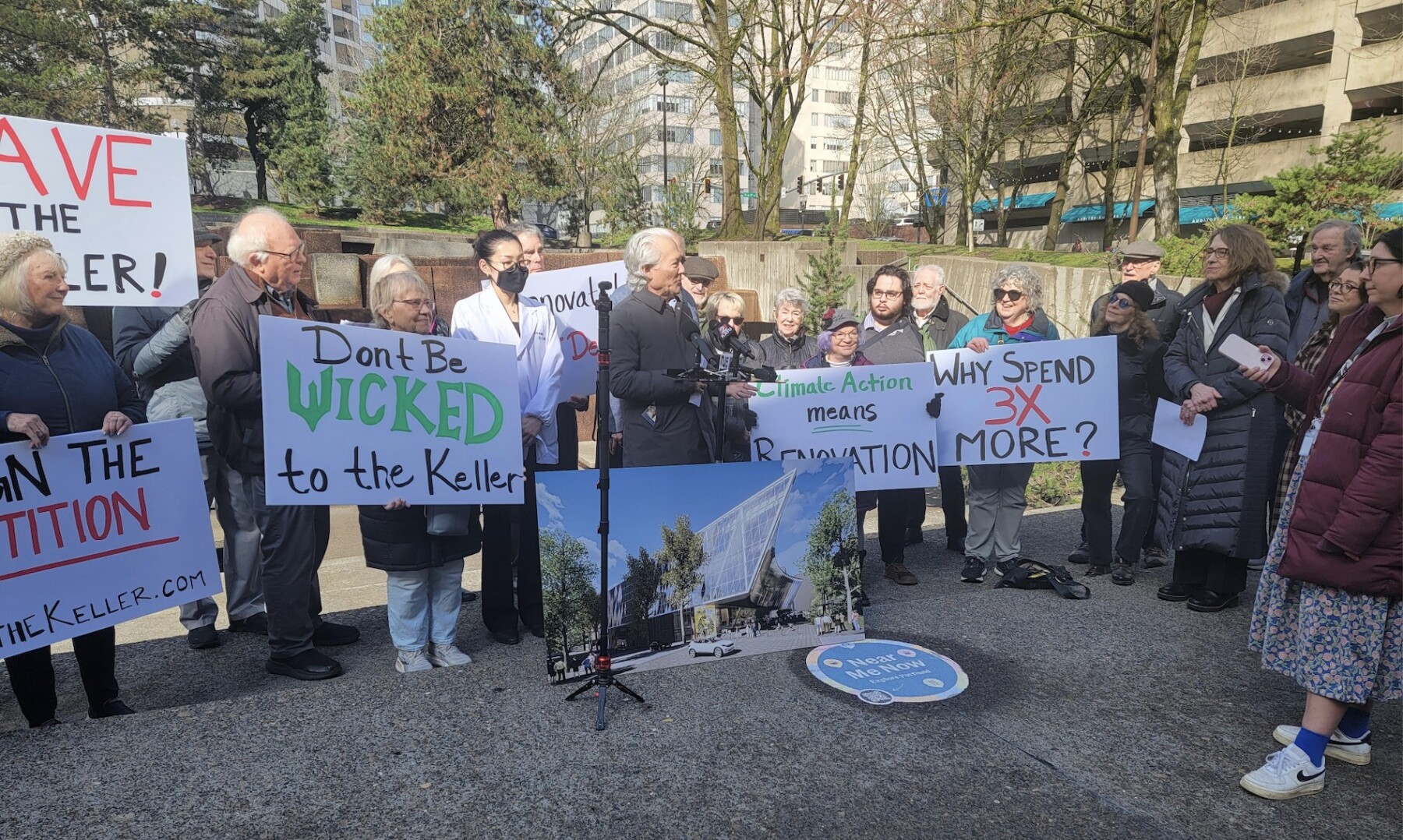
On a chilly Feb. 25 morning, dozens of supporters of the stately but aging performing arts center gathered across the street in front of the iconic Keller Fountain to oppose the so-called “two venue” proposal approved by the previous five-member City Council in October 2024 – that a new 3,000-seat center should be built at Portland State University before the Keller is renovated.
Speaker after speaker at the “Save Keller” press conference denounced the subsequent city-commissioned Market Feasibility Study that concluded the audience in the greater Portland area is not large enough to financially support two such large venues, and that the city should support building a new one at PSU while not renovating the Keller at all.
“The Keller is profitable, popular, and central to downtown’s recovery. It is time to stop the time-wasting charade and make a decision that reflects fiscal responsibility and the will of Portlanders,” said former Portland City Commissioner Mike Lindberg, a member of the new 90-plus member coalition of community leaders that called the press conference.
Among other things, the speakers denounced the Market Feasibility Study as deeply flawed. They released a letter to the current City Council, which will make the final decision, listing multiple reasons why renovating the Keller is a better deal for taxpayers, the environment, and the downtown economy. Those reasons, they declared, include a much lower cost, reduced carbon emissions compared to new construction, and continued patron support for businesses near the Keller.
Speaker Stephen Kafoury, a lawyer and former state legislator, described the choice in stark terms. “If you don’t renovate the Keller, it has no other use,” Kafoury said of the performing arts center, located at 222 S.W. Clay St. “The only other choice is demolition, which would leave a hole in the heart of downtown.”
According to Keller supporters, based on 2024 estimates, renovating the auditorium would cost $236 million while building a new 3,000-seat theater at PSU would cost $449 million. The PSU proposal also includes parking garages and other infrastructure upgrades, bringing the total estimated cost to $857 million; the State of Oregon and private donors would pay most of that.
The Keller renovation was proposed by the nonprofit Halprin Landscape Conservancy that supports the fountain across Southwest Third Avenue from the performance hall, where Portland Opera and Oregon Ballet Theatre are among the prime tenants. It would require closing the Keller for up to two years, displacing the current popular touring Broadway shows that support the operation of the other city-owned theaters downtown, known collectively at the Portland’5 Centers for the Performing Arts.

After the press conference, PSU defended its proposal in a statement as the best alternative:
“Portland State University remains excited about the future of performing arts and culture in downtown Portland and is an active participant in the City’s process to engage an arts and culture vision for Portland’s next 100 years,” the PSU statement reads. “That future-facing vision is about evaluating the best possible opportunities for Portland and Oregon to benefit our entire arts ecosystem, serve artists and patrons, inspire students, ensure big shows come to Portland, and help activate downtown 365 days a year.
“We do not believe an outcome defined by a single organization best serves the city of Portland or its arts organizations. Portland State has had multiple conversations with Halprin and its representatives about collaborating on a vision that includes both sites, and we welcome further conversation through the City’s defined process. The City of Portland owns the Keller Auditorium and is ultimately responsible for planning for its future.”
City Council faces a complicated decision
Newly elected City Council President Jamie Dunphy (District 1) is skeptical of the Keller advocates’ cause, however. He doubts the Keller can ever accommodate the increasingly large and complicated popular touring Broadway shows that generate much of the revenue that supports all of thePortland’5 city-owned downtown theaters.
“I’m aware the supporters are upset, but there’s no scenario where the Keller is the right option,” Dunphy, a musician with years of experience in staging professional shows, told Oregon ArtsWatch.
At the same time, Dunphy said the city cannot allow the Keller to sit fallow if a new performing arts center is built at PSU. He said the location is too critical to the downtown economy, and, contrary to Kafoury’s assessment, believes some other use can be found it.
“I don’t know what that is, but there’s no way we’re going to demolish it,” Dunphy said.

Dunphy does not know where the majority of the council stands on the question, however, or even whether most of the other members have spent much time thinking about the choice between the Keller and the new PSU project, which would be located at what is being called the Portland Performing Arts + Culture Center, at 310/330 S.W. Lincoln St.
According to Dunphy, many other questions need to be answered before the council makes the final decision. Perhaps most important is how to pay for either project in addition to other pressing infrastructure needs. They include deferred maintenance costs for the three Portland’5 buildings (including the Keller), which have been managed for years by Metro, the elected regional government. Responsibility for them is now being turned over to the city.
Complicating the issue is the sudden request for the city to help finance $600 million in renovations at the Moda Center to keep the Portland Trail Blazers playing in town. The 2026 Oregon Legislature is considering creating an Oregon Arena Fund that would require the city to contribute at least $185 million in the short term and tens of millions more over time. The Legislature has until the session ends on March 8 to create the fund.
Background of the controversy
With about 3,000 seats, the Keller Auditorium is the only venue in the greater Portland area that is large enough and properly configured to host touring Broadway theater shows. It was built in 1917 and modernized in 1968. Portland Opera and Oregon Ballet Theatre are also major locally focused tenants. A 2016 city study determined that the building does not meet current earthquake codes, however.
In response, the Halprin Landscape Conservancy that supports the Keller Fountain across Southwest Third Avenue proposed that the Keller be completely renovated and upgraded, with the street closed to traffic and converted into a public plaza. That would require closing the building for up to two years, displacing the touring Broadway shows that consistently draw large crowds.
Instead of simply agreeing, the previous five-member City Council solicited other proposals. Portland State University submitted the only alternative considered viable. It would convert the current University Place Hotel and Conference Center into a new campus that includes a 3,000-seat performing arts center owned by the city and related facilities owned by PSU, including a 1,200-seat community theater, an academic building, and a 150-room hotel.
Rather than choose between the two proposals, the previous council passed a resolution in October calling for both of them. The so-called “two-venue” solution would build the center at PSU first, allowing it to host touring Broadway shows while the Keller then shuts down for renovation. The resolution also called for the city to commission a Market Feasibility Analysis to assess whether there is enough public support in the region for both projects.

Since then, the five-member council that approved the resolution has been replaced by a new 12-member council elected from four new geographic districts under the City Charter reforms approved by Portland voters in November 2022. The mayor is still elected citywide but can only vote to break a tie. All bureaus are now overseen by a professional City Manager, including the Office of Arts & Culture that is now staffing the city’s share of the projects.
Market Feasibility Study reaction
The Future of Large-Scale Performing Arts Market Feasibility study was conducted by the Chicago-based Hunden Partners consulting firm. Released on Jan. 23, it found the so-called “two-venue” proposal not to be financially feasible. According to the analysis, the potential audience in the greater Portland area is not large enough to support Broadway-capable venues with approximately 3,000 each.
But more than that, the study recommended proceeding with the PSU proposal and not renovating the Keller to continue operating as a large-scale performing arts center.
“There is insufficient market support for two Broadway-capable venues in Portland. More limited physical programming potential and required downtime would diminish the returns on an investment in a renovated Keller,” the study said.
Keller supporters accuse the study of exceeding its mission.
“The scope of that report was to evaluate the market feasibility of a second Broadway capable venue, not to recommend demolishing a city-owned asset that works,” Bob Naito, a Portland business leader and Halprin board member, said. “Portland restores what works. We don’t bulldoze it.”
Council President Dunphy suspects the conclusion is correct, however, although it should still be debated.
The council is not expected to begin directly addressing the issue for months. Three groups appointed by the city are meeting behind closed doors to discuss the potential projects. They include: the 11-member Future of Large-Scale Performing Arts Steering Committee, which was appointeed by the City Administrator; the 16-member Future of Large-Scale Performing Arts Ex-Officio Table, which was appointed by Mayor Keither Wilson; and the Community and Economic Development Project Team, which consists of city staffers.
Metro’s assessment of the deferred maintenance needs of the Portland’5 Centers for the Arts must also be received and analyzed by the city. And if the 2026 Oregon Legislature does not create the Oregon Arena Fund, it could be considered again during a special session or during the next regular session in 2027.
After the Feb. 25 press conference, the city released the following statement from Mayor Keith Wilson:
“Portlanders are passionate about the future of our city, and we appreciate how that advocacy can translate into action. Performing arts are essential to Portland’s identity. We all agree that our city needs a large, successful venue in downtown, where the arts can thrive and grow. That’s why our former City Council mapped out a thoughtful and strategic process driven by both community input and data, including the recent market feasibility study.
“As shared when that study was released, no decisions have been made regarding the future of Keller Auditorium. As a next step in this process, our Future of Large-Scale Performing Arts Steering Committee and Mayor Wilson’s Ex-Officio Table will be sharing recommendations, expected in the coming months.”
***
- To learn more about the Save Keller coalition and read its letter to the City Council, visit savethekeller.com.
- The most recent Oregon ArtsWatch story on the Keller Auditorium and PSU project, Public officials discuss fate of Keller Autorium in private, can be found here.
- To learn more about the PSU Portland Arts + Culture Center, visit paccpdx.org.