


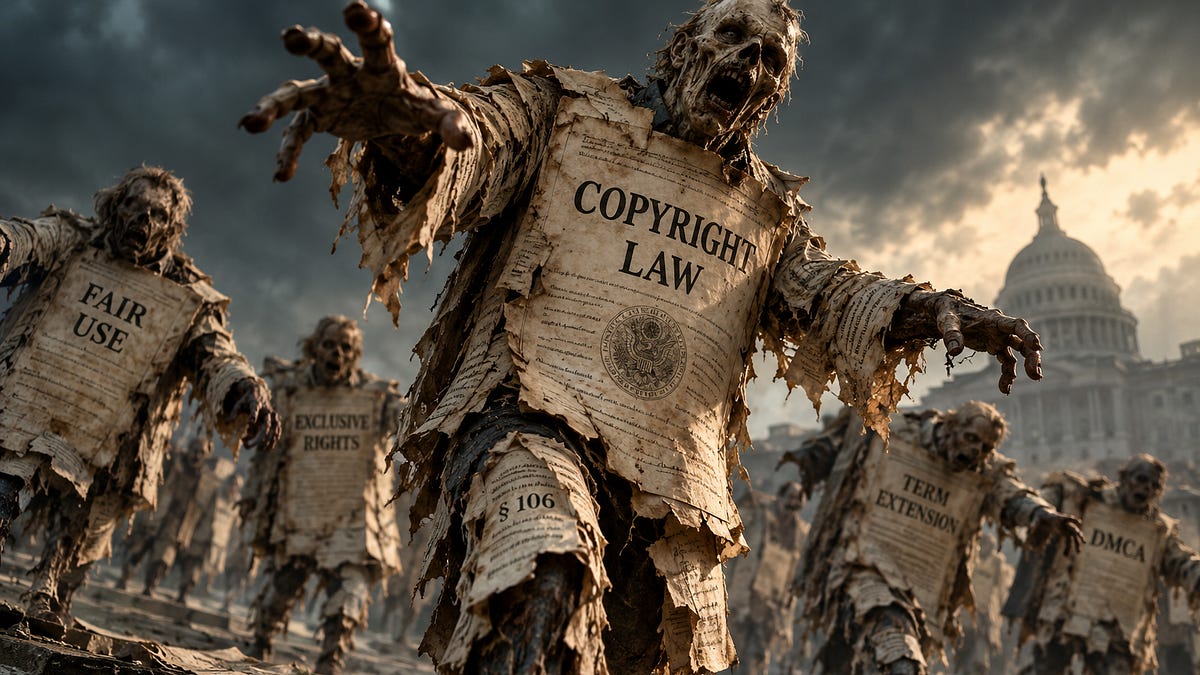
Fifty years ago today, copyright law in America changed fundamentally. That change was an accidental disaster for both creators and the culture they create.
That’s not to say that the culture and creative work of the past 50 years has been a disaster. To the contrary, creativity and culture across the world have exploded in ways none could have imagined 50 years ago. But the change in law changed fundamentally how creators would be regulated by copyright law, and critically—this is the core point of this essay—in ways no member of Congress ever anticipated or certainly intended.
That’s not to blame Congress. In 1976, the changes Congress effected, no doubt, seemed sensible to many. The United States was on its way to conforming its law to the standard of copyright law internationally. It was shifting the regime from an opt-in regulation to a regulation by default. No longer would creative works need notice or be registered to gain the protection of copyright law. Eventually, no longer would registrations need to be renewed. Copyright would become an automatic regulation that came into being upon the fixation of a creative work in a tangible form.
Again, in 1976, that all made sense. The entities that would be regulated by the regime in 1976 were presumptively commercial entities. The law was targeting those commercial entities. It was aiming to ensure that creators were compensated when those commercial entities exploited their work in at least a limited range of uses. The law was not primarily focused on regulating consumers. To the extent consumers were creators, their creativity was largely untouched.
Twenty years later, the technology of creativity changed fundamentally. With the birth of digital technologies and the Internet, the reach of copyright law exploded. Now anyone using or sharing a creative work triggered the application of copyright—did you make a “copy”?—not just by commercial entities, but also, presumptively, by consumers as well. Snap a picture with a digital camera (there were some in 1996), and you’ve created a copyrighted work. Upload that image to your computer, and you’ve made a copy of that creative work. Email that picture to your best friend, and you’ve now made a string of copies of that creative work from your machine to each of the intermediate email relays on the way to the inbox of your best friend. When she takes that image and posts it on her blog, she’s made a copy of that creative work, and every machine that accesses her blog makes a copy of it too. The point should be obvious: this simple act of non-commercial creativity was arguably drawn into the presumptive reach of copyright law, and copyright lawyers scrambled to figure out how the law should be regulating this explosion of creative activity.
In 1976, Congress knew it had no clue about any of this. This much everyone should be able to agree upon. Congress recognized computers were coming. But it also recognized it didn’t understand how that change would matter to copyright. In 1976, not a single member of Congress could have imagined Facebook, file sharing, Twitter, or Google. They wrote a statute. That statute, on its face, could be applied to this new technology and these new uses of culture with this technology, even though how it applied—the burdens it would impose, the freedoms it would leave unregulated—none had ever considered. A statute written in one world was now being applied to a radically different world, with no clear mechanism for anyone with democratic accountability to ask: Is the balance effected now—the balance between freedom and control—one that makes sense of copyright’s purpose?
Lawyers have long struggled to think about how statutes written in one era should be read to apply to questions none of their authors could have imagined. This is the point Justice Samuel Alito makes when talking about the Supreme Court decision in Bostock v. Clayton County. (See his book, So Ordered, chapter 2). In that case, the court held that Congress’s 1964 Title VII statute applied to discrimination based on sexual orientation. Regardless of which side you take on that question, Alito is certainly right that no one in 1964 was thinking about sexual orientation when legislating about sex discrimination. What the law is not very good at is thinking about how words written in one context should apply in contexts never contemplated by their authors.
No example of this problem is more compelling than the law of copyright. The presumptive application of copyright law to radically different technologies will immediately create winners and losers. Those winners and losers will then scramble to either exploit the law or to try to get it changed. And that’s precisely what happened 30 years ago when Congress and the courts began to work out how copyright law should apply to these new digital technologies. Some interests were well represented. They had effective lobbyists. The record labels and Hollywood quickly got Congress to enact legislation to protect them against file sharing and the commercial exploitation of copyrighted works. Consumers, and the public, didn’t have similarly effective lobbyists. As their interests were affected, there were but a few in Washington defending them (yay EFF!). The consequence was completely predictable: the history of copyright law in the context of the Internet saw an explosion of regulation, allowing the law and, through licensing, private control to extend to ordinary consumers and noncommercial creators in ways that would have been unimaginable in 1976. In a line, we went from a world where the default of copyright touched almost no one, to a world where the default of copyright touched practically everyone. As Jessica Litman put the point powerfully more than 30 years ago,
At the turn of the century, U.S. copyright law was technical, inconsistent, and difficult to understand, but it didn’t apply to very many people or very many things. If one were an author or publisher of books, maps, charts, paintings, sculpture, photographs or sheet music, a playwright or producer of plays, or a printer, the copyright law bore on one’s business. Booksellers, piano-roll and phonograph record publishers, motion picture producers, musicians, scholars, members of Congress, and ordinary consumers could go about their business without ever encountering a copyright problem.
Ninety years later, the U.S. copyright law is even more technical, inconsistent, and difficult to understand; more importantly, it touches everyone and everything. In the intervening years, copyright has reached out to embrace much of the paraphernalia of modern society. The current copyright statute weighs in at 142 pages. Technology, heedless of law, has developed modes that insert multiple acts of reproduction and transmission—potentially actionable events under the copyright statute—into commonplace daily transactions. Most of us can no longer spend even an hour without colliding with the copyright law. Reading one’s mail or picking up one’s telephone messages these days requires many of us to commit acts that the government’s Information Infrastructure Task Force now tells us ought to be viewed as unauthorized reproductions or transmissions. (The Exclusive Right to Read, 13 Cardozo Arts & Entertainment Law Journal 29 (1995)).
In this fight over copyright on the Internet, early on, most artists and musicians aligned themselves with the labels and against the Internet. These creators were paraded through Washington, begging Congress to do as the lobbyists for the labels and studios recommended: massively increase the control they had over the use and spread of creative work. At the time, some scholars argued that increasing that control would not necessarily benefit the artists. That insight led my colleague, William Fisher, to propose an alternative regime that would secure to artists compensation for the use of their work while freeing people to share the work freely. (See Promises to Keep (2004)).
The scholars were right. Today, the distribution of music is dominated by a few big companies, while artists earn fractions of a cent on the distribution of their work. Extreme copyright protection helped build extremely powerful, concentrated platform owners; it did not translate into strong revenues for artists.
And it wasn’t just Congress that was acting to adjust copyright law to these new technologies. Courts took up the fight as well. Recognizing that it didn’t understand how technology would change, the 1976 Copyright Act effectively drafted the courts to the task of updating the law as the technology changed. This was a change in how Congress wanted the courts to engage with the question of new technologies and copyright; it reversed a practice that had dominated in the late 19th and early 20th centuries. In that earlier practice, courts stood back when technologies changed and waited for Congress to step in. After 1976, the presumption was that courts would do their best to adjust the law to fit new technologies.
When change is incremental, that incremental adjudication makes perfect sense. But in the context of the Internet, the judges became the policymakers. Hotly contested questions of policy became the stuff of ordinary judicial decision-making, as judges were drafted to engage in a four-factor balancing act (called “fair use”) to judge whether some new use should be deemed “fair.” In 2000, for example, a federal district court found that a company’s system for enabling people to secure access across the Internet to copies of music from their own CD collections was a “willful infringement” of the copyright held by record companies. That exposed the company to hundreds of millions in damages, essentially a corporate death penalty. Many in Silicon Valley marked that case as the beginning of a nuclear winter for innovation, at least as it affected music. No venture capitalist was going to risk their investment on the whims of a federal district court judge.
The point is not that the judges were wrong, or that their decisions didn’t reflect a plausible balance between the rights of creators and the rights of the public. I do believe they were wrong, but the point I’m making is narrower: No one could deny that technology had radically changed the nature of creativity and the business model for creators. And no one believed that the authors of statutes written to address printing presses and radio had any idea about file sharing or digital remix. Yet rather than recognizing that the words of these old statutes read in radically new contexts would inevitably produce consequences that no legislator anticipated, courts accepted Congress’s delegation. And an unelected judiciary became the primary effective policymaker for copyright.
Again, and again this is the core point I mean this essay to make: The issue is both sensible policymaking and accountability. When technology radically changes the nature of creativity, we need the policymaker that our Constitution envisions—Congress—to step up. And that will happen only if courts step back from doing Congress’s work for it. Again, it is perfectly fine for courts to innovate at the margin. How should rules for cassette recorders extend to later digital audio recorders? It’s not obvious, but it’s not rocket science either. The trade-off isn’t perfectly clear. But it is perfectly reasonable for Congress to draft courts to make that kind of judgment.
The Internet should have triggered a different response. Rather than allow copyright law, like some sort of zombie, to wander in its regulation to govern the wide range of new uses of creative work by consumers, our constitutional policymaker should have been compelled to take up the many questions these new technologies would raise. And they should have addressed those questions not from the perspective of industry alone, but from the perspective of copyright policy generally. Because as the 1976 Act evinced, through the hundreds of hours of testimony that led to its passage, copyright is always a balance between protecting the rights of creators and ensuring broad access to the culture they create. It has always been a balance between the need to protect a private and public domain. Copyright terms are limited not because the law seeks to steal from creators, but because the monopoly the law gives to the creators needs to be limited. It has a purpose: to incentivize creativity. Once that purpose is satisfied, the commitment of copyright law, since the beginning of copyright law in America at least, has been and always should be to balance between the creators and the culture the creators enable. That balance, when the technology of creativity changes fundamentally, is a balance that should be redrawn by the primary policymaker in our Constitution: Congress.
We are now on the cusp of yet another radically new technology for creating and sharing knowledge—AI. And in the words of Yogi Berra, it’s déjà vu all over again.
Once again, no one can deny that these new technologies will change how knowledge and creativity get made and shared. And once again, no one could believe that the authors of copyright law had anything like LLMs in view when they crafted the contours of fair use or secured to libraries the right to share published work. Yet rather than Congress stepping up to frame a system of protection in light of this fundamentally new technology, lawyers are racing to federal district courts to ask judges to apply old words to new technologies—and along the way, to determine exactly how or whether these new technologies can survive. Rather than recognizing that we face a world of new questions, driven by a technology that no one was imagining even thirty years ago, zombie copyright is once again about to declare how it will regulate this new technology.
Consider the case brought by the New York Times against OpenAI. OpenAI (like every frontier LLM) has trained its model on the open Internet. In the views of some, training without permission violates copyright law. As author Charles Graeber put it in an essay in the Times, “One day, hopefully copyright protections will be extended to prevent the unlicensed training of A.I.s.”
Such a result would not just be bad law but terrible innovation policy. Bad law because the act of training is quintessentially transformative, which should be the core of copyright’s fair use protection. Whether for commercial or non-commercial purposes, the law has always secured the freedom to learn from published work. If ChatGPT is trained on Times editorials and, when prompted, reproduces a substantially similar editorial, copyright properly regulates that reproduction. But if it takes the insights from that editorial (and a million others) and hazards an opinion of its own, that act the law leaves free. Better the law recognized this directly, but if not, at least let the judges (as two other lower courts have (Bartz; Kadrey).)
But beyond the law, a finding of liability from training would be terrible innovation policy—and here, the lessons from the Internet are especially apt.
As I’ve described, at the start of the “copyright wars,” when technologies to enable file sharing swept the Internet, artists aligned themselves with record labels against the new technology. At the time, many warned that rules that strengthened the record labels were not likely to benefit artists. As I’ve said, they were right: The massive increase in regulation shifted power to platform owners, not creators, leaving creators dependent upon the goodwill of technology giants.
That same distortion is likely to follow from a finding of liability for LLM training. If all training requires a license, then none but a handful of tech giants will be able to afford the costs of training. That’s not because authors are greedy but because the copyright system is the least efficient property system known to man. It is effectively impossible to clear rights to the vast majority of copyrighted works, if only because it is economically impossible to identify who owns what. Imposing those obligations on trainers would drive all but a few out of the business of training. And while the owners of the tiny slice of creative work still commercially available could license their content, the vast majority of our culture is beyond the ken of copyright lawyers. Books go out of print, contracts for clearances are lost, creators pass, estates are messy: anyone who asserts that licensing would be simple is either ignorant or thinks you are.
This is why fair use must govern training. But that doesn’t mean that Congress’s work is done. The right solution to these competing claims distinguishes between securing a freedom to train and administering compensation to copyright owners after training is complete. Not because current law entitles anyone to that compensation, but because current law was not written with LLMs in view. It is completely appropriate for Congress to craft a new system of compensation to account for this change, ensuring that authors and artists are rewarded efficiently while securing the freedom to train for the widest range of possible uses. That new (non-copyright) system might well—please, let it—return some of the formalities of pre-1976 copyright law, so if publications like the Times wish to remain irrelevant to the future, there is a simple way for them to so signal. But the idea that judges could summon from the four-factor fair use balancing test an appropriately subtle structure for regulating this new world is the dream of Aslan singing Narnia into existence. The right regime courts could not craft, because the remedies available to copyright courts are not systematic, but case-specific. Courts are essentially forced to choose between a control by (mainly unidentifiable) creators and a freedom to train. That crudeness harms everyone.
Questions about training are just the beginning. Just as important should be questions about the freedom of users and consumers to deploy AI across the work that the law should deem them to own. All the large American LLM AI companies trained their LLMs on the open internet. All of them claimed the right to train their models on the internet and on the copyrighted works that they had legal access to. Again, I think they’re right in that claim. As I’ve just argued, I think there should be a fundamental right to train on any published work.
But right now, if a consumer takes an e-book that she has purchased access to and asks an LLM to incorporate that e-book into their own collection of notes, the rules built into the LLM are likely to call the LLM’s copyright police. That code-based police officer will then likely ban the use by the consumer of the work the consumer has purchased legal access to, even though the LLM claims the right to the same use, even without paying for it. Thus, OpenAI, Anthropic, and Google all claim that the law gave them the freedom to do for free what ChatGPT, Claude, and Gemini now are not likely to let their own users do, even with work they have paid for.
None of this makes any sense. We need the law to secure to consumers the broadest range of free use of work they have legal rights to. The law should secure that noncommercial use absolutely. Yet that the law does not do today, so vast archives of scientific and cultural work now remain locked from LLM access and training for no good reason. Copyright policy, which houses the law, should work to free this work to be usable to help build the extraordinary potential for understanding and knowledge.
The point is not that everything should be free. The point instead is that not everything should be regulated. And that what we need is a principled effort to create an environment that will encourage creators and artists by giving them the resources their work deserves, while at the same time, preserving the opportunity for consumers and innovators to find new ways to advance the understanding that these technologies promise.
None of that can happen in the context of the current regime of copyright law. What we urgently need is an effort to secure to artists and creators remuneration during this transition period, while we work to understand what framework makes sense going forward. That regime must not drive concentration to a small group of technology platforms. It cannot be allowed to further the concentration that defeats the interest of artists and creators. It must instead craft the law to tilt to support both innovation and creativity, to enhance and build upon the knowledge from our past.
I get these words are hard to grok just now, given both the outraged skepticism that people have about AI today and the overwhelming sense that our Congress is corrupt and therefore unable to address these—or any—questions at all. The second point goes a long way to explaining the first. No doubt, if we had a functioning Congress, it would have crafted the guardrails necessary to make sure that the buildout of AI technologies today does not pollute our air and water and drive up our energy prices. We’ve known for a decade that these technologies will demand an enormous amount of new energy. All that energy should be green energy, and all the production should be subject to the highest standards for both water and air quality. If the companies can’t afford to build it without polluting our air and water, then it shouldn’t be built.
Those requirements could easily have been imposed by Congress had Congress been capable of regulating. But it isn’t, and it isn’t because of the deep corruption that defines our current moment in government (see everything else I’ve been writing for the last 20 years).
But if you can imagine—and I know this is hard— a world where this technological development is properly regulated, and where companies that commercially exploit our culture are properly taxed to reward the creators who help build it, then maybe you can glimpse something of the enormous potential for good this technology could have.
Potential: That’s not to say it promises that good today. It’s not to say, given our corrupted Congress, it’s likely to promise that good anytime soon. It is only to say that the only thing standing between us and that good is the failed institution of federal policymaking.
There are many questions in this field that are not just difficult to solve but maybe impossible. If the AI doomers are right—see If Anyone Builds It, Everybody Dies—it is impossible to control superintelligence, so therefore we should not build it. I don’t know enough to know whether that’s true. What I do know is this: We know how to uncorrupt a corrupted government; we know how to make policymaking at least strive to reflect the long-term interests of society in general. Whether we can solve the AI control problem or not, we can solve the control of government problem. And if we did, then we could launch the conversation that we as a society need now: How can we harness the potential of this technology to improve humanity? Or in the narrow context of this essay, how can we end zombie copyright, and force Congress to step up, to protect the future against the clumsy controls of a copyright regime written for a radically different technology, while securing to authors and artists a fair compensation for their work?
These are not easy questions. They are especially not easy in the context of today, where the issues have been so radically simplified by an extraordinary self-righteousness that peppers the pages of the most prominent, popular publications. The Times and The Atlantic are both publications I deeply admire. And yet somehow, they’ve been led to believe that their view of what’s right is obviously right, and that the only people who would question that view are people whose livelihood depends on AI thriving.
I don’t have any interest in any AI company. I’ve never taken any money from any AI company. I spend most of my pro bono hours helping whistleblowers from AI companies who want to make sure AI is developed safely. I don’t defend AI or the right to train because I expect someday it will make me rich. I defend it because there is a clutch of interests that need to be negotiated here. That negotiation needs to happen outside the architecture of a 50-year-old law written for a radically different technological context.
Happy Birthday, Copyright Act of 1976. May your zombie influence finally come to an end. I know it won’t. But an old man can dream.
