


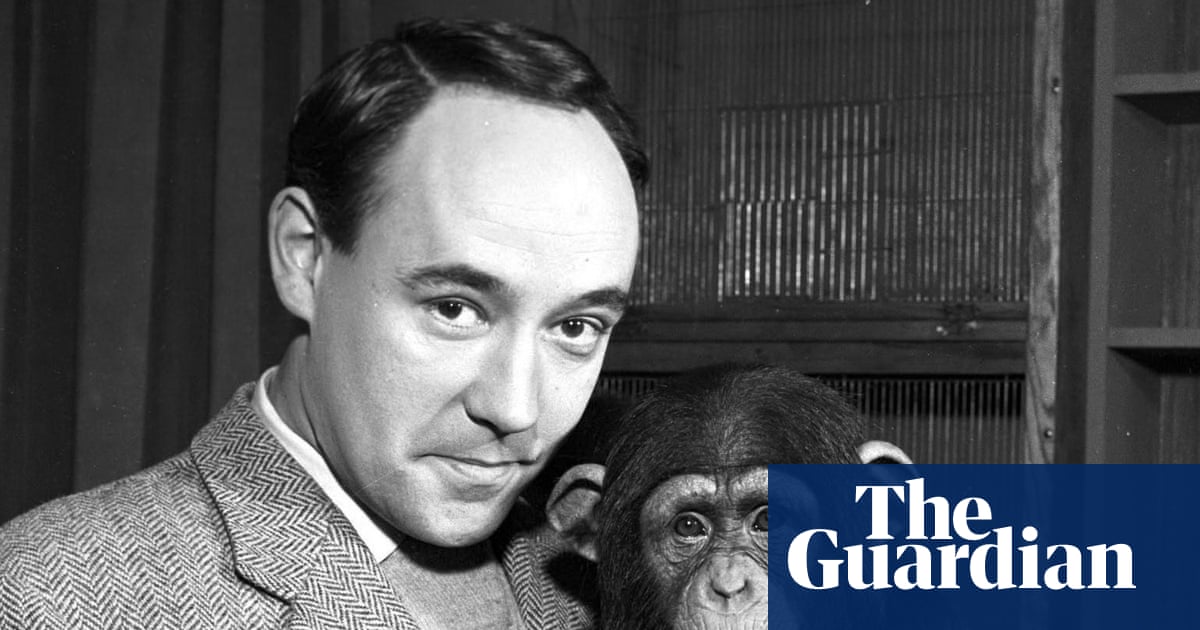
Desmond Morris, the zoologist, writer and broadcaster, who has died aged 98, in the course of 60 years put his name to more than 50 books, and fronted several hundred hours of television, starting with the Granada children’s weekly programme Zoo Time from 1956. It was broadcast from a special residential television studio built within the grounds of London Zoo.
He also established himself as an authority on mammals, became an encyclopedic observer of human behaviour and maintained a separate and distinguished career as an artist.
He was certainly the only candidate who could ever have transferred convincingly from curator of mammals at London Zoo to take over the Institute of Contemporary Arts (ICA) in Pall Mall. His career as an impresario of the modern arts, however, was interrupted by the astonishing success of his book, The Naked Ape (1967), which went on to become one of the world’s bestselling titles, and he moved for a few years to Malta.
The Naked Ape: A Zoologist’s Study of the Human Animal was a contemplation of the evolutionary pressures that fashioned the only one of the 193 living species of ape or monkey to have no hair.
It sold an estimated 18m copies and was placed on the Catholic Church’s notorious index of forbidden books. The same index also contained Balzac, Stendhal, Voltaire and Zola, so Morris willingly accepted the ban as flattery.
His was not the first popular book that decade to treat human society as shaped by evolution, but Morris addressed, zestfully but with a zoologist’s decorum, the detailed intimacies of the human animal as “the sexiest primate alive”, including intricate considerations of arousal, copulation and “falling in love, for becoming sexually imprinted on one partner, for evolving a pair bond”.
His hairless primate, he argued, was a social carnivore pulled one way by hunter-gatherer instincts and another by culture. “It is the biological nature of the beast that has moulded the social structure of civilisation, rather than the other way round.”
Most popular science theses, sooner or later, are overturned or overtaken, and some of the text now seems obvious, some contentious and some just daft. But in 1967 Morris struck a note that chimed perfectly with the febrile mood of the times, and created a literary template that later generations of popular science writers could only hope to match.
His first book, in 1958, was a study of the ten-spined stickleback; his last was 101 Surrealists (2024), one of a number of surveys of surrealist artists. His career as a painter had begun long before: his first London exhibition – shared in a gallery with the surrealist master Joan Miró – was in 1950. In 2019 he had a solo show at Farleys House & Gallery in Chiddingly, East Sussex, once the home of the critic Sir Roland Penrose and the photographer Lee Miller.
Throughout his life, he saw living things as works of beauty, and paintings as a form of biology. “I tried to create a private world in which my own, invented organisms evolved and developed like a personal flora and fauna from my imagination,” he wrote in Animal Days, a memoir published in 1979. “Somehow they obeyed biological rules and grew and metamorphosed as if they were real.”
However, by 1979, he had already established an alternative career as a writer and presenter of compelling TV programmes, on animal and human behaviour, and backed up his popular entertainments with a series of books and scientific papers.
While a teenager in Swindon, his home town, he was taught to jitterbug by a local girl who was later to become famous as the actor Diana Dors (Diana Fluck); while doing his stint as national serviceman in the Education Corps, he briefly met the celebrated Welsh poet Dylan Thomas.
He established friendships, or at least rapport, with the greats of biological science such as Peter Medawar, Niko Tinbergen, JBS Haldane and Konrad Lorenz; he got to know the sculptor Henry Moore and the painter Francis Bacon; while at the zoo he draped a python over Miró; he was championed by the novelist Anthony Burgess; he was sought out by the actor Marlon Brando and the director Stanley Kubrick. For his first Zoo Time television broadcasts on ITV, he was directed by William Gaskill, who would go on to become a dominant force in British theatre at the Royal Court in Chelsea.
He maintained a lifelong friendship with his notional competitor, David Attenborough, who at the time presented Zoo Quest for the BBC. Morris had a career as both scholar and entertainer, and enjoyed both roles.
“If I am honest,” he wrote, “it is a struggle I have never fully resolved, the “ham” and the academic in me still doing battle with one another, with first one, then the other, getting the upper hand.” And throughout his life he wrote and wrote. In 1967, as he arrived to direct the ICA, he fulfilled a long-delayed promise to a publisher and dashed off the text of The Naked Ape in four weeks.
Morris was born in the village of Purton, on the outskirts of Swindon, the only child of Captain Harry Morris, a first world war veteran who died when his son was 14, and Dorothy (nee Hunt), and from his earliest childhood Desmond acquired an enthusiasm for animals, the countryside, books and illustration.
He was educated at Dauntsey’s school in West Lavington, Wiltshire, and while there wrote his first contribution for Natural History Magazine, based on his observations of toads, and was paid 5 shillings, which he spent immediately on books, “a reaction that I must confess has persisted throughout my writing career. With The Naked Ape, it took me several years before I managed to spend all my earnings, but with ‘Toad in the Hole’ I achieved my goal in one glorious afternoon.”
He pursued biology at the University of Birmingham under Medawar, and decided he needed to achieve a good degree to have the chance to transfer to doctoral research in Oxford, where Ramona Baulch, the woman he would marry in 1952, was to study history.
He joined Tinbergen, one of the founders of the science of ethology, or the behaviour of living animals, who had already transformed his ambitions with a single lecture. “No religious conversion could have been more dramatic,” Morris recalled. His doctoral paper in 1962 was entitled “Homosexuality in the ten-spined stickleback”.
In 1956, he joined Granada Television to head the film unit at London Zoo in Regent’s Park, and to launch Zoo Time, a series of always unpredictable and sometimes disastrous encounters with various animals.
His first programme required him to handle a Russian bear cub presented by the Soviet premier Nikita Khrushchev to Princess Anne. This “small, writhing ball of fury” savaged his forearm, and he reported that the head keeper overheard the Queen say, “What a silly man, to give a little girl a pet like that.” Two million viewers were mesmerised, and Zoo Time eventually ran to 500 weekly half-hour programmes over 11 years.
But while Morris bled on screen for his art, he also pursued research, to become the zoo’s curator of mammals from 1959 to 1967. “It was only one thing that drove me on – insatiable curiosity. Quite simply, I wanted to know everything there was to know about every mammal in the world.”
He then discovered that nobody knew exactly how many species there might be. In 1965, six years after becoming curator, he published The Mammals: A Guide to the Living Species, which established that – at that moment – 4,237 species of warm-blooded, milk-secreting vertebrates scurried, hopped, stalked or swam the planet.
While at the zoo, Morris encouraged a chimpanzee called Congo to paint, and even exhibit at the ICA; Pablo Picasso later acquired one of the ape’s pictures. He also pioneered what came to be known as panda diplomacy: during the most hostile years of the cold war, he visited the Soviet Union with London’s panda Chi-Chi, to persuade it – without success – to mate with Moscow’s An-An.
He continued to paint: in the course of his life he staged more than 50 solo exhibitions of paintings in Britain, Europe and the US. “I still consider myself a serious artist, but a very minor one, and I’m a minor artist because I’ve been doing too many other things,” he told a Guardian interviewer in 2007.
In 1968, a year after the publication of The Naked Ape, he left the ICA. In those days, very successful authors often moved to milder climates with even milder tax regimes. Morris, relocating with Ramona, their son Jason, and a Rolls-Royce, purchased a 30ft cabin cruiser and a handsome villa on Malta. The island’s strict censorship meant that no citizen could legally read the book that had bought him a place in the sun.
Malta was by then a retreat for a number of successful writers, among them Burgess, who was so angered by Catholic censorship of his friend that, against the advice of Morris, he caused a public furore. He was compelled to leave, and Morris took up a research post at Wolfson College, Oxford.
Fame and fortune changed the way Morris lived, but it did not change his drive. In the next 30 years he and Ramona made 281 trips to 76 countries. “I developed – I still possess – an insatiable urge to see every aspect of human activity,” he would write in another memoir, The Naked Eye (2000), and in those 30 years he composed at least 16 books on the human species, including The Human Zoo (1969), Manwatching (1977) and The Soccer Tribe (1981), observing the behaviour of players and fans.
He went sailing with Attenborough (“I cannot think of any meeting between us that has not involved prolonged and uncontrollable laughter”) and talked about evil and other things with Brando (“We both love ice cream and enjoy our food too much, and we both played the drums when we were teenagers.”)
As well as returning to Oxford in 1973, he also went back to television, continuing to make commercial and BBC programmes about humans, animals and art for the rest of the century and beyond.
He wrote books about bodies, sex, bison, leopards, intimate behaviour, Maltese boat design, amulets, the art of ancient Cyprus, cats, dogs, horses, babies and even Christmas, and studied, among many other things, human gesture (“If there were a Nobel prize for gesticulation, a Neapolitan would win it”) and gangland Los Angeles (“I am engrossed in the aesthetic qualities of the graffiti jungle, comparing it to the greatly overrated Jackson Pollock”).
Ramona, who worked with him as co-author on some of his books, died in 2018. Morris then sold their home in Oxford and moved to Ireland, to be near their son Jason.
Before they were married, Ramona had starred in a short surrealist film, Time Flower, made by Morris in 1950 while a student at Birmingham; last year it was shown for the first time in 75 years, at the university’s Flatpack film festival.
He is survived by Jason.
Desmond John Morris, zoologist, artist, writer and broadcaster, born 24 January 1928; died 19 April 2026
