


New rules took effect in the European Union (EU) today requiring retail businesses to use sustainable packaging, with regulators saying that unnecessary packaging waste is difficult to recycle and is expensive for both businesses and consumers.
Supporters say the Packaging and Packaging Waste Regulation (PPWR) will do away with fragmented national standards across the EU, cut greenhouse gas through reduced use of plastics, decrease pollution on land and in the sea, and reduce PFAS “forever” chemicals in food-contact packaging.
The rules are one example of a series of similar initiatives known as Extended Producer Responsibility (EPR) laws, now coming on the books in California and other U.S. states. To help affected businesses comply with the new sets of rules, some suppliers of packaging and related equipment are adjusting their products to accommodate new demands such as handling lightweighted packaging, post-consumer recycled (PCR) materials, smaller pack sizes, and elimination of secondary packaging.
Another instance of industry support for businesses comes from the European Pallet Association e.V. (EPAL), a German nonprofit group which operates an international pallet exchange pool. EPAL says that more than 1,700 EPAL licensees produce and repair EPAL Euro pallets, helping to create what it calls “the biggest open pallet exchange pool in the world,” including 670 million EPAL Euro pallets and approximately 20 million EPAL Box pallets currently in circulation.
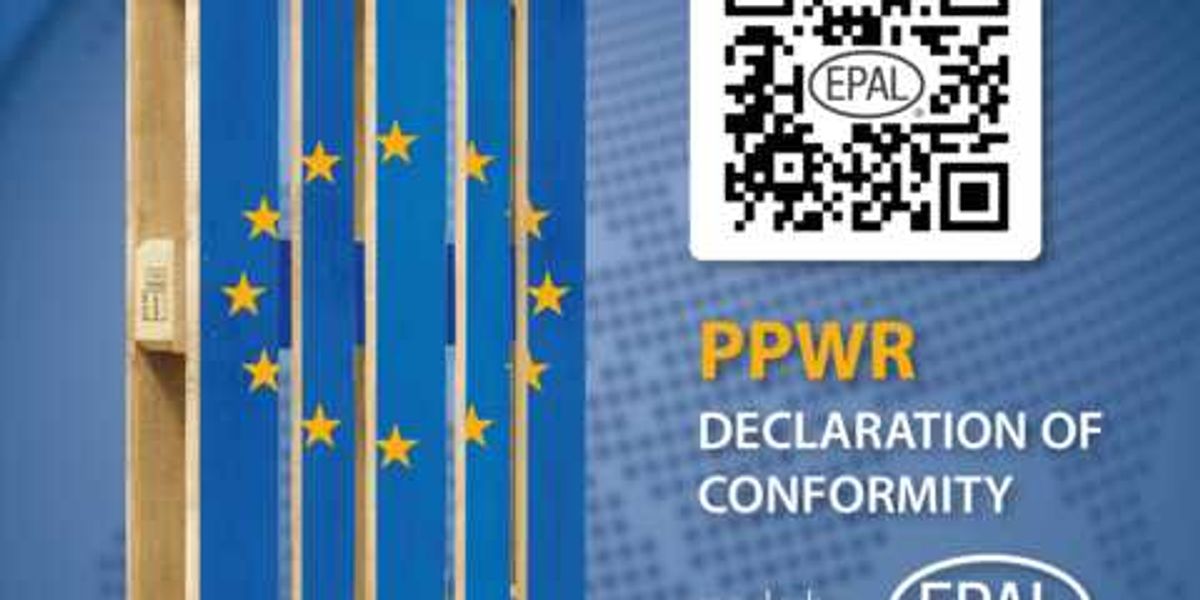
The PPWR regs hold that pallets are transport packaging and fall within the scope of the rules, so EPAL now provides confirmation that EPAL pallets are recyclable and reusable, and that they meet the requirements for substances in packaging.
According to the group, that move provides users of EPAL pallets in industry, retail, and logistics with a reliable basis for the use of EPAL pallets under the new legal framework of the PPWR. “The reuse of packaging works particularly well when it is easily accessible and the pallets can be shared by as many companies as possible across different sectors. This is the strength of the open EPAL pallet pool, and the publication of the PPWR declarations of conformity for EPAL pallets contributes to this,” Dirk Hoferer, President of EPAL, said in a release.
“Users of pallets should be able to focus on their core business. EPAL’s publication of the PPWR declarations of conformity for EPAL pallets simplifies compliance processes… This provides legal certainty and reduces the documentation burden on companies. This is a significant advantage, particularly for companies with complex or cross-border supply chains,” Hoferer said.
Pallet user can prove their compliance by using a QR code, which displays the digital pallet passport for EPAL pallets when scanned. “To facilitate proof of PPWR compliance, we use the digital pallet passport for EPAL pallets, which we developed when EPAL pallets with QR codes were introduced in Year 2024 and which originally contained only information about the production of EPAL pallets,” Jarek Maciążek, President of EPAL, said. “We have now further developed the digital pallet passport and will, in future, make all key information about EPAL pallets and their use and reuse available here.”
