


As readers of this blog must be aware – perhaps with interest, perhaps with mounting annoyance – I have become obsessed with the elusive phenomenon of “feeling it.” It’s my impression that orchestras are feeling it less and less. And that the human condition, these days, is less and less susceptible to feeling it.
The responses, both public and private, have been exceptionally thoughtful. A range of opinion is in play. But the responses I receive from orchestral musicians, especially via email, practically without exception confirm that something has gone missing. I tried to define that something a week ago as “diminished motivation: as if the music fails to impel a commanding physical and emotional response.”
My ruminations have focused on broadcast recordings from the post-World War I decades – in particular, performances conducted by Serge Koussevitzky in Boston, by Leopold Stokowski in Philadelphia, and by Arturo Toscanini, Ettore Panizza, and Artur Bodanzky in New York. In their different ways, these recordings document a degree of engagement I rarely encounter nowadays.
Some readers have expressed surprise that the name George Szell does not figure in my narrative. Beginning in 1946, Szell famously created and sustained a singularly refined ensemble in Cleveland: a tabula rasa he made his own. He was a conductor who experienced an epiphany when he heard Toscanini’s New York Philharmonic on tour in Prague in 1930. He subsequently wrote: “The clarity of texture; the precision of ensemble; the rightness of balances; the virtuosity of every section, every solo-player of the orchestra – then at its peak – in the service of an interpretative concept of evident self-effacing integrity, enforced with irresistible will power and unflagging ardor, set new, undreamed-of standards literally overnight.”
Szell’s perfectionism was a New World ideal, sidestepping Old World lineage and tradition. Concurrently, under Fritz Reiner, the Chicago Symphony acquired a comparable reputation for precise virtuosity: a perfection not only of notes and intonation, but of calculated balance and timbre. I first heard the Cleveland Orchestra under Loren Maazel. I first heard the Chicago Symphony under Georg Solti. The deep imprints of Szell and of Reiner remained evident. I found something missing on the inside.
The other day I explored Szell and the Cleveland Orchestra recorded in live performance. I wound up with a tremendous 1968 reading of Brahms’ First Piano Concerto with Rudolf Serkin. The opening tutti is precise, intense, and engaged. The entire performance sustains these virtues. And I still find something missing.
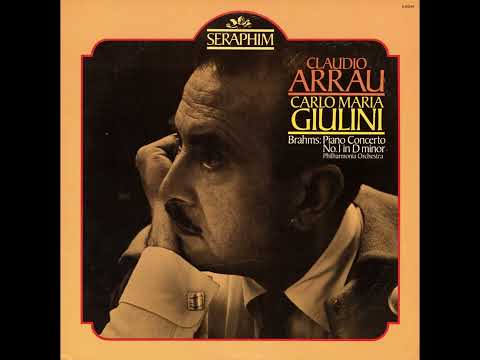
There exists a 1960 studio recording (embedded above) of the same concerto with Claudio Arrau, Carlo Maria Giulini, and the Philharmonia Orchestra. It’s all about the inside of things – to a degree that doubtless frustrates and annoys many listeners expecting a more straightforward account. I experience the opening tutti with my gut. When Giulini lands on the big downbeat reprising the first theme (measure 10), my response is physical. (Intensified by an infinitesimal retard, it bears a slight but crucial agogic accent.) When Giulini reaches the second theme (piano, espressivo), we enter another realm of feeling, pierced with pain. A vast emotional landscape has been placed in play.
My first book was a study of Claudio Arrau. The prevailing topic is interiority – of Arrau the man, of Arrau the pianist. It was a capacity that increasingly isolated him. He profoundly remembered, from his pre-World War II Berlin days, the performances of Wilhelm Furtwangler (“all that he touched became gold”) and of Edwin Fischer (“he had this divinatory quality”). A stray comment, about the E minor theme in the first movement of Beethoven’s G major Piano Concerto: “It’s the first time the music goes into a minor key. I’ve performed this concerto hundreds of times, and the only conductor who did it exactly right – with a really deep melancholy – was Eugen Jochum. We didn’t even have to talk about it.” A “really deep melancholy” is what Giulini finds in the second subject of the first movement of Brahms’s D minor concerto. I remember Arrau using the term herzereisend.
Arrau was a gentle and endearing man whose dapper persona barely cloaked a volcano of feeling the sources of which are a major topic in my book. We made an agreement that I would show him the manuscript when it was finished and invite his comments – but that I could feel free to ignore them. He made a total of three comments. Two had to do with his personal life and I honored them. The third comment had to do with his recordings of the two Brahms concertos with Carlo Maria Giulini. He was painfully disappointed that I found them studio-bound and self-conscious. What he was telling me was that he discovered in Giulini a profound partnership.
In retrospect, I do not know what ears I deployed in 1980, because I now discover in their performance of the First Concerto (not so much the Second) a consummated collaboration. I would call it a performance deeply felt. Both these artists, Arrau and Giulini, were mysterious in ways that Szell and Serkin were not. Szell’s rigorous aspirations are evident: “The clarity of texture; the precision of ensemble; the rightness of balances; the virtuosity of every section, every solo-player of the orchestra . . . in the service of an interpretative concept of evident self-effacing integrity, enforced with irresistible will power and unflagging ardor.” He once said of his Cleveland performances: “We calculate the inspiration.” Daniel Majeske, his Cleveland concertmaster from 1969, testified: “He spelled out everything in millimeters and micrograms. He certainly could have been a pharmacist.” Szell was a conductor who spoke of perfecting a rendering of the score, then “adding” interpretation. Giulini and Arrau began with feeling.
Returning to my Arrau book, I discover myself asking him: What happened? He replied: “Artists are afraid. They are scared of any kind of commitment. And the young people are all afraid of emotion.”
I write about George Szell and Rudolf Serkin embodying stripped New World performance templates, imbued with “Werktreue,” in “Artists in Exile: How Refugees from Twentieth-Century War and Revolution Transformed the American Performing Arts” (2008).
