


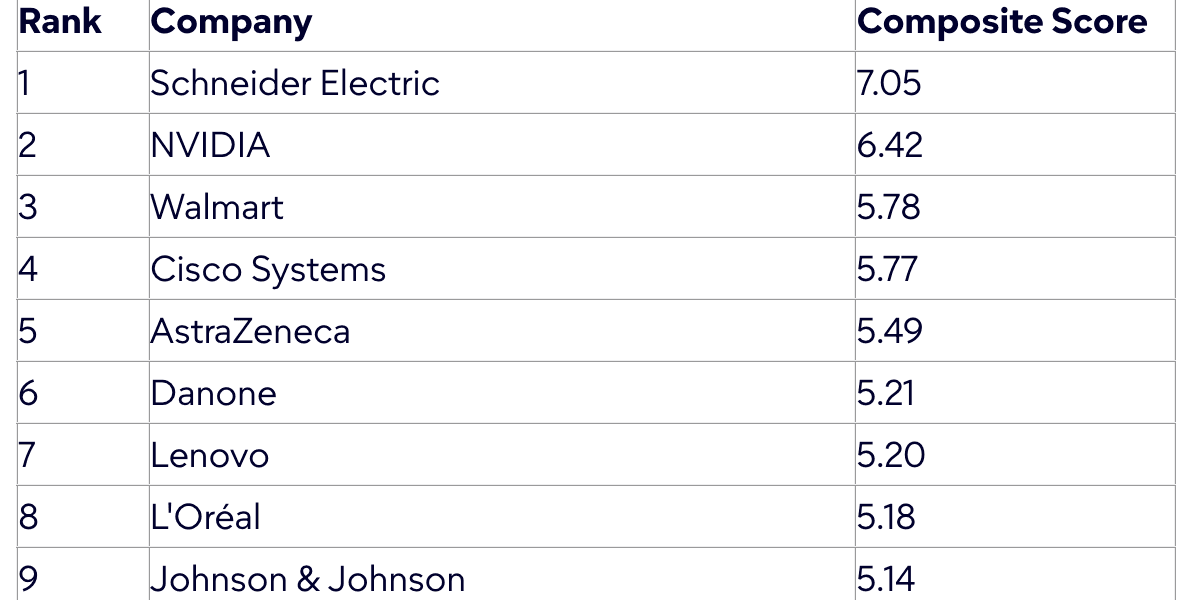
Analyst firm Gartner this week unveiled its annual list of the leading supply chain organizations, finding that Schneider Electric retained its top position in the rankings for the fourth consecutive year, NVIDIA placed second, and Walmart climbed 10 spots to third.
Schneider Electric maintained its leadership position by integrating autonomous workforce capabilities and end-to-end resource orchestration across its operations, Gartner said. The company is prioritizing generative and agentic AI to support human decision-making, enhancing real-time visibility, predictive insights, and coordinated action across the entire supply chain.
“Schneider Electric continues to demonstrate how organizations can balance bold transformation ambitions with disciplined execution,” said Laura Rainier, Senior Director Analyst with the Gartner Supply Chain practice. “Its approach to AI-enabled orchestration, circularity and workforce transformation exemplifies how supply chain leaders are preparing for the autonomous business era.”
Gartner creates its “Global Supply Chain Top 25” by compiling a list of companies from a combination of the Fortune Global 500 and the Forbes Global 2000. It then ranks them with two main components: business performance and community opinion. Business performance in the form of public financial and ESG (environmental, social, governance) data provides a view into how companies have performed, while the community opinion component gives a peer and Gartner expert view to companies’ past performance and future potential with a focus on maturity, leadership and innovation. These two components are combined into a total composite score.
According to Gartner, its 2026 listing revealed three macro trends: autonomous workforce, network-centric strategies, and end-to-end supply orchestration.
“This year, leaders are differentiating themselves by building autonomous workforces, investing in network-centric strategies, and orchestrating supply chains end-to-end across increasingly complex ecosystems,” Rainier said. “Leading supply chains are embracing AI not simply to automate tasks, but to fundamentally redesign how work gets done between people and machines.”
