

Gensol-BluSmart Case: How Did IREDA End Up Facing an Alleged ₹672 Crore Exposure? – Indian PSU

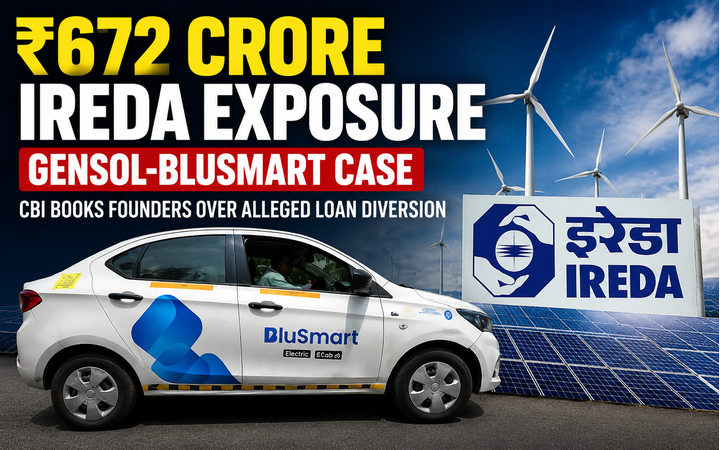
The Central Bureau of Investigation (CBI) has registered a case against Gensol Engineering Ltd, its subsidiary Gensol EV Lease Ltd and BluSmart founders Anmol Singh Jaggi and Puneet Singh Jaggi over an alleged loss of ₹672.74 crore to the Indian Renewable Energy Development Agency (IREDA).
The development marks a significant escalation in the long-running Gensol-BluSmart saga and puts the spotlight not only on the promoters and alleged financial irregularities but also on the safeguards surrounding lending by government-backed financial institutions.
According to the complaint filed by IREDA, loans were sanctioned to Gensol Engineering and Gensol EV Lease for procurement of electric vehicles intended for BluSmart’s electric mobility operations. The CBI case reportedly concerns allegations that the funds were diverted for purposes other than those for which they had been sanctioned.
The alleged exposure comprises approximately ₹453.77 crore relating to Gensol Engineering and ₹218.97 crore relating to Gensol EV Lease, excluding interest and other applicable charges.
From Green-Energy Financing to a Criminal Investigation
The case is particularly significant because IREDA is not an ordinary commercial lender. A government-backed institution, IREDA has been at the centre of India’s renewable-energy financing ecosystem and has played a critical role in funding the country’s transition towards cleaner energy.
The Gensol episode therefore raises questions extending beyond one corporate group.
At the heart of the matter is whether the mechanisms used to sanction, disburse and subsequently monitor loans for EV procurement were adequate to ensure that the money was deployed for the stated purpose.
The allegations are now subject to investigation and must ultimately be established through due legal process. The CBI registration itself should not be treated as a finding of guilt.
The ₹672.74-Crore Question
The size of the alleged exposure makes the case particularly important from a PSU perspective.
IREDA had earlier classified the loan accounts of Gensol Engineering and Gensol EV Lease as fraudulent under the applicable RBI framework and reported the matter to the RBI. The combined exposure was reported at ₹672.74 crore.
The subsequent CBI action indicates that the matter has moved substantially beyond a conventional loan-recovery dispute.
The allegations reportedly include diversion or misuse of funds and forged documents. The CBI case has been registered under provisions relating to criminal conspiracy, cheating and forgery, among other allegations.
The Larger PSU Governance Question
For India’s public-sector financial institutions, the Gensol case presents an uncomfortable but necessary question:
When a large loan is sanctioned for a clearly defined asset-purchase programme, how effectively is the end-use of that money independently verified?
In EV financing, this question becomes even more important because the underlying assets—electric vehicles—are identifiable, countable and capable of being tracked through invoices, registration records, financing documents and operational deployment.
That makes post-disbursement monitoring a critical component of risk management.
If the allegations are eventually proved, the episode could trigger a broader examination of whether existing safeguards were sufficiently robust to detect irregularities before the exposure became as large as ₹672.74 crore.
Not Just a Gensol Story
The Gensol-BluSmart crisis has already raised wider questions about corporate governance, promoter conduct, related-party transactions, financial reporting and the sustainability of rapidly expanding EV businesses.
The latest CBI action adds another dimension: institutional accountability.
For IREDA, the issue is not simply recovery of money. It is also about demonstrating that public money entrusted to a specialised renewable-energy financier is protected by strong appraisal, documentation, monitoring and early-warning mechanisms.
At the same time, it would be premature to assign culpability to any individual or institution until the investigation and judicial process are completed.
A Warning for India’s Green-Finance Architecture
India is committing enormous amounts of capital to renewable energy, electric mobility, battery storage and other clean-energy technologies.
Government-backed financial institutions are expected to provide the financing backbone for this transformation.
That makes governance failures potentially more consequential than in conventional lending.
The Gensol case could therefore become an important test of India’s evolving green-finance architecture.
The larger lesson is straightforward: green financing cannot mean relaxed financing.
Every rupee deployed in the name of the energy transition must be subjected to the same—if not stronger—standards of credit appraisal, end-use verification, financial monitoring and corporate governance.
The CBI investigation will now have to establish what actually happened to the ₹672.74 crore exposure.
But regardless of its eventual outcome, the case has already raised a question that India’s PSU financial institutions cannot afford to ignore:
How can public capital be made safer while financing India’s high-growth green economy?
