


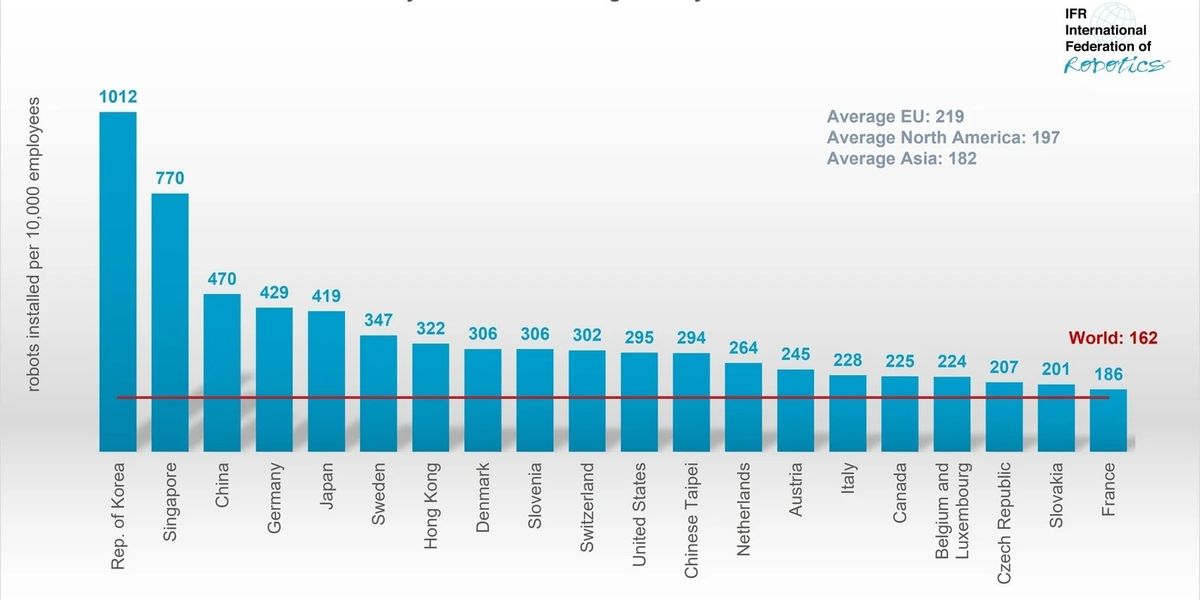
Global robot density in factories has doubled in seven years, according to the “World Robotics 2024 report,” presented by the International Federation of Robotics (IFR).
Specifically, the new global average robot density has reached a record 162 units per 10,000 employees in 2023, which is more than double the mark of 74 units measured seven years ago.
Broken into geographical regions, the European Union has a robot density of 219 units per 10,000 employees, an increase of 5.2%, with Germany, Sweden, Denmark and Slovenia in the global top ten. Next, North America’s robot density is 197 units per 10,000 employees – up 4.2%. And Asia has a robot density of 182 units per 10,000 persons employed in manufacturing – an increase of 7.6%. The economies of Korea, Singapore, mainland China and Japan are among the top ten most automated countries.
Broken into individual countries, the U.S. ranked in 10th place in 2023, with a robot density of 295 units. Higher up on the list, the top five are:
- The Republic of Korea, with 1,012 robot units, showing a 5% increase on average each year since 2018 thanks to its strong electronics and automotive industries.
- Singapore had 770 robot units, in part because it is a small country with a very low number of employees in the manufacturing industry, so it can reach a high robot density with a relatively small operational stock.
- China took third place in 2023, surpassing Germany and Japan with a mark of 470 robot units as the nation has managed to double its robot density within four years.
- Germany ranks fourth with 429 robot units for a 5% CAGR since 2018.
- Japan is in fifth place with 419 robot units, showing growth of 7% on average each year from 2018 to 2023.
