


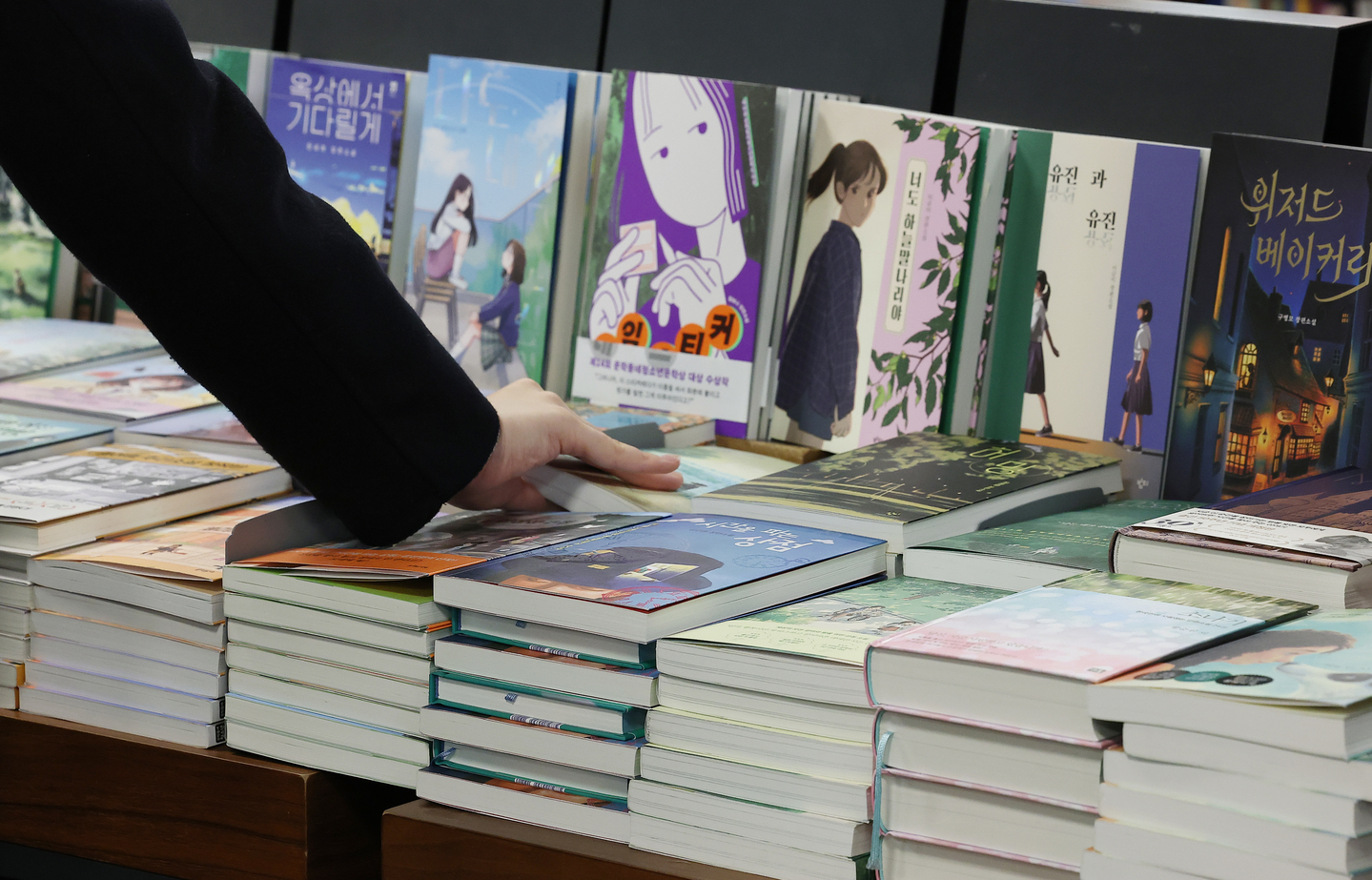
A person picks a book at a bookstore in Seoul on Nov. 13, 2025. [YONHAP]
From book recommendations to breakdowns of topics, AI has entered the reading space. Bookstores, libraries and e-book platforms alike are increasingly using AI to suggest titles and guide readers through books in real time.
The question now is whether AI can become more of a reading companion, rather than just a discovery tool.
So far, AI is most actively used for personalized curation.
Last month, Kyobo Book Centre unveiled Trend+, an AI service that recommends books based on the selection patterns of its in-house merchandisers.
Navigating through the app leads users to a page
that suggests titles tied to current issues, such as recently announced international literary awards and trending topics in the news.
Online bookstore
Yes24 also launched Crema AI last year, a chatbot that recommends books through conversations with users. When users give it prompts such as “a novel to read when feeling tired and drained,” the chatbot suggests books drawn from its purchasing and catalog data.
Flybook, a startup that offers personalized book recommendations through an app, has begun installing AI-powered kiosks at around 250 libraries across the country.
Users select their age, gender, current mood, interests and preferred genres, and an AI librarian recommends about five books available in the library.
![An AI-powered kiosk installed by startup Flybook at a library [FLYBOOK]](https://www.infralog.in/wp-content/uploads/2026/04/1777004596_686_How-AI-is-reshaping-book-discovery-—-and-the-act.jpg)
An AI-powered kiosk installed by startup Flybook at a library [FLYBOOK]
“Satisfaction among [human] librarians is high,” said Kim Jun-hyun, the CEO of Flybook. “In the past, book loans tended to focus on bestsellers and newly released titles, but after the introduction of the kiosks, we have seen a noticeable increase in the borrowing of quality books that had previously gone unnoticed.”
He added, “I believe AI can simultaneously solve the problem of not knowing what to read and the difficulty of maintaining consistent reading habits.”
Subscription-based reading platform Millie’s Library is taking things a step further by integrating a conversational AI chatbot into its platform.
By tapping “Read with AI” at the bottom of an e-book, users can ask questions about the text they’re reading.
For example, if a user asks what fish represent in the book “Why Fish Don’t Exist” (2020) by Lulu Miller, the chatbot will explain that fish can be seen as a metaphor for life beyond the order and categories we know,
and also recommend relevant passages for deeper reading.
![A user asks what fish represent in Lulu Miller's ″Why Fish Don't Exist″ (2020) using an AI chatbot service offered by Millie’s Library. The answer, provided by AI, includes links to relevant passages for further reading. [CHOI HYE-RI]](https://www.infralog.in/wp-content/uploads/2026/04/1777004596_772_How-AI-is-reshaping-book-discovery-—-and-the-act.jpg)
A user asks what fish represent in Lulu Miller’s ″Why Fish Don’t Exist″ (2020) using an AI chatbot service offered by Millie’s Library. The answer, provided by AI, includes links to relevant passages for further reading. [CHOI HYE-RI]
“In the case of this service, usage is particularly high for nonfiction books such as business and self-help titles,” a representative from Millie’s Library said. “We are using AI as a tool to lower the barrier to reading and enable deeper reading experiences.”
The target users of these AI services are people in their 20s and 30s in Korea, as reading is often seen as a fashionable trend among this demographic.
“We wanted to appeal to younger readers, who tend to be more receptive to AI recommendations and actively embrace new technologies,” a representative for Kyobo Book Centre said.
Over the past year, 50 percent of users of Millie’s Library’s AI reading service were women in their 20s and 30s.
![Images of an AI-powered recommendation service, Trend+, available on the Kyobo Book Centre app. [SCREEN CAPTURE]](https://www.infralog.in/wp-content/uploads/2026/04/1777004596_789_How-AI-is-reshaping-book-discovery-—-and-the-act.jpg)
Images of an AI-powered recommendation service, Trend+, available on the Kyobo Book Centre app. [SCREEN CAPTURE]
However, deeper applications of AI that use the book’s actual text are unlikely to expand widely in the current industry climate, while most AI recommendations are currently based on consumer patterns and data rather than the text itself.
Resistance to AI remains strong among publishers, authors and readers, to the extent that the slang term “click publishing” has emerged — referring to books created with minimal effort.
“If publishers believed that AI could learn the full text [from e-books provided on reading platforms], more than 90 percent of publishers would refuse to supply their books,” an industry insider said.
As a result, providers of AI reading services emphasize that they “do not train AI on full book texts without authorization,” drawing a clear line by stating that they use only “publicly available book information, reader reviews and anonymized user data.”
![People read at an outdoor library set up by the Seoul Metropolitan Government at Gwanghwamun Square in Jongno District, central Seoul, on Oct. 13, 2024. [NEWS1]](https://www.infralog.in/wp-content/uploads/2026/04/1777004597_172_How-AI-is-reshaping-book-discovery-—-and-the-act.jpg)
People read at an outdoor library set up by the Seoul Metropolitan Government at Gwanghwamun Square in Jongno District, central Seoul, on Oct. 13, 2024. [NEWS1]
Experts say that while AI services have limitations, they can still encourage more active engagement with reading.
“For readers who want to quickly find and consume books, the current level of AI services, even without learning from the full text, can be sufficiently useful,” said Kim Gil-han at Dasan Books, which recently supplied 70 titles to the AI reading service.
Literary critic Kim Sung-shin also pointed out the limits of AI services, saying, “While they can make books more accessible, the essence of reading lies in interpreting texts and reconstructing meaning.”
However, he acknowledged that “if AI can guide readers to stay longer with texts and interpret them more deeply, it could play an important role in transforming reading culture.”
This article was originally written in Korean and translated by a bilingual reporter with the help of generative AI tools. It was then edited by a native English-speaking editor. All AI-assisted translations are reviewed and refined by our newsroom.
BY CHOI HYE-RI [[email protected]]
