


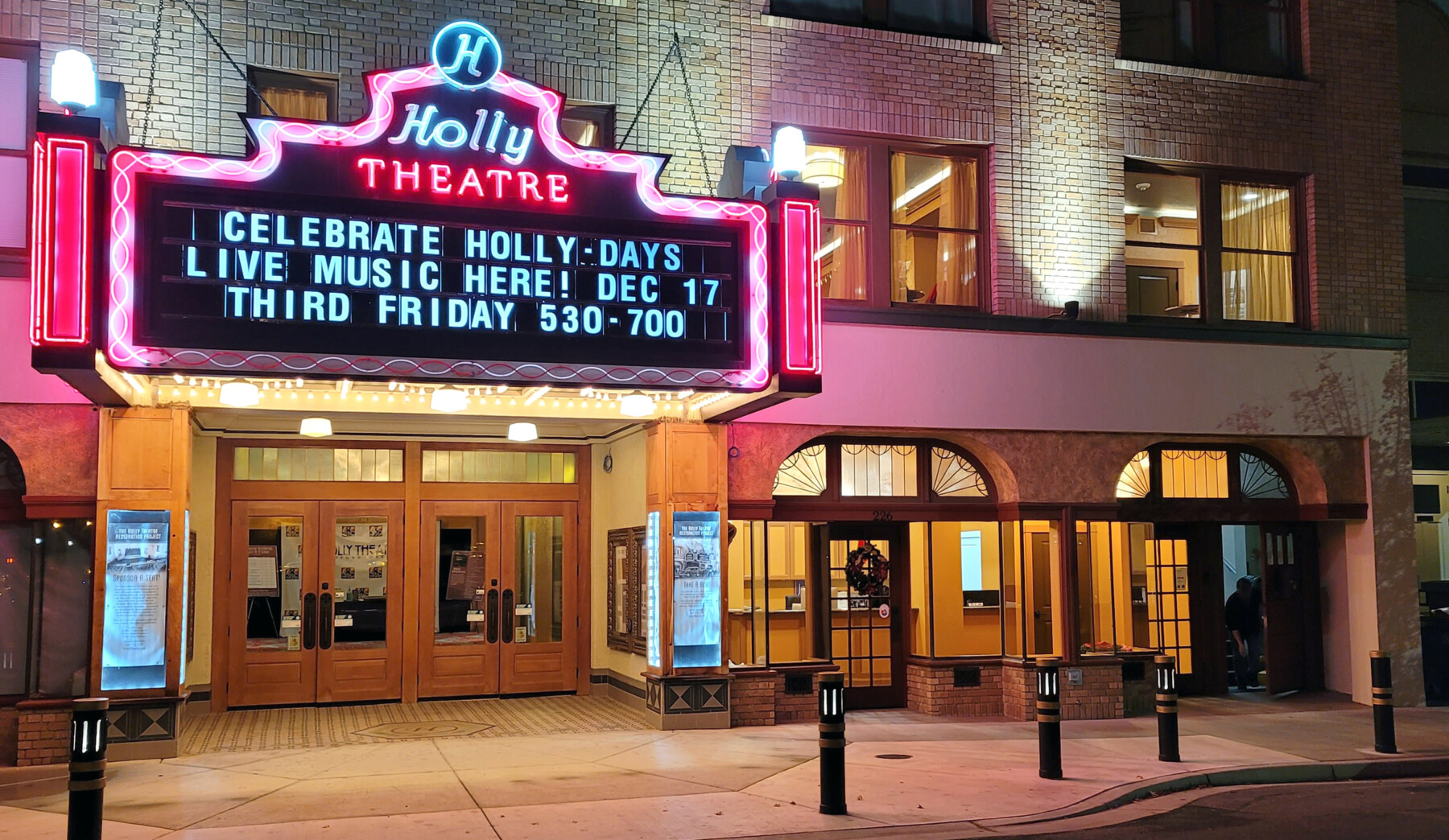
MEDFORD — Medford is hardly without cultural assets — the long-established Craterian and a network of smaller performing arts venues and theater companies have served audiences for decades.
But the restoration, completed last year, of the 1930 Holly Theatre downtown, with its 1,000-seat capacity and historic presence, expands that landscape in both scale and symbolism. More than a preservation success, the Holly is a test of how arts infrastructure can strengthen a mid-sized, non-metro city redefining its downtown and regional role.
OREGON CULTURAL HUBS: An occasional series
As the largest indoor performing arts venue between Eugene and Redding, Calif., the theater positions Medford not simply as a medical and service hub, but as a broader regional cultural center drawing audiences from across Southern Oregon and Northern California. In a state where arts attention often gravitates toward Portland or Ashland, the Holly’s revival offers a case study in how a historic landmark can complement an existing arts ecosystem — strengthening downtown vitality while reconnecting a community to its past.
Medford in 1930
When the Holly opened in 1930, Medford was a much smaller city, with agriculture, orchards and service industries shaping much of daily life. Downtown served as the commercial and civic center for the surrounding area. The Pacific Highway had been completed only a few years earlier, changing travel patterns and reducing rail’s dominance. Against that backdrop, the arrival of a Spanish Colonial Revival movie palace designed by local architect Frank C. Clark announced not so much swagger as persistence.
George Kramer, the Ashland-based historic preservation consultant who worked on the Holly restoration, resists romanticizing the moment. Construction was announced just before the Great Depression took hold, he noted, and the theater reflected “dogged determination and lack of appreciation for how severe the Depression would become.” Entertainment, he said, became “one small bright spot — escapism — during the Depression,” though “the Holly was never a financial success as a movie venue.”
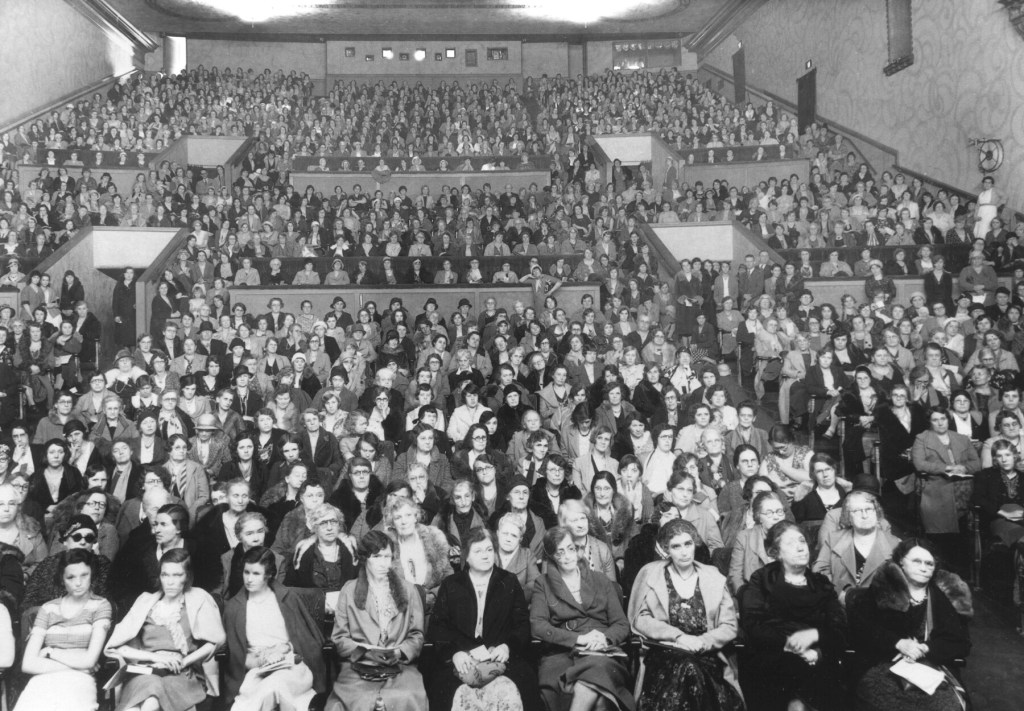
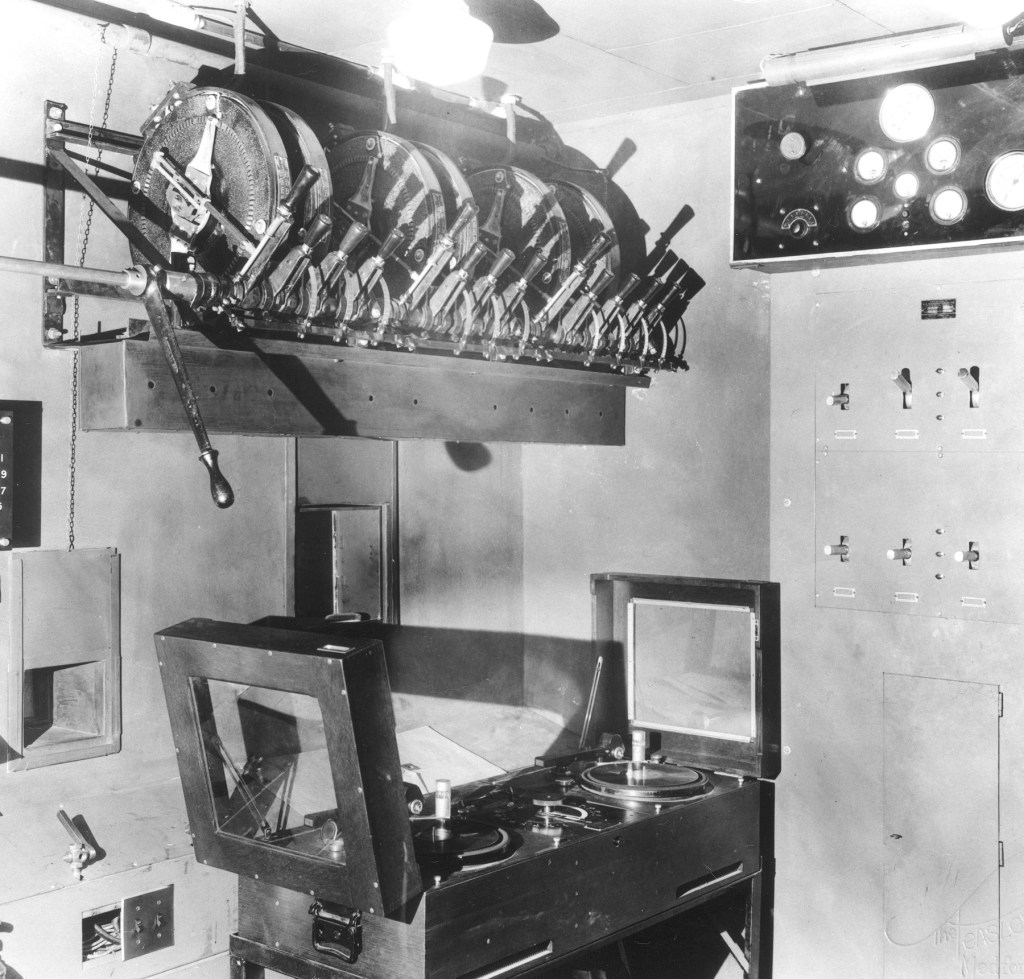
Still, it was a major civic statement. With roughly 1,000 seats — about one-tenth of Medford’s population at the time, according to Kramer — the Holly was not a modest neighborhood picture house. It was Southern Oregon’s first grand theater built specifically for talking pictures, arriving at a moment when sound films were transforming the industry. Although other Medford theaters had been adapted for sound, the Holly was designed for it from the start.
Karl Stahnke, the Holly’s volunteer coordinator, said that mattered both technologically and culturally.
“With this advancement in film, it helped prove that movies were not just a fading trend, but a giant leap forward in affordable entertainment for the masses,” he said.
Beyond the silver screen
The theater quickly became more than a place to watch films. Its stage and dressing room wing allowed it to host local talent shows, ballet performances, lectures, and civic events. Angus Bowmer, who would go on to found the Oregon Shakespeare Festival, presented an early production there. Legendary contralto Marian Anderson performed there. Community members came not only for movies but for debates, educational presentations and performances that brought national culture into a regional city.
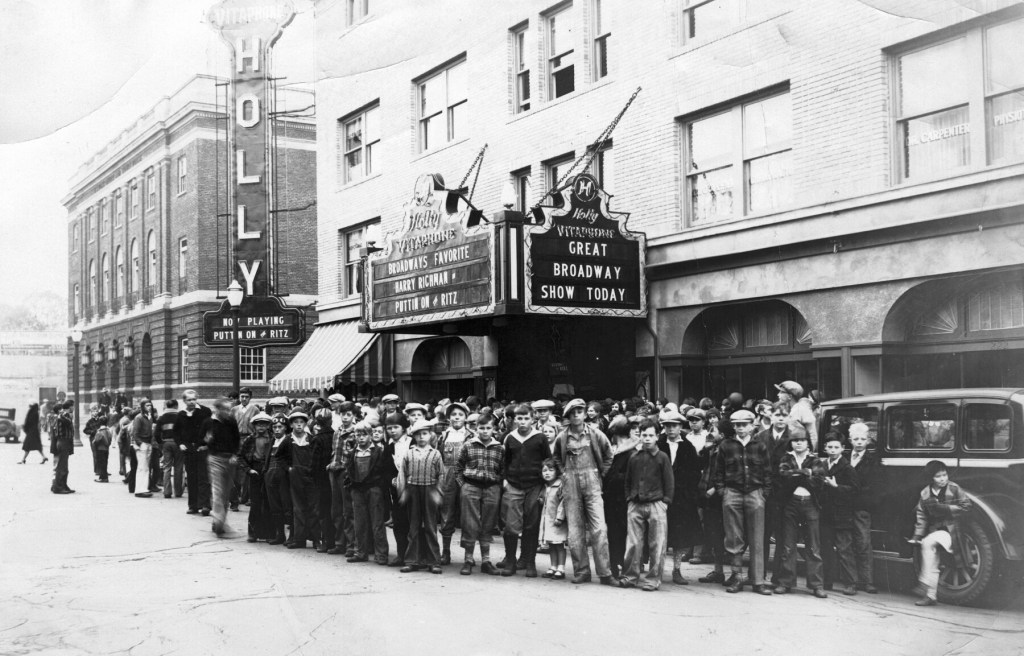
That broader civic role is central to understanding why the Holly lingered in local memory long after it ceased to function. The decline was gradual but familiar. Multiplexes, suburbanization, shifting film distribution and the expense of operating a large single-screen house all worked against it. Kramer’s assessment is blunt: “The Holly was never successful as a movie theater. It was too large.” It closed in 1986.
The decades that followed were not kind. The building sat vacant, suffered neglect, and at one point was gutted by would-be redevelopers who envisioned “atrium offices” before going bankrupt. A later owner hoped to restore it but died in a car accident. Another proposed an opera venue without adequate resources. A cracked roof truss in 2002 contributed to structural instability and condemnation. By the time the JPR Foundation, which supports Jefferson Public Radio, purchased the theater in 2011, the building had endured what Kramer called “benign neglect or worse.”

Saving the Holly
What survived, however, was the idea of the Holly.
John Snider, a retired congressional district director who became one of the project’s earliest volunteer leaders, said he was recruited soon after retiring in 2011.
“I was the first volunteer involved in the Holly,” he said. He expected a limited role as co-chair. Instead, the work widened. He eventually helped bring in Ron McUne and Karen Doolen as fellow co-chairs. “It would not have happened without their incredible effort.”
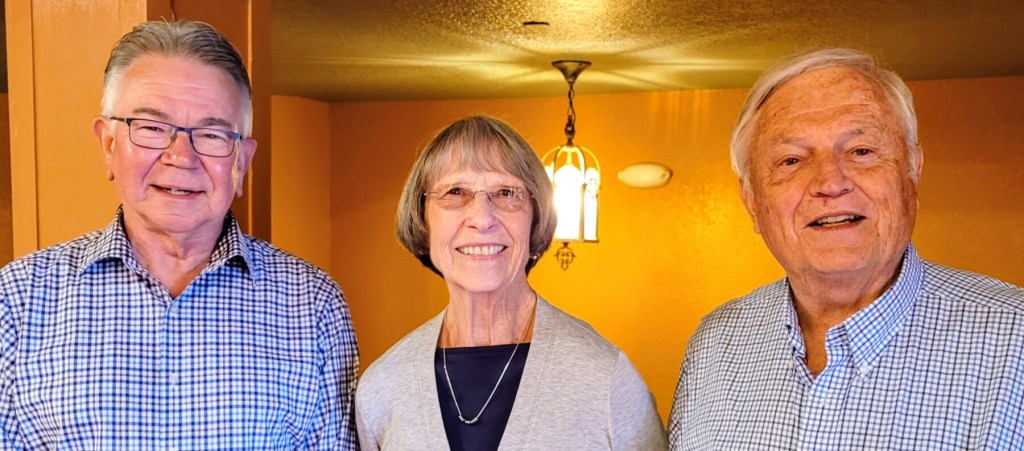
The JPR Foundation had its own reasons for taking on the risk. McUne, former executive director of Britt Festivals and one of the co-chairs of the Holly Restoration Committee, said the foundation had seen what could happen with its sister venue, the Cascade Theatre in Redding. That theater proved successful both as a performing arts venue and as a way to extend Jefferson Public Radio’s cultural reach. When the Holly became available after the death of owner Art Alfinito, JPR leadership saw an opening.
Early on, the foundation secured Medford Urban Renewal Agency support to restore the façade and reproduce the marquee and blade sign. A lighting ceremony in April 2012, McUne said, was a turning point. “Everyone knew at that point that the restoration of the Holly was a reality.”
Lessons from the Cascade
The decision to pursue the Holly restoration was shaped in part by experience. Ken Silverman, who was vice president of the JPR Foundation board when the theater was purchased in 2011 and later served eight years as board president, said the organization drew confidence from its renovation of the Cascade Theatre.
“More than 20 years ago, the JPR Foundation Board took on the responsibility for renovating the Cascade,” he said. “The success of the opening of that historic theater and the impact it had on downtown Redding were the inspiration to do it again with the Holly.”

The path forward, he acknowledged, was far from smooth.
“It certainly was a wild ride,” Silverman said. Even so, the board believed the theater could once again become an asset for the region.
Silverman said the project also fits the foundation’s broader role alongside Jefferson Public Radio: helping create shared cultural experiences across Southern Oregon and Northern California.
“The JPR Foundation has always seen its role in the region as an organization that also works to bring people together to experience live music and cultural events,” he said. “The vision of the Holly project has always been to complement the amazing work done by JPR and to expand the cultural opportunities available for our community.”
Funding the restoration
Historic restoration campaigns are rarely linear, and the Holly’s was not. What began as a project estimated at $4.3 million would eventually require more than $13 million in donations, grants, loans and tax-credit-related financing. The source of the money shifted less than the scale of the need. Snider said the approach remained consistent throughout the campaign: engaging the public broadly and putting new funds to work as soon as they arrived.
“As soon as a donation or grant came in, it was immediately put to work on the restoration,” he said. “We operated on ‘pay-as-you-go,’ and we never lost sight of the goal.”
The project drew support from city and urban renewal sources, state funding, local and regional foundations, nonprofit grants, and major private gifts. In 2022, after restoration work resumed following a COVID-related pause, the project had key support from the Jeff and Tina Blum family in the form of a low-interest $3 million loan, along with eligibility for $1.8 million in historic tax credit funding and a $250,000 grant from the City of Medford. Earlier, Rep. Sal Esquivel had secured $2 million in state funding, according to Snider, and public pressure helped preserve that commitment during a dispute with Gov. Kate Brown.
But the most visible expression of support may have been the donor base itself: more than 3,300 contributors. Some gifts were small, others substantial. For Snider, the cumulative effect mattered most. “Each one felt like a vote for us to finish the Holly,” he said.
Why people gave
What were people voting for? In some cases, memory. In others, downtown development. Often both.
Doolen, who brought decades of nonprofit fundraising experience to the campaign, said many stories came from residents whose connection was inherited as much as lived.
“To me the strongest support is driven by the emotion of people who remember how much the Holly meant to their mother, grandmother, or other older relatives,” she said. “That’s what makes the Holly special to them today and that’s why they supported the restoration project.”
Stahnke heard similar stories over the years. One supporter told him her family came from the Applegate Valley by horse and wagon to buy supplies in Medford and see a movie at the Holly. “Years later, she is now bringing her grandchildren to the Holly, and is proud that five generations of her family have been to the Holly for great entertainment,” he said.
Sentiment alone, however, would not have carried a 14-year campaign. The project’s advocates had to keep the public engaged through delay, cost escalation and skepticism. One of the most effective tools was simple access. Monthly open-house tours let people walk through the wounded building, imagine its recovery and follow progress over time. McUne said more than 8,000 people took those guided tours during restoration.
Doolen described the first-Saturday open houses as essential to building sustained belief.
“When people could experience the Holly firsthand and learn the history and the plans for the future, they came to share our vision and chose to become more engaged by spreading the word, signing up to volunteer, and donating,” she said.
The seat sponsorship program also turned fundraising into a form of ownership. All 1,008 seats were sponsored by donors whose names appear on plaques. Appreciation events, progress updates and recurring tours helped prevent the project from disappearing into abstraction.
Early skepticism
That did not mean there were no doubts. Early on, the Holly faced “political” headwinds, as Snider put it, from people who believed Medford should have only one major theater. McUne said the most pronounced resistance came from supporters of the Craterian Theater, who worried that another restored venue would split an already finite audience.
Holly leaders responded by arguing that the venues served different purposes. The Holly’s greater capacity — McUne put it at 38% larger than the Craterian — and its stage limitations meant it would not simply duplicate the Craterian’s programming. Touring Broadway productions, for example, require more wing space and stage depth than the Holly can provide. The project’s backers pointed instead to the Cascade in Redding as a model and even produced an analysis showing minimal overlap in programming.
Over time, McUne said, skepticism in the community began to ease.
“We changed many minds on how the Holly was not competing with the Crate, but only increasing the availability of art and entertainment in the area,” he said. Since reopening, he added, the Holly and the Craterian have on occasion both sold out very different performances on the same night — “much to the delight of local restaurants.”
Restoring, not reinventing
If the fundraising campaign was a test of endurance, the restoration itself was a test of discipline. The Holly’s placement on the National Register of Historic Places and its reliance on historic tax credits meant close coordination with the National Park Service and Oregon’s State Historic Preservation Office. The challenge was not to create a fantasy version of a 1930 theater but to recover the one that actually existed.
Kramer was especially insistent on that point.
“I was adamant that we needed to honor the Holly’s frugal approach to design, to not unnecessarily ‘improve’ upon its past and turn it into something it never was, but rather to reflect the original Depression-era appearance,” he said. “As a result, painting rather than using rich materials was important.”
That philosophy complicates the usual rhetoric of lavish movie-palace restoration. The Holly was grand in scale and civic presence, but not opulent in the manner of bigger-city palaces. It was built economically by largely local talent: Clark as architect, Earl Fehl as builder, and Carl F. Berg of the National Theatre Supply Company, whose firm designed auditorium interiors and supplied theater equipment across the West Coast. The Holly was larger than a typical small-town theater, Kramer said, but it used “pretty standard materials that could be inexpensively constructed.”
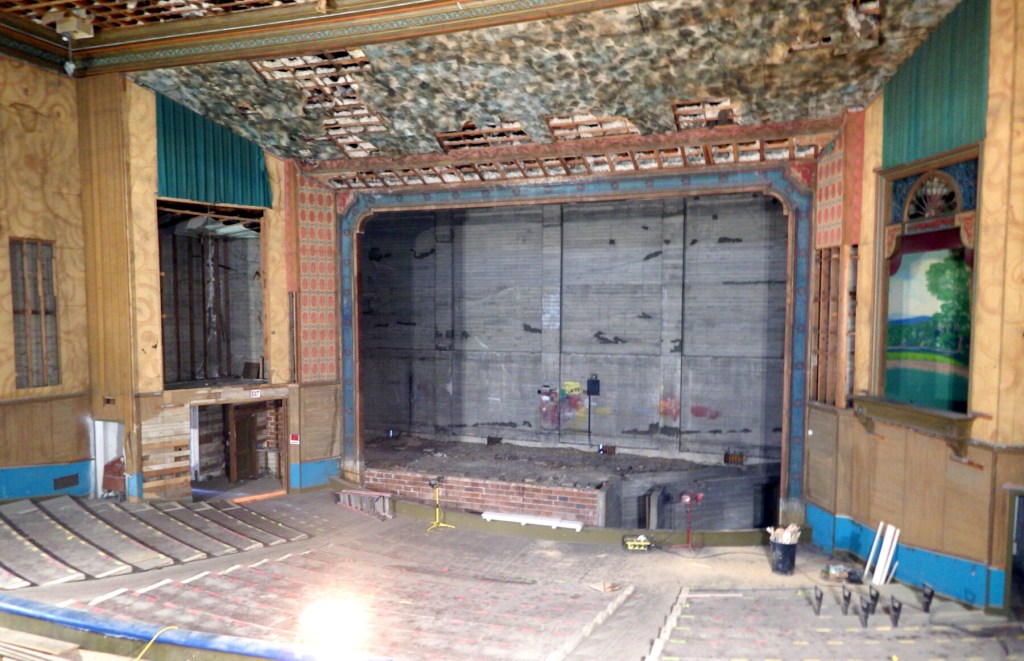
Preserving that character did not preclude modernization. Modern wiring, plumbing and seismic upgrades were tucked behind walls. Lighting fixtures were restored and fitted with contemporary bulbs and controls. Dressing rooms, stage rigging and lighting were upgraded. An elevator was inserted into a building never designed for one, along with a significant expansion of restrooms and accessible seating.
Historic form, modern function
Snider praised Kramer’s rigor in safeguarding the project’s historic-tax-credit eligibility while allowing needed changes. “Every change had to be signed off by him,” he said.
The result, supporters argue, is less a compromise between past and present than a layering of them.
“It seems like there were way more improvements than tradeoffs or compromises,” Snider said. In his telling, the theater’s original design — created for the new demands of sound film — had already bestowed strong sightlines and acoustics. Doolen noted that acousticians from New York had been hired for the original design and that the restoration reused Homasote, the cellulose fiber material employed on the auditorium walls, helping preserve those acoustic qualities.
The pandemic nearly broke the project’s momentum. COVID stalled work for close to three years. Inflation and supply-chain problems followed. Southern Oregon’s own traumas, including the Almeda Drive Fire, also reshaped the region’s philanthropic and economic landscape.
Setbacks and persistence
Meanwhile, restoration itself kept revealing the unexpected. “Tearing into the walls of a 95-year-old building is full of surprises, which usually results in more time and more money,” McUne said.
Yet the campaign did not dissolve. Part of that persistence came from continuity: Many of the same fundraising committee members remained involved from near the beginning to the end. Part came from public accountability. McUne said the leadership team felt a strong obligation to the thousands of donors who had invested in the project. “Failure just wasn’t an option,” he said.
Now that the theater is open and operating, the terms of the conversation have changed. The question is no longer whether the Holly can be restored, but what kind of institution it will become.
On the most basic level, it is already functioning as an events venue. Doolen points to a long list of activities hosted even before the restoration was fully complete or in its earliest operating phase: mezzanine rentals, public meetings, civic gatherings, a reception for dignitaries from sister city Alba, Italy, visiting for the Pear Blossom Parade, chamber functions, and at least one private school graduation booking. St. Mary’s School will hold its 2026 graduation there, Snider said, a detail that connects the restored building back to one of Medford’s own institutions.
On the touring map
The Holly’s general manager, Tiffany Maude, places the venue’s role in regional rather than strictly local terms.
“Being the largest indoor performing arts venue between Eugene and Redding puts the Holly in a unique position on the touring map,” she said.

Outside the summer season, when outdoor venues dominate Southern Oregon’s performance landscape, the Holly offers a stop for touring acts that might otherwise bypass the region. The practical implication is not simply prestige. It means Southern Oregon audiences may not need to drive to Eugene, Portland or Redding for certain performances.
At the same time, the Holly is not trying to be all things.
“There are arts organizations in our region that are much better equipped to produce large stage productions and musicals,” Maude said, “with the rehearsal infrastructure and production teams those shows require. The Holly serves a different role.”
Maude emphasizes that it is not configured to produce large-scale musicals or theater requiring substantial rehearsal infrastructure. Its model is closer to that of a presenting house and rental venue: primarily touring artists and concerts, plus availability for nonprofits, community groups and independent producers. In that sense, she argues, it complements rather than competes with more production-oriented organizations such as Oregon Shakespeare Festival and other regional presenters.
Limits and possibilities
The stage limitations are real. Doolen says the Holly can accommodate a chamber music group but not a full orchestra and often refers inquiries to other venues. That matters because it keeps expectations grounded. The Holly may be the valley’s largest indoor venue, but it is not a universal one.
It is, however, a civic symbol — and symbols matter in downtown development, though not always in tidy ways. City officials interviewed for this story were direct in viewing the Holly as both a cultural investment and an economic tool, with several leaning more heavily toward the latter.
Councilor Kevin Stine called the theater “primarily an economic catalyst for downtown activity,” adding that its arts role is “an added bonus.” He also framed the pre-restoration condition of the building as untenable: “When you’re looking at economic development in downtown Medford, the fact is that having a landmark like the Holly Theatre sitting unused and not reaching its potential wasn’t acceptable.”
Council Vice President Garrett West placed the Holly within broader downtown momentum that includes new restaurants, building renovations and streetscape improvements.
“When there is a show at the Holly, people do not just show up for the performance and leave,” he said. “They come early for dinner, they grab a drink afterward, and they spend time walking around downtown.” That pattern, he argued, supports existing businesses and may help justify future investment, including more housing in the downtown core.
Measuring the impact
Council President Jessica Ayres, while more measured about outcomes, said she expects the theater to support tourism-related businesses and help generate “additional opportunities such as pop-up vendors, special events, and increased hotel occupancy.” She said she plans to continue talking with theater staff, business owners and Travel Medford to understand its actual effect on foot traffic, hotel stays and activity at other arts venues.
That emphasis on actual impact is important, because arts-led redevelopment narratives can sometimes outrun evidence. At this point, the Holly’s economic promise remains partly prospective, though early anecdotes are encouraging to supporters. One sold-out show drew ticket buyers from 20 states, according to both Snider and Maude.
McUne points to evenings when the Holly and Craterian have both been full. City officials see the venue as a reason for people to linger downtown rather than pass through it. But a year into operations, the longer-term effects on occupancy, business development, regularized evening traffic and downtown residential growth will take more time to measure.
Economic ripple effects
The business community is watching the Holly’s return closely as well. Eli Matthews, president and CEO of the Chamber of Medford & Jackson County, said the theater’s reopening adds both cultural and economic momentum to downtown.
Downtown merchants have already begun noticing the effects of event nights, particularly as audiences arrive early or linger afterward.
“We’ve received a good amount of positive feedback from local business owners regarding the influx of visitors during Holly events,” he said. “Many report noticeable increases in visitation leading to greater spending in their establishments.”
For the chamber, the theater’s significance also lies in its regional reach. By drawing audiences from across Southern Oregon and Northern California, Matthews said, the Holly strengthens Medford’s position as a destination rather than simply a stop along the way.
“Travel and tourism are among our fastest-growing industries,” he said, “and being able to showcase the Holly’s offerings when promoting Medford to visitors is invaluable.”
Beyond commerce
The cultural case may be easier to observe, if harder to quantify. Medford has long served as a regional center for healthcare, retail and services. The Holly complements that identity by reviving a historic place built for collective experience.
West, the vice president of the city council, said communities need “cultural spaces where people can come together and experience something memorable.” In his view, the Holly helps signal that Medford is not merely functional. “It is a place people come to experience something,” he said.
That may be the most significant shift the Holly embodies. For decades, the building was a reminder of loss — a vacant shell in the center of the city, too damaged and too costly for easy rescue. The restoration turned that problem into a civic project, and the project into a test of whether Medford would back a more expansive view of itself.
Not everyone agreed at the outset. The timeline stretched, costs tripled, and the theater’s future was never assured. Yet the campaign endured, in part because it joined nostalgia to utility: preserving a landmark while making an argument for what downtown could still be.
The next chapter
Maude describes success five or 10 years from now in straightforward terms: a theater that becomes “a regular gathering place for the community and for audiences across Southern Oregon,” one that remains active with concerts, community events and special performances while continuing to contribute to the vitality of downtown.
“We are also proud to be members of the League of Historic American Theatres,” she said, “which connects the Holly to a national network of restored historic venues serving their communities through the arts.”
City Council President Ayres hopes the theater’s steady use will help anchor broader downtown development and encourage rising occupancy in nearby buildings.
Doolen and her colleagues are already looking beyond reopening to 2030, when the Holly turns 100. Their current “Holly 100 Committee” is working not only on operations but on unfinished areas in the building, including a future members’ lounge and additional conference and office space.
For Kramer, whose job has been to look backward accurately, the theater’s significance is not just architectural.
“The Holly shows what determination and community effort can do, if given the chance,” he said. He had long believed the venue would succeed if it reopened, particularly because Medford, with a population of just under 90,000, is now large enough to support a hall of its size.
A living landmark
That conclusion still deserves testing over time. A restored theater is not self-sustaining simply because it is beautiful, historic, or beloved. It has to program intelligently, maintain community trust, respond to changing audience habits and operate within the real limits of its building and market. Holly leaders appear aware of that. Maude said the staff is watching ticket trends, patron feedback and data closely in its first year, adjusting to a live-entertainment landscape that remains volatile.
But the Holly’s reopening has already accomplished something more basic and more visible. It has returned one of Medford’s most conspicuous historic structures to public life, not as a static monument but as a working venue. In doing so, it has given downtown a new-old landmark, Southern Oregon a larger indoor cultural room, and Medford a more complicated story to tell about itself — one rooted not only in services and commerce, but in memory, performance, and the stubborn civic labor required to bring a damaged place back into use.
If the next chapter unfolds as its supporters hope, the Holly will not stand merely as a restored relic of 1930 ambition. It will function as proof that cultural hubs — working alongside other arts institutions and civic efforts — can help shape how a community sees itself, and how it chooses to gather.
