


If I told you that there’s an activity that improves your vocabulary, your communication skills, and your knowledge of history and foreign languages; that provides an endless supply of fun facts and enjoyable epiphanies; and that is completely free and ready for you to start right this second, you’d be forgiven for raising an eyebrow of incredulity. But no, this multi-advantageous activity really does exist. I’ve devoted a significant chunk of my adult life to pursuing it.
In order to understand the words that your eyes are currently scanning, you first had to learn them from someone else – most likely from parents, older siblings, grandparents, teachers and others around you. Those people acquired their vocabulary from others still, and those others were instructed themselves. With this fact in mind, we appreciate that each of us is a link in a millennia-long chain of language, connected to people over the centuries by the words they bequeathed us. Following where, and through whom, that chain has passed is the business of etymology.
Like examining one fine thread of a spider’s web, tracking a single word’s etymology back in time will lead you into a web of connections between languages, peoples and places. In English etymology, my main focus here, the cast of characters is diverse. Legions of Romans, longships of Vikings, schools of Muslim scientists, academies of Greeks, and one fateful army of Normans in 1066 have all influenced the words of what linguists call Modern English (c1500 CE-present day). Of course, all those people didn’t exist in a vacuum. The whistling arrows at the Battle of Hastings and the scratching quills of William Shakespeare formed part of real historical events and sociopolitical circumstances that are still reflected in our vocabulary.
Etymology is therefore a great way to get stuck into the past, and many of us delight in history for its own sake. But that’s just one of the diverse benefits of becoming a word detective – learning to uncover the backstories of the words you use.
The delights of etymology
Most immediately, there are the fun bits of trivia and joyful ‘Aha!’ moments of realisation. These can come in handy in various social scenarios. That an aftermath is nothing mathematical but rather an ‘after-mowing’, that malaria is literally the medically outdated idea of ‘bad air’, that a migraine was originally conceived of as suffering a ‘half-head’ (hēmikranía) of pain, according to the Greeks, or that a dandelion is a French ‘tooth-of-lion’ are etymological titbits that might help a conversation flow, or win you that quiz night.
Etymology elucidates seemingly strange features of the English language. If we consider only the present, it’s baffling that a date is a fruit as well as a point in the calendar, and that a seal of approval isn’t the one with flippers (probably). Bring in history, and we gain soothing explanations for how this all came to be.
Then there are the linguistic skills that etymology nurtures, often subtly and incrementally. So many ingredients have been mixed into the English lexicon that sifting through them will naturally expose you to a lot of other languages – a heavy measure of French, several tablespoons of Latin and Greek, some Spanish for spice, a pinch of Persian, a dose of Dutch and a dram of Modern German. The etymology of one language quickly becomes a springboard for jumping into others.
The etymologist’s toolkit also includes the materials for word-building: prefixes, suffixes, roots. From these, the ancients constructed vocabulary. The Romans, for example, used via (the Latin word for ‘road’) as a root for coining what would become English devious, impervious, obvious, previous and trivial too. One Latin prefix, con-, unites concept, connect, constructed, continue, conversation and countless more.
With these conceptual tools, the vocabulary of English (or any language) is broken down and becomes more learnable – no longer an impenetrable mass of words, but an assemblage of recognisable basic elements. This can improve your passive knowledge of a language, but also your active creativity when wielding it.
Before we get started, consider some bigger-picture benefits too. I don’t exaggerate when I say that etymology can make people better at thinking about and interacting with our fellow humans. The etymologist accesses a unique perspective on human history. Language links faraway people and places in ways that aren’t generally known about. They can make the exotic feel familiar, and the domestic feel strange. When your language leads you to consider your small place in a world-spanning web of connections and an endless flow of linguistic innovation and conversation, it opens the door to cultivating humility, respect and kindness.
I believe that all this treasure is yours for the taking, stored in the words you already know. Now, I must admit that no one can teach you all the etymological knowledge in a short amount of time. It takes years to get up to the level of the expert word nerds – but the joy is in the journey. What I can do is get you started. The following steps will help you begin to think like an etymologist and see your words anew.
Pick a word, any word
The entire lexicon of the English language is fair game for the etymologist. From the humblest verb to the most daunting multi-syllabic piece of scientific jargon, all words have a history to learn about. Some of those histories may be quite brief, as new words are born all the time. As a general rule of thumb, the shorter the word is, the longer its history. Simple, frequent words, which are essential for fluent English but rarely attract our attention, tend to hide centuries of use and change. They’ve become essential for a reason.
Nonetheless, the choice of words to investigate is entirely yours. Die, dog, gentleman, hose, know, microphone, midwife, not and subscriber are just some of the words to which I’ll be reintroducing you in this article.
Get to know your tools
As you set out to learn more about your words, there are some invaluable resources you can turn to, including etymological dictionaries, reference works and etymology websites. These resources are plentiful, although some are more accessible (financially and terminologically) than others.
For English etymology, the guiding light is The Oxford English Dictionary (OED), an incredible project, begun in the 1850s, to document the whole of the English language. The entire dictionary is too big to be commercially viable, but its content is available for subscribers online and in smaller etymological books. In terms of free online resources, I personally swear by Wiktionary, the lexicographical counterpart to Wikipedia. It’s an endless maze of pages and clickable links, and many of its entries include etymological information. Etymonline is another wonderful project, well presented and with a focus on English. There are free online dictionaries and resources specific to languages other than English as well; searching for ‘X etymological dictionary’ (where X is a given language) will bear virtual fruit.
When you look up a word in one of these resources, you may notice some distinctive uses of punctuation. Like any field of study, etymology has its own jargon and symbolism, all for the sake of efficiency. Hyphens, for example, are commonly used to indicate that an element of vocabulary is incomplete. I previously referred to the prefix con–, with a hyphen that points to its prefixation and dependence on another word. Likewise, I could write that the root of the adjective credible is cred–, which is not a standalone word.
Another practice is the liberal use of asterisks. When an asterisk comes before a word in your etymological resource, it means that the word is nowhere to be found in our historical texts, but we have very good reason to believe it existed at one time. For example, there are scholars who suggest that the word die had an ancestor in Old English (the language c450-1100 CE), but that the ancestor word just didn’t get written down; they thus refer to this word as *dīeġan, prior to its textual emergence in the Middle English period (c1100-1500 CE). Our surviving texts haven’t captured all of human language – especially from before the invention of writing. So that’s why you might come across that symbol. Don’t worry; the asterisk is silent.
Connect words through shifting sounds
You can learn so much just by listening to how you and the people around you speak. The pronunciation of a single word can change based on who’s saying it, when, and where. All English speakers fluctuate in how they pronounce words sometimes; I’ve noticed that the way I personally say issue and nausea isn’t settled. Then there are the differences that divide big groups of people; these are better known, and recognised as regional or national accents. The sound of English speech, let alone its vocabulary, is increasingly fragmented.
Take the word not. English speakers are no longer united over how to pronounce its O. Say not slowly but otherwise normally, concentrating on its vowel. For me, a Brit, it’s still a vowel made with rounded lips. For most folk in North America nowadays, the O in not has been unrounded; the word sounds like ‘naat’.
Simple observation gives us our first principle: sounds change. Over and over, down the millennia, variation in speech has led to gradual but permanent shifts. It’s barely noticeable from one generation to the next, but greater distances in time add up the incremental changes until comprehension becomes difficult. Geography plays a role in these changes too. If you move a population of speakers to the other side of an ocean (a serious obstacle for historical travellers), natural shifts in speech may well happen on one shore but not on the other.
Differences in pronunciations aren’t always obvious, so do check those etymological resources above or your preferred online dictionary; they often come with precise breakdowns of a given word according to different accents, and may surprise you with the variation. Resources with sound are of course better suited for appreciating the differences; I can recommend YouTube for this, with many channels (eg, Pronunciation Studio) providing great analysis of how English may or may not sound across the world.
Many of the sound changes behind contemporary English happened within older stages of the language. For example, the word not has been worn down by frequent use. This reduced the sounds of its ancestral form (nōwiht), and today you might not realise that it’s one of three lexical triplets; from nōwiht emerged not, nought and naught. Even when a sound change is more or less settled in the way people currently speak, spelling might still acknowledge that something’s changed. Around the end of the Middle Ages, the first consonant of know and knowledge fell silent, but the written K still honours its memory. (Arguably, it’s still to be heard in acknowledge.)
Other changes, meanwhile, happened so long ago that they unite English with other tongues. The many accents of English today may feel like innocent disagreements, but it’s from such variation that new languages emerge. French, Spanish, Portuguese, Romanian, Italian, Catalan – populous Romance languages that we think of as mutually independent – started life as accents and dialects within everyday Latin. English too is a child of this process, in that it emerged from the splitting of a much older language. By recognising how languages and their sounds diverged, we can connect English to its linguistic siblings and cousins, and to the individual words they make use of.
Track the descent of words’ meanings
The other side of the etymological coin is a shift in meaning. Words differ greatly in terms of how much we make them refer to. Some remain very specific, while others take on a cosmos of meanings; consider the many possible uses of humble words like type or run.
In just the past century, we’ve seen many meanings of words shift and new ones establish themselves. The positive sense of cool has, for me, overtaken the temperature sense. We can sort the recent changes according to general processes. For example, a word might:
- broaden, in how many things it can be used for (eg, guy for anyone, code for computing), just as it can narrow (eg, a skyline is no longer any old horizon);
- get more positive through amelioration (eg, wicked, swag, vibrant) or more negative through pejoration (eg, throw shade);
- take on new meaning through metaphor (eg, carbon footprint, computer mouse, tight friends);
- or just straightforwardly drift from one meaning toward another, the way the human job of computer has been ousted by the machine.
Armed with these concepts as seen in recent English, you can expect to encounter them in earlier eras of the language.
Based on historical texts, the experts have painstakingly compiled dictionaries that present and explain words’ evolving meanings. In Bosworth Toller’s dictionary (of Old English), the Middle English Compendium (for later medieval English), or just good ol’ Wiktionary, you can see how nice and knight have increased in positivity and status (amelioration), while crafty and silly have come to refer to negative qualities (pejoration).
Meanwhile, tracking the history of the word bird reveals an instance of broadening. It used to refer to baby birds only, while fugol was the general term for birds. Fugol itself has narrowed, becoming fowl today. Likewise, dog has broadened at the expense of hound, while deer has gone from any animal to just one family of them. When we consider the former states of English words, connections to other languages seem clearer. In German, for example, a bird, a dog and an animal are still Vogel, Hund and Tier.
Another example of narrowing is that, today, wife means a married woman, but in English 1,000 years ago, it was any woman. And an older meaning can endure elsewhere. In this case, it’s behind the profession of a midwife – literally, a ‘with-woman’. (By the way, mid is an obsolete word for ‘with’ in English, but still current in German: mit. On the basis of deer–Tier and mid–mit, we can identify an English-German D-T correspondence, and look out for this sound divergence in further German words.)
Old senses of a word can linger and lurk in certain contexts for centuries, and not just in trusty compound words like midwife. A word created from another word can preserve its parent’s original sense. For example, the adjective willing points to how the verb will used to mean ‘want’. Archaic and long-frozen phrases are also good places to find examples of this. Look up the word quick and you’ll see that it used to mean alive, not speedy, and there’s a remnant of this in the Christian phrase ‘the quick and the dead’, and in quicksilver and quicksand. Keep an eye out for places in the lexical landscape where older strata of meaning poke through to the surface.
Tear words apart
Don’t take words at face value; interrogate them to see what they’re made of. Identifying the component parts of English words is the way par excellence to improve your knowledge of vocabulary and etymology, and to find interesting and surprising connections.
Across languages of today and of yore, you’ll often find a system of vocabulary-building in which new words are formed (or ‘derived’) by adding extra bits to a central core (or ‘root’). This system was beloved by the ancient Romans and Greeks, and that preference is reflected in what was later adopted into English.
Take the English subscriber. If you strip away the prefix sub- and the suffix -er, you release its root: scrib-. This is what the Romans used for anything to do with writing. Subscriber shares its root with scribe, describe, description, transcribe, script, scripture, manuscript and many more. In recognising this (perhaps helped by one of the dictionaries, which often drill listed words down to their roots), you connect a hoard of English words and learn a bit of Latin. You can also spot another sound change, namely that in Latin B became P before T.
Some words may have more than one root, strange as that sounds. Modern English is a fan of fusing independent words together, as in blackboard, toothpaste or gentleman. We call these ‘compounds’. Each of the elements involved has its own history and family of related words. The gentle- in gentleman goes back to Latin gentīlis, itself derived from gēns, a kind of clan in Roman society. Notice, meanwhile, how the bare word gentle has continued down a path of meaning – from ‘socially superior’ to ‘soft’!
In many cases, we can track the usage of these roots back to antiquity and beyond, heading into prehistory. This is the era of a language’s history before it was written down – but it’s not entirely dark. One prehistoric root could be the origin of many words across later historically documented languages.
To give an example, pater is a Latin word for ‘father’ and also the root within a set of words that English took from Latin: paternal, patron, patriot, expat, pattern, padre and perpetrate. Yet pater itself is much older than Latin, going back to a prehistoric ‘Indo-European’ root that also passed into Greek and directly into English. Via the root’s Greek route, English gets patriarch. Directly from the prehistoric source, English also gets its words father, fatherly, grandfather, etc. The root’s original P has become F during that exclusively English journey, but this isn’t such a surprise. Having been used for so long, it’s had more time and opportunity to undergo a sound change.
Behind all these English words, one ancient parental root has been at work. To help you keep track of these connections, you might like to collate words according to the roots they contain. This could take the form of a family tree, with later creations traced back to their shared parent. (For some fun examples of what this can look like, check out Starkey Comics or my friend Yoïn van Spijk’s work.) More simply, it could be a spreadsheet or a notebook that groups together related words under a single heading (eg, ‘the pater family’).
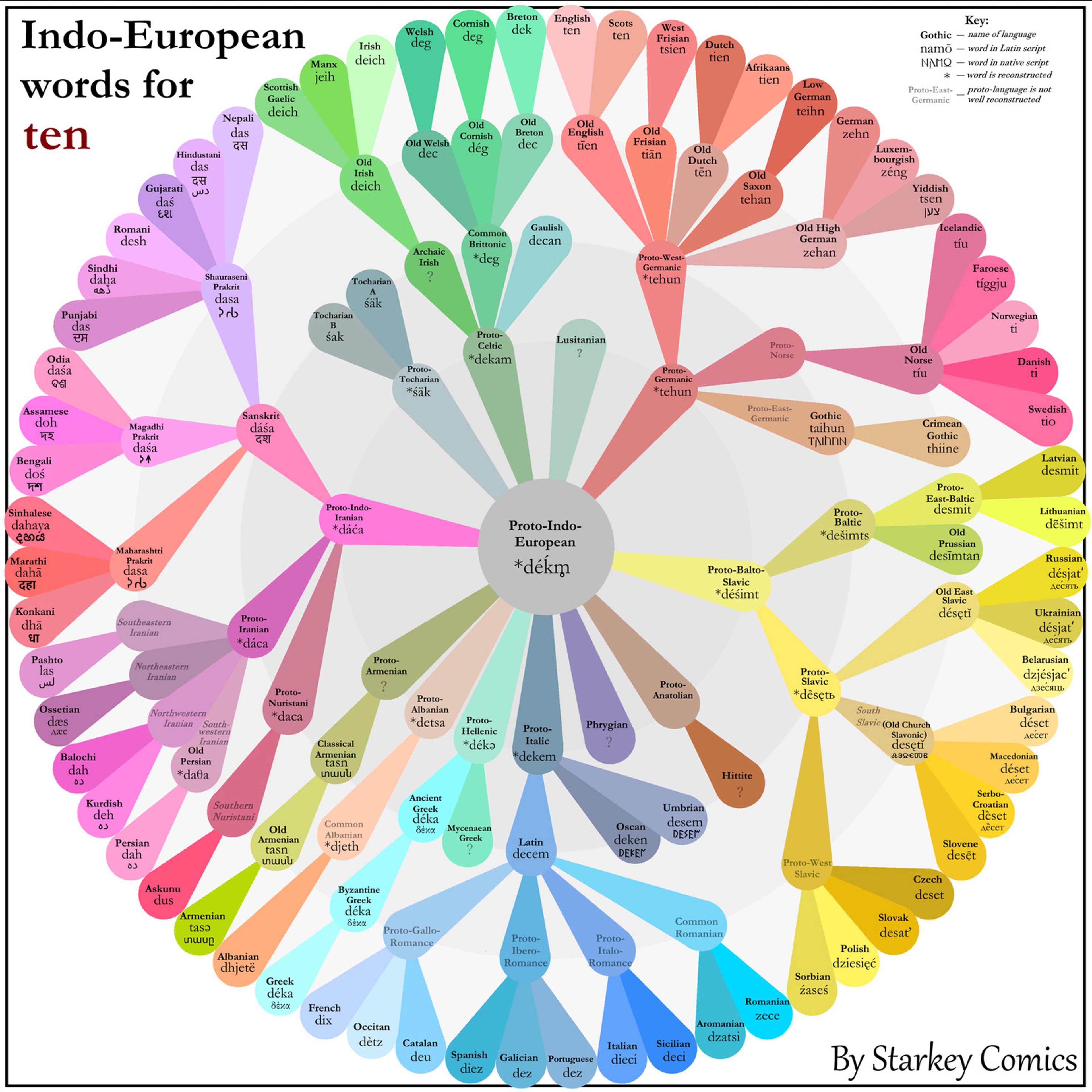
Indo-European words for 10. Courtesy Starkey Comics and larger version HERE
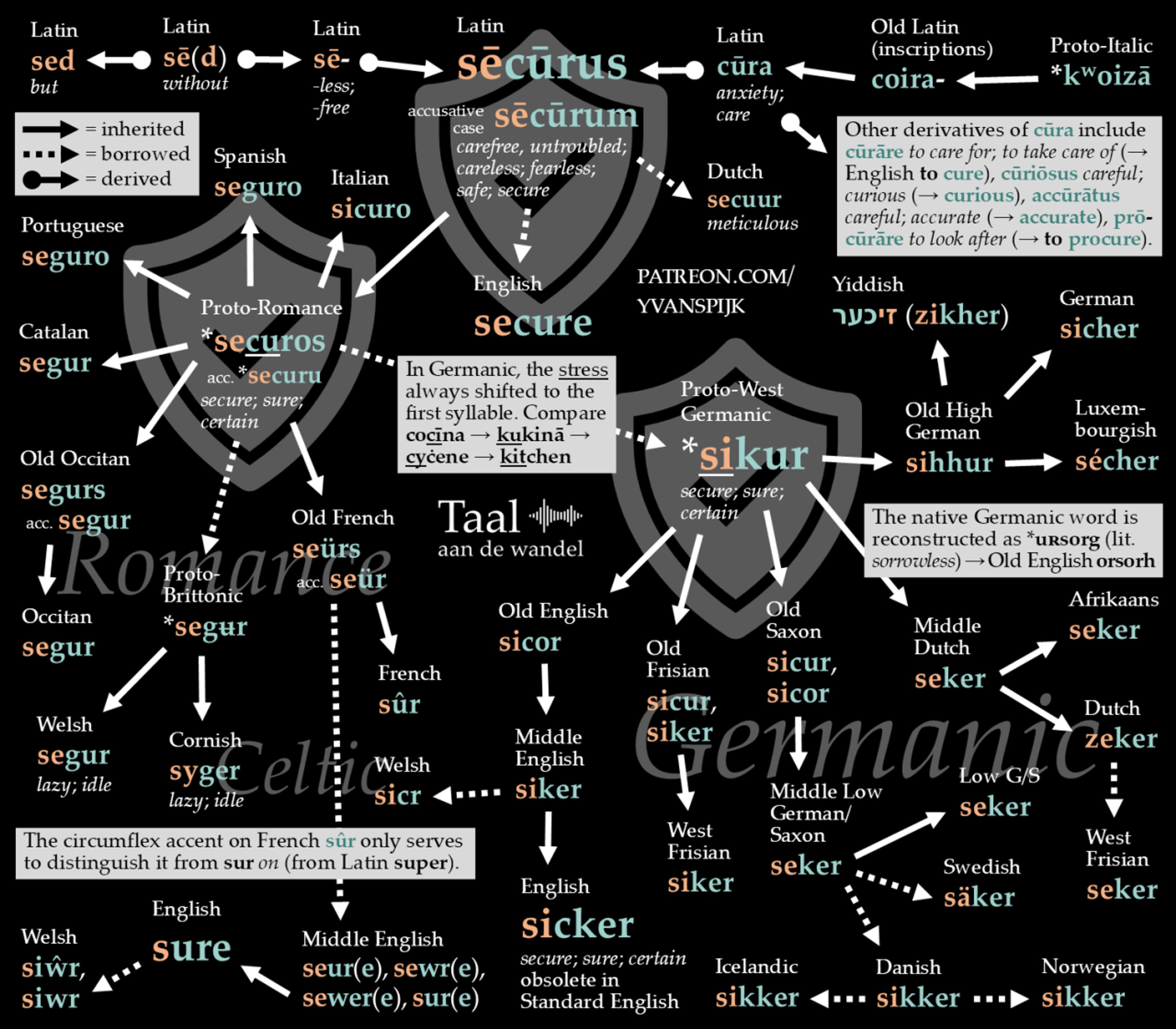
Etymology of ‘secure’. Courtesy Yoïn van Spijk and larger version HERE
Roots are one of the ways that some websites (like Etymonline) and books (eg, The American Heritage Dictionary of Indo-European Roots) organise their entries, and they are an unbeatable source of etymological epiphanies. In time, you’ll have encountered the same roots so often that you’ll develop an etymologist’s intuition for them. What’s more, when you can’t identify a familiar root, you’ll have a sense that a word’s history is going to be unusual. I’ll leave it to you to find out why preposterous and reciprocal are interesting for this very reason.
Take up and read
Fortunately for the etymologist, the English language has a long historical record, with sources that have survived centuries to reach us in the present day. If you have the time, pick up an older example of English writing – a novel, a poem, a play, a journal – and pay attention not only to the content but also to the words used to express it.
It doesn’t even need to be a particularly old text; something from 70 years ago can use words and spelling in ways that are both archaic and etymologically illuminating. Writers until a few decades ago often spelled tomorrow and goodbye with a hyphen, as to-morrow and good-bye. This division was a product of the words’ origins as phrases, literally meaning ‘on the morning’ and ‘God be (with you)’.
The further back you go, the more interesting differences you will spot. Shakespeare in the 16th and 17th centuries is particularly good for this, being someone whose English is still mostly understandable to modern readers. His language is a comfortable depth in which to immerse and train yourself, easier than braving the deep end of Beowulf and the Old English era. A favourite of mine is his ‘All the world’s a stage’ monologue from the play As You Like It. This philosophical contemplation of life, set amid a rambunctious comedy, contains words like hose that clearly meant something different for Shakespeare than for us – eg, an item of legwear, not a tube for watering the garden. Search the word in an etymological dictionary and you’ll see that the ‘legwear’ sense of hose is the older one (it also appears in German: Hose, for ‘trousers’), while the ‘watering tube’ sense is a later but successful development.
Know your donors
Knowledge of history both benefits and is benefitted by knowledge of etymology. If you consider the history of people speaking a language, you’ll build up an intuition for where the language could have acquired its words from. The major donors of vocabulary to English are unsurprisingly languages spoken in the European neighbourhood of the island of Great Britain, where English for centuries developed. French and its close sister languages are the big hitters. If you turn to your etymological dictionary and look up words from the first two sentences of this paragraph alone (history, benefit, etymology, consider, people, language, intuition and acquire), you’ll see the lexical debt that English owes the medieval dialects of France.
More recently, English speakers conquered and settled in a lot of the world, opening the door to influences from more languages. British rule over India, for example, saw Brits adopt plenty of words from Hindi-Urdu and Persian. The colonising of North America by English speakers has brought words from Native American languages into English too. As a very general rule: the closer a language lies to Britain or large populations of English speakers, the more words it has given to English. That said, prestige and power also play a part. Latin and Greek have been culturally weighty languages throughout European history. Consequently, the two have drenched English in vocabulary, despite the distance between their sources and Britain.
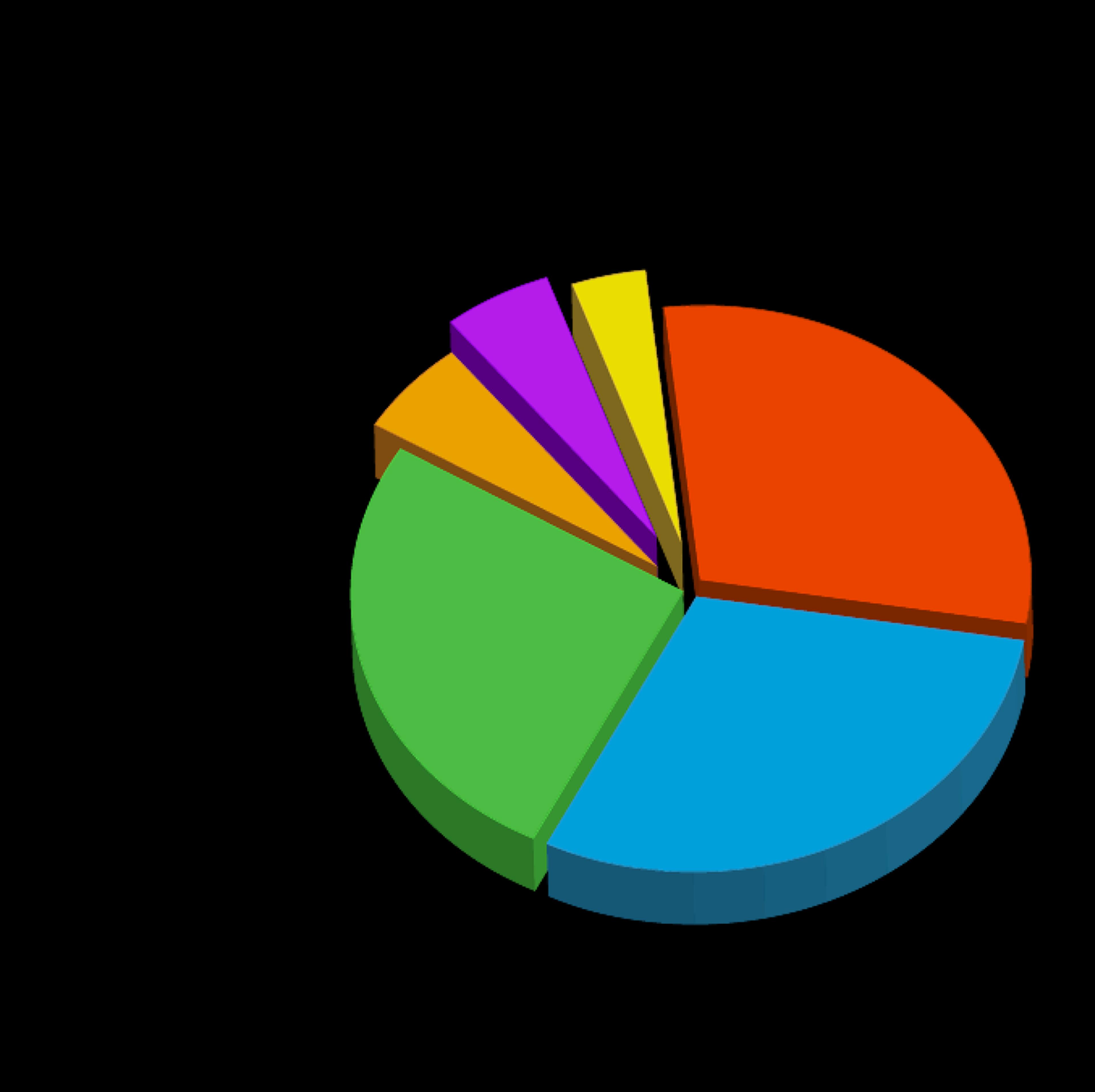
Origins of English. Courtesy Wikipedia
You don’t have to reach for the history books to identify donors; words carry signatures. Many ingredients of the English lexicon display telltale combinations of sounds or letters that indicate their origin. For example, the letter Y, when used as a single vowel, is typical of words of Greek origin: oxygen, crystal, hypothetical, cycle, and typical too. The modern device of the microphone is made up of two Greek elements, meaning ‘small’ and ‘sound’ respectively. Phone has a PH spelling (for a F-sound) which is another signature of Greek origin. It’s also present in photo, phrase, graphic, catastrophe and many more.
Sometimes these signatures speak not only to the language of origin, but also to a particular historical era of that language. English has heaps of words spelled with CH that come from French: chair, champion, chase, chief, chalet, chauffeur, chef and moustache. But the CH in the first half of this list sounds different from the CH in the second half. This is because the initial four derive from medieval French, while the final four were adopted from French in the modern era. Chef is in fact a repeated acquisition, taken the first time from Old French as chief. Since then, the word has shifted in sound and been applied to culinary contexts. A chef remains for the French the chief or boss of any workplace, not just professional kitchens.
Oh – and if CH stands for a hard K-sound (chronic, chorus, school, stomach), the diagnosis is a Greek origin again. Words are calling out for you to notice where they come from!
Expect puzzles, dead ends and mystery
Finally, a quick word of warning: brace yourself for head-scratching conundrums and delightful mysteries. Because historical documents do not completely cover historical English, there are plenty of words that evade straightforward etymology. Sometimes, there are lively debates involving equally plausible theories. You must be alert to the implausible ones too; unsolved mysteries can invite far-fetched ideas.
Other times, we word detectives don’t have enough information to even start a debate. For instance, working with the few scraps available, it’s still a big puzzle where English ultimately got its trusty word dog from, and why dog then overtook hound in popularity. But if everything was solved and sewn up with a bow, what would be left for etymologists to investigate?
All of this is intended only to get you started out on your etymological journey. It’s the beginning, not the final word. Because it’s impossible to know everything about historical language (believe me, I’ve been trying my best), there is no one established route to follow. Instead, pick the words that interest you, and follow where they lead.
