


In August, I participated in a panel at Gen Con about the future of AI in gaming. The energy was tense and emotions ran high. One panelist even cried as he lamented the end of his career and the industry as he knew it. There were calls for banning large language models (LLMs), lynching the CEOs of the AI Labs, and claims that AI was just a “stochastic parrot” capable of ripping off ideas but not doing true creative work. If you make games, or anything creative for a living, it’s easy to see AI as a threat.
The question keeps coming up: Is AI coming for my job? And more importantly: What can I do to adapt to the future?
This article will share the answers to those questions and give you tips to be ready for the fast approaching future of creative work.
The first step to building a better future is to acknowledge the reality of today. AI is not going away, and it is immensely capable across a wide range of domains. According to a recent Stanford study, 88% of organizations are using AI and the number is growing.
If you haven’t spent at least 8 to 10 hours using agentic AI to solve real problems in the last three months, you probably don’t understand how quickly it’s advancing or how capable it has become across a massive range of tasks, even though there are still plenty of things it does poorly. Agentic AI means you are asking it to do real work for you, not just talking to a chatbot.
AI can do amazing things that empower you as a creator. The same task that might take a team of engineers months to complete can now be done in days with limited human supervision. Three years ago, AI could barely do basic math problems. Today, it is solving frontier math challenges that have frustrated the best human minds for decades. In 2023 an AI generated video of Will Smith eating spaghetti was a hilarious and disturbing meme, and today a single prompt can generate movie quality synched audio and video. AI can now pass the bar exam and diagnose complex diseases better than most doctors.
Even if AI doesn’t get any smarter than it is today, it will have a massively disruptive effect on our economy as it’s usage becomes more distributed and we learn how to integrate it into our work. It’s also important to understand that there is no sign of AI slowing down. In fact, according to all the frontier labs, the rate of growth is only increasing.
Today, AI is mediocre at writing and terrible at game design, but there is no reason to believe it won’t get good at those things too. Despite popular myths to the contrary, AI is creative. I worked with the Wharton School of business and Ethan Mollick to build the Breakthrough Game, a game designed to improve creativity. We divided each aspect of creativity into sections and used a gamified system to help teams at Fortune 500 companies and startups around the globe be more creative. Creativity can be assessed by independent judges who evaluate the originality, feasibility, and potential impact of ideas. In a blind study where ideas generated by AI are compared with those from humans, judges find AI to be more creative than 85%+ of humans, though their ideas do tend to cluster around similar themes.
In general, it is safe to assume that if it can be done in front of a computer, an AI will be able to do it better than almost everyone within the next 5-10 years (likely sooner).
So, what do we do? What can a human who wants to live a creative and fulfilling career in the digital realm do?
There are four steps:
-
Stay Weird
-
Stay Connected
-
Make Things
-
Build Context
Let’s dig in.
If AI is powerful at doing things, then the ability to decide what it should do becomes critical. Good judgment about what to work on, what problems are worth solving, and what should be created is enormously valuable and will remain so, even as AI gets better at those things too. AI can innovate and ideate, but what it can’t do is be you.
Each of us has a unique set of lived experiences and idiosyncrasies that make us who we are. AI will tend to move towards the average of its training set, but it can’t move towards the unique creativity you have to offer. Others call this skill “taste” or “judgement” but I prefer to call it “your voice.”
Your voice is something you discover at first by intelligently consuming art you like, art you hate, and distilling what makes things good or bad to you. Then you refine your voice by creating things and putting them out into the world, making things that embarrass you at first and iterating until you find themes that combine the different parts of your psyche and taste into something unique that will also appeal to others.
As AI evolves, your ability to create and test ideas will increase. The cost to produce will go down, so you can create increasingly weird and niche work that connects with an audience that loves your particular kind of weird. Spend time refining your taste and your voice and you will be able to create things AI would never dare to dream of.
We will always want to have a connection to other humans. Creative work is valuable not just for its quality as a product, but for the connection it gives you to the creator. We pay more for an original art piece than for a replica, because the original brings us closer to the creator and thus has higher scarcity and value. Industrialization gave us mass manufactured goods that are cheaper and (in many cases) higher quality than hand crafted goods. Still, we pay more for hand crafted goods because we care about the hands that did the crafting.
We all have a responsibility to be transparent about where we use AI and where we don’t to give our audiences a chance to connect with us and know where the human element contributed to the final result. As a creator, you should talk to your audience and share your process. Be transparent about your experiments and your failures. Build in public and add value to others who want to follow in your footsteps. In this way you can build trust with an audience who will want to support you in your work even if cheaper and “higher quality” work gets generated by an AI. Even more importantly, building this real connection with people will make your work more rewarding and create a positive feedback loop to help you improve.
Everything that used to be a barrier to you creating things is going to disappear. Already, I’ve felt this in my own work. I don’t know how to code, but I’ve managed dozens of engineers and spent millions of dollars building digital games. For years, I wanted to learn programming because I wanted to be a better leader and better understand the “black magic” behind the software we were building.
The problem was that the mountain always seemed too steep. I signed up for countless “learn to code” courses, started them with good intentions, and never made it far enough to build anything useful.
Now everything has changed. In the last six weeks I have built a game-prototyping tool my team had wanted for over a decade, a landing page and companion app for my book, a short-form video role-playing game prototype, an automated project management tool that updates me every week on project status, and a dashboard that pulls my company’s critical financials from our actual data for review each week.
I am, by any practical definition, a full-stack engineer who cannot write code. How? Did I learn some magic prompt? Discover a secret technique?
No. I just started talking to Claude Code and went step-by-step. When things didn’t look right, I asked for bug fixes or shared screen shots and iterated. Sometimes things break and ugly bugs show up, but that was the case with our human engineers as well. The only difference now is I can fix these bugs myself in minutes instead of waiting weeks for the backlog of tasks to move up the priority ladder and get scoped, built and tested.
Building with AI today feels like playing a video game where, instead of earning XP and fake achievements, you end up with something real at the end. I barely play games anymore, now I just build.
You may not care about coding or game design, but my advice is to just pick one small thing that is exciting to you that you want to bring to life, or one annoying thing that you would love to automate or eliminate. Commit to 8 hours of experimenting and you will be shocked at the result. If you don’t know where to start, start a conversation with Claude or ChatGPT and have it interview you to help generate good ideas. This process will include frustrating moments as you hit the boundaries of what AI is not (currently) good at, but it will yield invaluable practical results and knowledge.
Over time, as I’ve worked with these tools, the feeling has transformed from “neat toy” into “I feel like a cyborg.”
You’ve had a sense of this if you use a smartphone. I outsource a lot of my thinking to my smartphone. It reminds me of calendar events, maps my way to destinations, and helps me find good restaurants nearby. AI tools let you extend this to your entire history of information.
I keep a “second brain” stored in a single folder of notes on my computer. Every decision my company makes, every progress update, plus years of personal stuff: book notes, seminar notes, annual reviews, the works. It lives as a pile of md files in my Dropbox so it syncs everywhere, and the AI reads it, cross-links it, and keeps it current.
I use Obsidian to manage it, mostly because Obsidian speaks the same native file format the AI does, so they play nicely together. The first time I opened the graph view (a little map showing how every note connects to every other note) I genuinely got chills. It’s a picture of my brain. A map of everything I’ve ever learned, and you can see how it all connects.
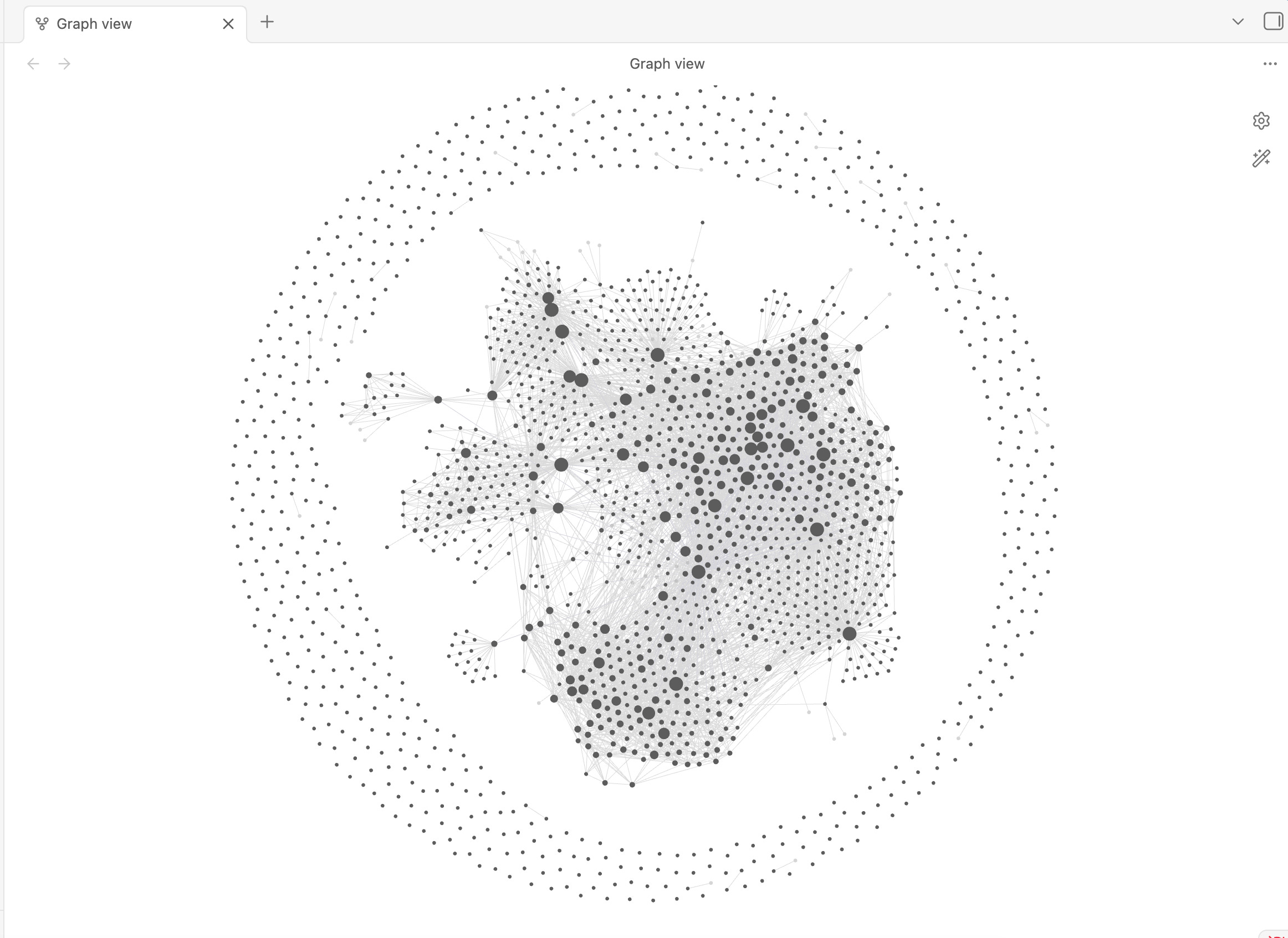
The reason this matters for you: the AI is only as good as the context you give it. A second brain means you’re never starting from zero. It already knows your business, your projects, your history. This context helps push the AI to support my particular taste and to recall the lessons I’ve learned (and often had to relearn). I even had the AI improve the folder structure for me and then gave it feedback until it was right. This living in a folder on your own drive also has the advantage that the information is yours, not stored in the AI, so if you want to stop using a particular program, or start using another one, you don’t lose the context you’ve built up.
I’ve been excited about the possibilities of AI for over two years, but something shifted in the last few months. I can taste the future now, and there’s no question this stuff is going to touch everything.
The thing that surprised me is that I’m not afraid of it taking my work. The opposite has happened: the more it does for me, the more I want to do. I have hired more people to run more tasks because each person is more effective at their job and I am capable of managing more projects.
So, when people ask if AI is going to take the jobs in our industry, my honest belief is: no.
Human desire and creativity is infinite. The more we are capable of creating, the more we will create. Some work will change, some jobs will disappear, but new opportunities will more than replace them. With these tools, the creative, the strategic, and the human parts are achievable with less time and more opportunity than ever before. Your job isn’t to compete with the machine. It’s to use the tools available to make the best thing you can. My goal with AI is simple: to make myself 10x more effective at the things I love to do and the things only I can do.
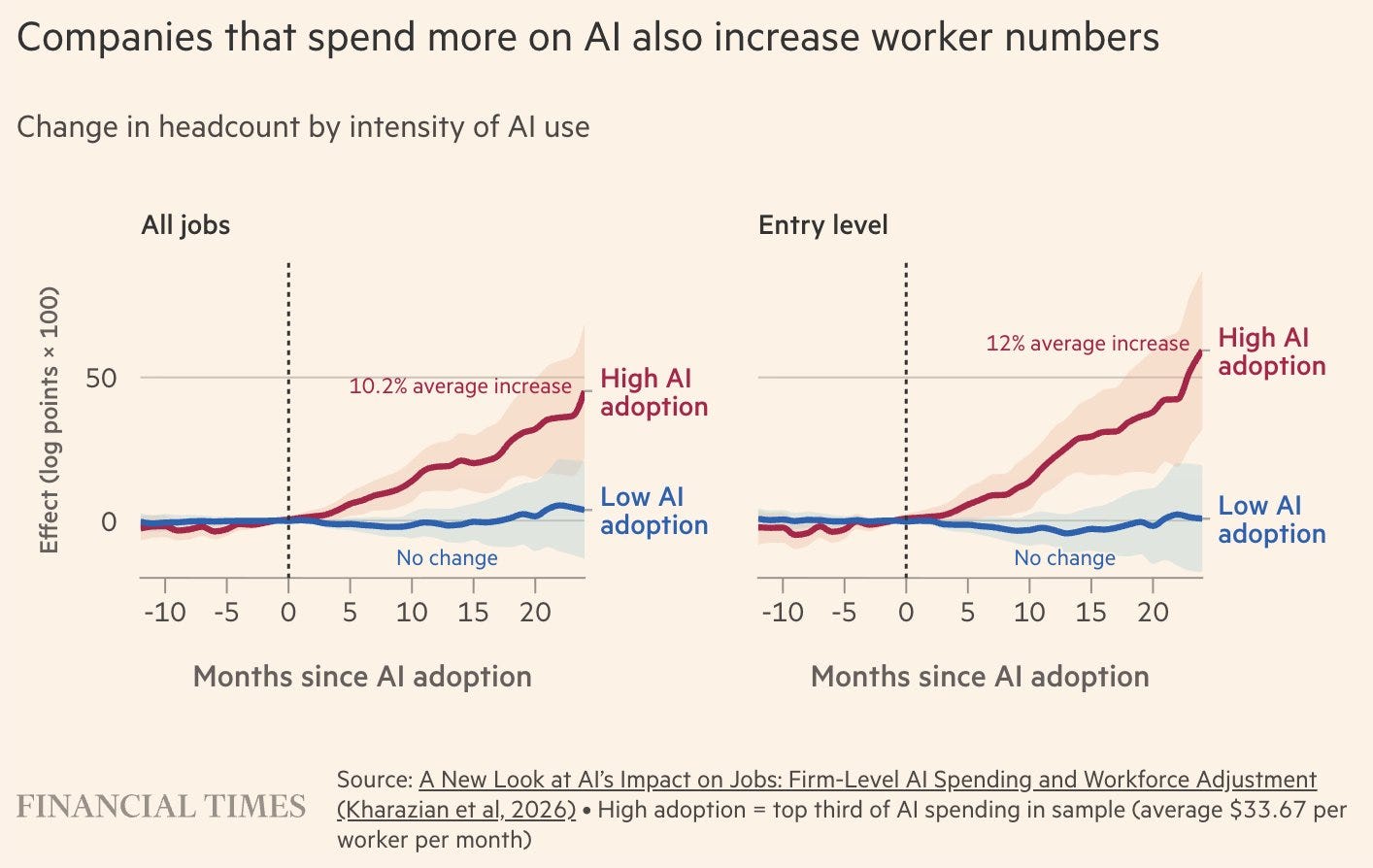
This isn’t just wishful thinking. The data supports this claim.
Looking at the data so far, AI has been associated with job growth, not job loss. Companies that embrace AI are often more likely to hire than those that don’t.
That’s certainly been my experience. By using AI to accelerate the parts of my work that don’t require my unique expertise, I’ve been able to take on more ambitious creative projects and as a result, hire more artists, designers, and engineers to help bring those ideas to life. I have more humans making more and better games because AI takes things off our plate that we don’t want to do and speeds up the things we do want to do.
As someone who has spent the last decade teaching others how to be creative and how to navigate the challenges of making something and selling it to others, I can confidently say now is a great time to be a creator!
This is a lot, and it can feel overwhelming. Still, I encourage you to take a playful mindset with these tools because you can’t really understand them until you’ve spent about 10 hours building something real. You don’t need to know code. You don’t need to be technical. You need one small fun thing you want to build, the willingness to look a little dumb while it breaks and you fix it, and the habit of asking the question of how to fix it and going through the steps instead of assuming you can’t. Follow your curiosity and connect to a tribe of fellow weirdos who love what you do.
So go install Claude or whatever tool you prefer. Then pick one fun, bite-sized project and build it.
It is easy to let fear and uncertainty take over. For now, let those feelings go and treat building with AI as a game. Creating things is fun. Go play.
