


Support CleanTechnica’s work through a Substack subscription or on Stripe.
Sometime around 1989 or the early 1990s, Carlo Rubbia, the Director-General of CERN, put together a special working group with instructions to design a way to generate electricity using radioactive materials that would be different from anything that had come before. The method had to do its work without producing any products that could be used to make nuclear bombs. In fact, it was to produce very little or no nuclear waste, and no long-term nuclear waste. And it had to be cheap enough to be practical at scale.
I had a friend who was a group leader at CERN at the time. According Steve, the project resulted in a design that was tested in every way it could be, short of actually building it. The conclusion was that it would clearly work. Since that time, I have got old, and Steve has passed on. But he took the project up for a while, and I co-authored white papers on the subject, a job for which I had to familiarize myself with the subject.
The process transmutes radioactive substances into what is mostly inert waste. Of course, that is a nuclear reaction, and it has to be done in a type of nuclear reactor. But it is very different from any reactor we have today. For one thing, it never has anything in it that is even close to critical mass.
In the old days, the reactor was called an “Energy Amplifier” because it used energy input to generate an output that is a multiple of the power. In time, the name was changed to “Accelerator Driven System” (ADS), possibly to be clearer about what it was doing.
The reactor was to be a big tank holding about 7,000 tons of melted lead with radioactive materials dissolved in it. Those materials could be thorium, unenriched uranium, or even nuclear waste. Also, the medium did not have to be lead, as a number of liquid heavy metals could be used. Mercury is one such element, and it has the advantage of being liquid at room temperature.
A particle accelerator drives protons to a high enough velocity to produce spallation when they strike radioactive atoms. These protons collide with lead atoms, mercury atoms, or whatever, causing a cascade of neutrons to break free. These bounce around from one atom to the next, losing energy in each bounce, until they hit a radioactive atom at just the right energy to cause it to break apart. When that happens, energy is released.
The radioactive atom might be any isotope of uranium, or thorium, or a wide variety of other things. The atom might be strontium-90, which is a serious radioactive toxin to human beings. In the ADS, this decays into yttrium-90, which is even more radioactive, but when that decays, which it does rather quickly, it becomes zirconium-90, and that is stable.
According to Steve, most of the material that decays in the ADS reactor winds up being lead-207, which is not radioactive. And when the waste is removed from the reactor and put into storage, it will be “about as radioactive as coal ash” in 300 years.
We are told that spent fuel from nuclear reactors has to be guarded for about 100,000 years. But with the ADS, we may have a choice to transmute it and wait for about 300 years, 50 years longer than the US has existed, or to leave it under guard for a period about twenty times as long as human history.
One thing that I did in those days was a back-of-an-envelope calculation of the amount of energy that could be derived from nuclear waste. I based my calculations on the Vermont Yankee plant, because that was close by and well known to me. In such a plant, something on the order of 2% to 3% of the nuclear fuel is actually used up. That leaves 97% to 98% of the original fuel unused, and this can be used by the ADS. We might guess that the spent fuel at Vermont Yankee could power an ADS that produces as much electricity as Vermont Yankee did for a time in excess of 500 years. Without reviewing my calculations in detail, Steve said he believed that sounded right. We might be wrong, of course, but he noted that the ADS is not an excuse to continue the use of conventional nuclear energy, which produces nuclear waste faster than an ADS can use it. And accelerator driven systems might even make conventional nuclear power obsolete.
Steve did point out that there was at least one thing hanging up construction of a plant. That was the need for a better particle accelerator. He said he believed that a circular accelerator about 10 meters across could do the job, but it would be expensive. He thought a straight, in-line accelerator would be better, but no one had ever built such a thing to be sufficiently power. Perhaps, in time, that would happen.
And now, it seems, it actually has just happened.
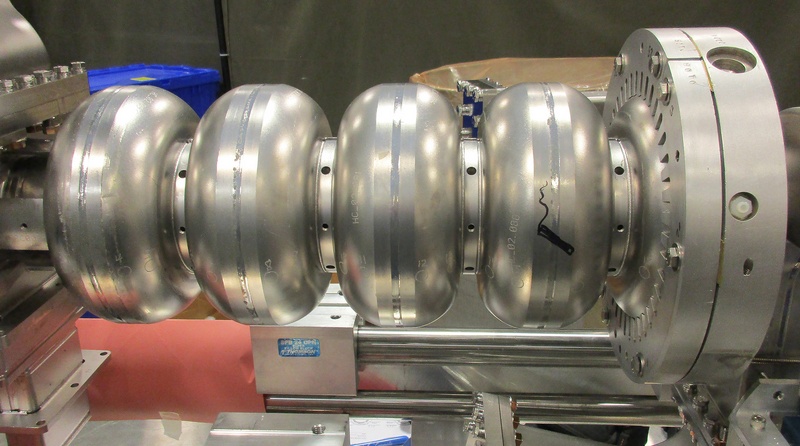
Jefferson Lab, a US Department of Energy laboratory in Virginia, recently announced in a press release that its scientists had developed a particle accelerator specifically for the purpose of building accelerator driven systems. The announcement says it is now testing niobium-tin cavities in a particle accelerator to make the system more efficient.
I am generally opposed to use of nuclear power to generate grid electricity for a number of reasons. But this is one reactor I believe I could be in favor of.
Sign up for CleanTechnica’s Weekly Substack for Zach and Scott’s in-depth analyses and high level summaries, sign up for our daily newsletter, and follow us on Google News!
Have a tip for CleanTechnica? Want to advertise? Want to suggest a guest for our CleanTech Talk podcast? Contact us here.
Sign up for our daily newsletter for 15 new cleantech stories a day. Or sign up for our weekly one on top stories of the week if daily is too frequent.
CleanTechnica uses affiliate links. See our policy here.
CleanTechnica’s Comment Policy
