


I swear I’m not trying to burn Spotify to the ground.
I look at Spotify as a representation of what’s going on in the music industry because it’s the biggest music company in the world. Ipso facto — the problems with Spotify are the problems with the music industry. I’ve been spending a lot of time lately picking the industry apart, piecing it back together, and trying to figure out why everyone says it’s broken when the data says the opposite.
Music revenues were up 6.4% last year, marking its eleventh consecutive year of growth. The industry has doubled since 2014 and there are now 837 million people paying for streaming subscriptions around the world.
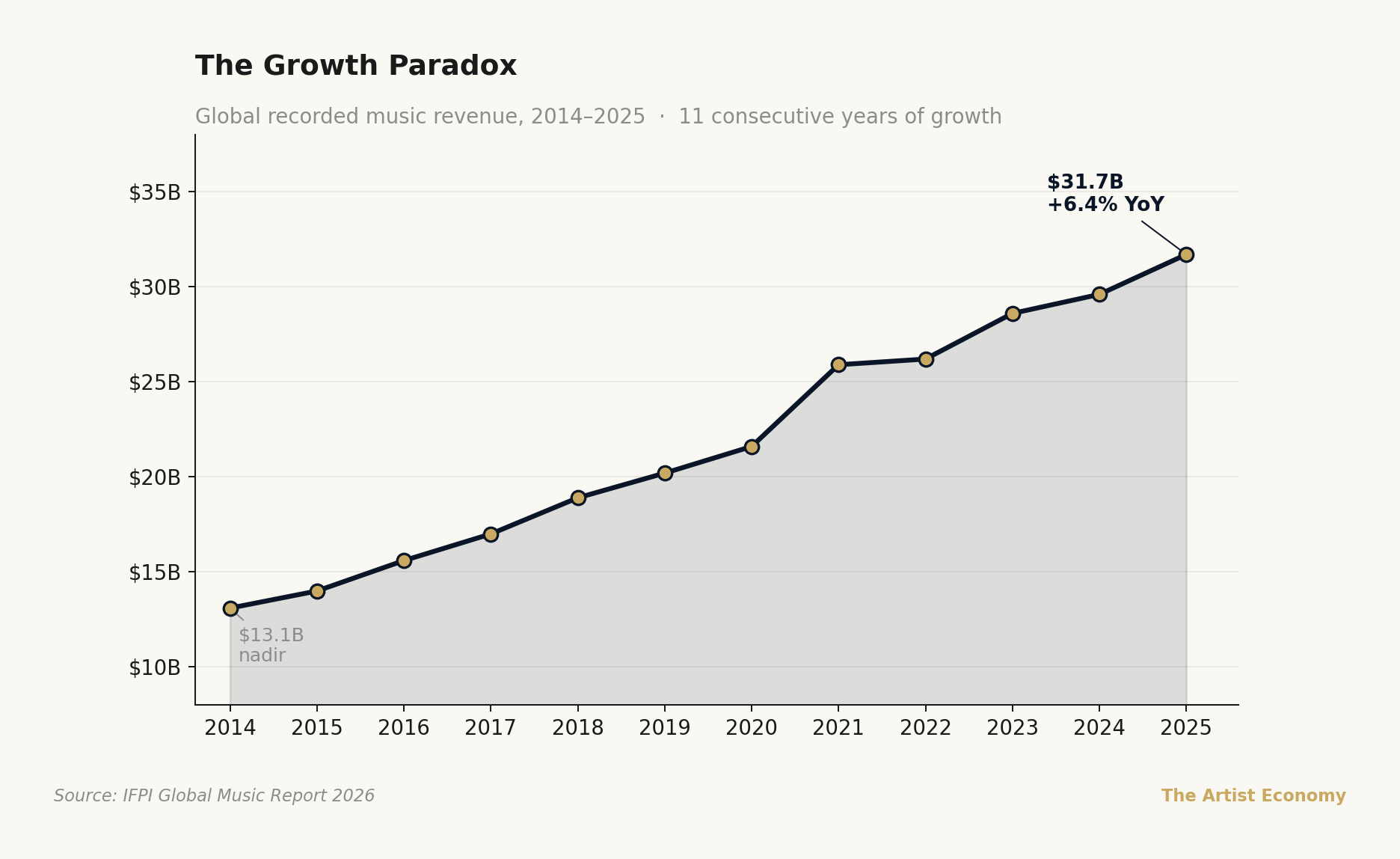
So why does it feel like everyone hates it?
As I lie in bed staring at the ceiling, composing this in my head before it lands in the iOS memo pad, I keep cycling through the same suspects. Is it the gatekeeping of data? Is it the over-investment in AI alongside the slashing of staff advocating deeply for artist-forward features? Is it the CEO funnelling hundreds of millions into AI military drones while running a platform built on a customer base that’s been culturally anti-war since Vietnam?
Or is it the platform itself? The economics that pay artists fractions of a cent. The data held behind a moat of hidden APIs that prevent any creative team from pulling fan information in a useful way.
Quick note before I keep going: Jacopo Romei recently made the sharpest counter to this whole framing that the music market isn’t broken at all. It just got bigger from the bottom, and the loudest complaints are coming from people who, in the old system, wouldn’t have existed as professional artists at all. He’s right about that- but the platform that the entire market runs on didn’t update to handle it.
The platform is the part I can actually redesign on paper, and I thought of a few solutions.
If I were nuking Spotify and rebuilding it from the ground up, the first thing I’d require is human-identity verification before you can upload a song to the platform. It’s not super hard or groundbreaking tech — you can’t open a brokerage account without it. The financial industry calls it KYC (Know Your Customer), the writing is on the wall.
If DSPs integrated a verification model using a third-party platform, we’d no longer have to worry about an influx of AI slop flooding the royalty pool. The 60,000 fully AI-generated tracks that are uploaded every day wouldn’t exist. Craziest stat I’ve seen about this epidemic are that 85% of all streams on AI-generated music is fraudulent (via Deezer). Luminate reports that the daily upload number of songs is 106,000 across all platforms with ~96.2% coming from indie and DIY distribution channels. Some of that is legitimate independent artisty, but a lot of it is industrial-scale royalty farming.
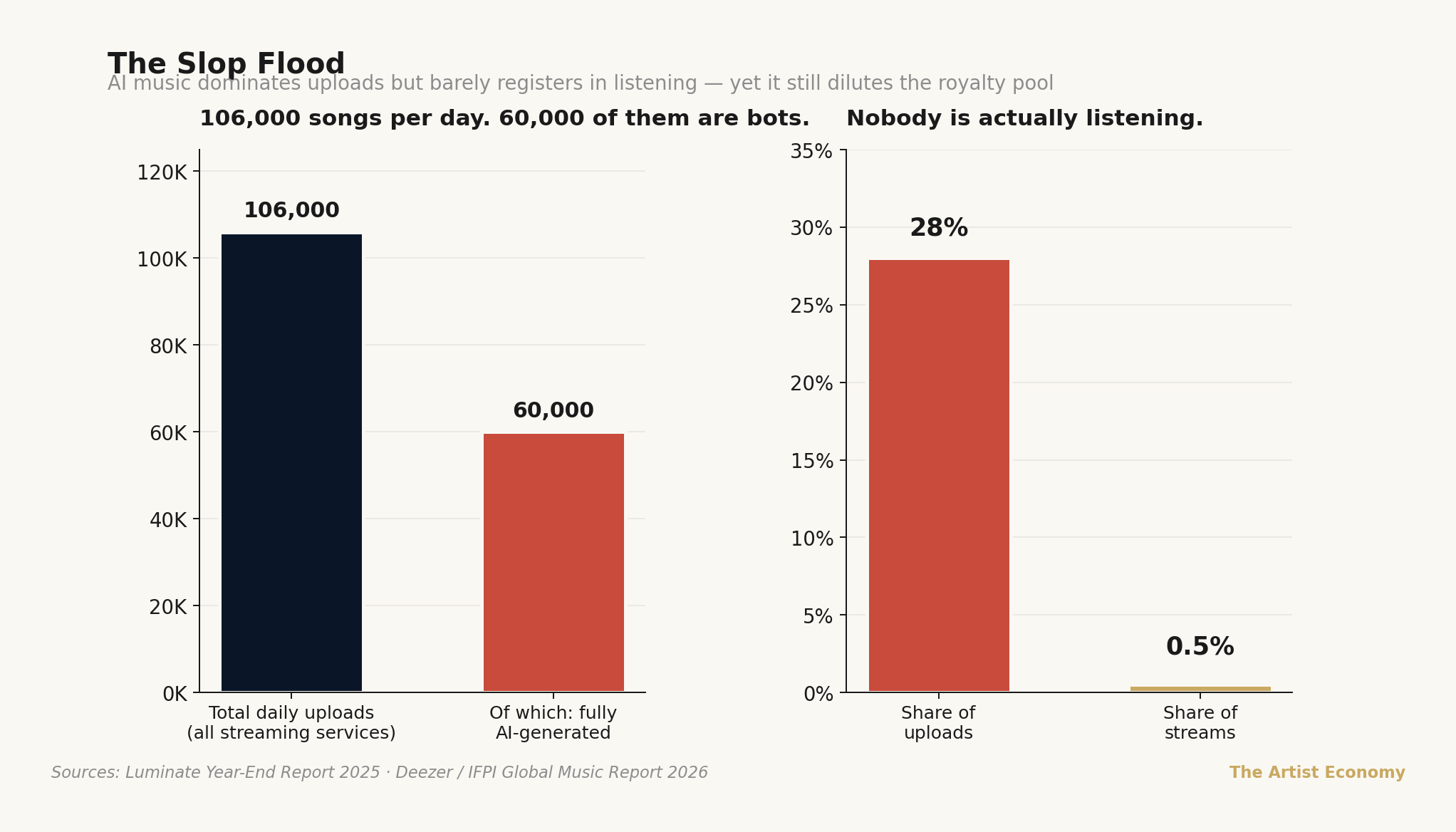
The kicker: on Deezer, fully AI-generated music makes up 28% of uploads but only 0.5% of streams. Nobody’s actually listening. But the songs sit in the royalty pool anyway, diluting the per-stream payout for every artist who built a real audience.
I get why Spotify won’t move on this. Spotify is a tech company in the music space, not a music company using tech. What better way to keep royalty flow in-house than to algorithmically seed its own AI-friendly catalog into the playlists humans built? They’re optimizing for shareholders, not for the preservation of culture. Simple KYC at the upload door wouldn’t entirely kill AI music, but it would make sure that you have to sign your name to attach to it.
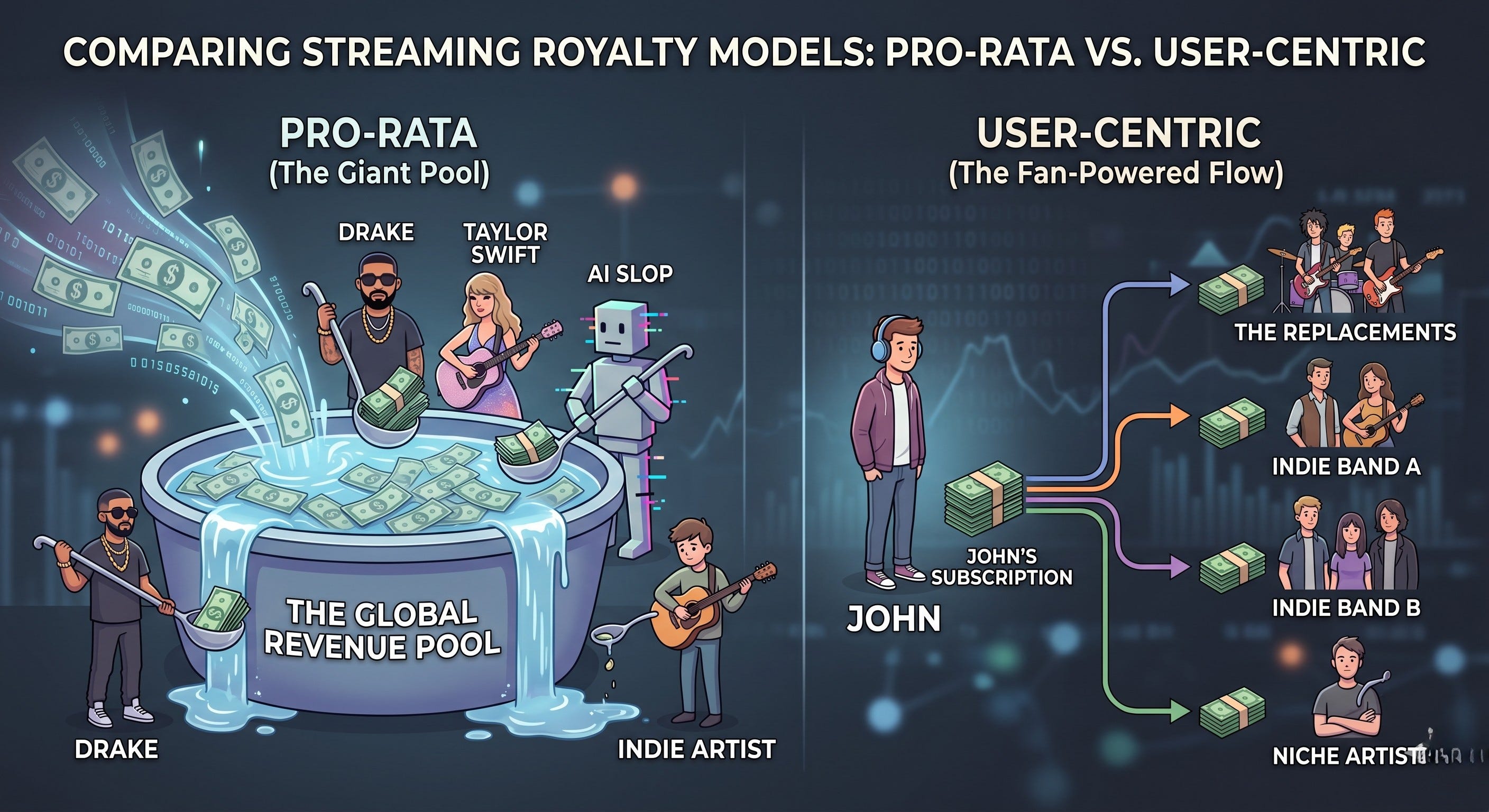
Huge one: the current royalty payout model is called “Pro-Rata.” Every subscription payment is dumped into a single pool, then split based on each artist’s share of total platform streams. The math means that John from Wisconsin’s $11.99, even if he only listens to The Replacements all month, gets paid out proportionally to Taylor Swift, Drake, and a Suno-generated lo-fi loop being streamed in a Berlin coffee shop.
Replace it with user-centric payments, sometimes called fan-powered royalties. John’s $11.99 goes only to the artists John actually listens to.
The positive economic effects driven by this change are easy to prove. A 2021 study from France’s Centre National de la Musique (CNM), using actual Deezer and Spotify data, found that switching to user-centric would shrink the Top 10 artists’ payouts on Deezer by 17.2% and on Spotify by 12.5%. A 2023 SoundCloud study covering 50,300 indie artists and 1.5 million listeners found that roughly 1 in 5 indie artists would see their royalty income double under fan-powered payments.
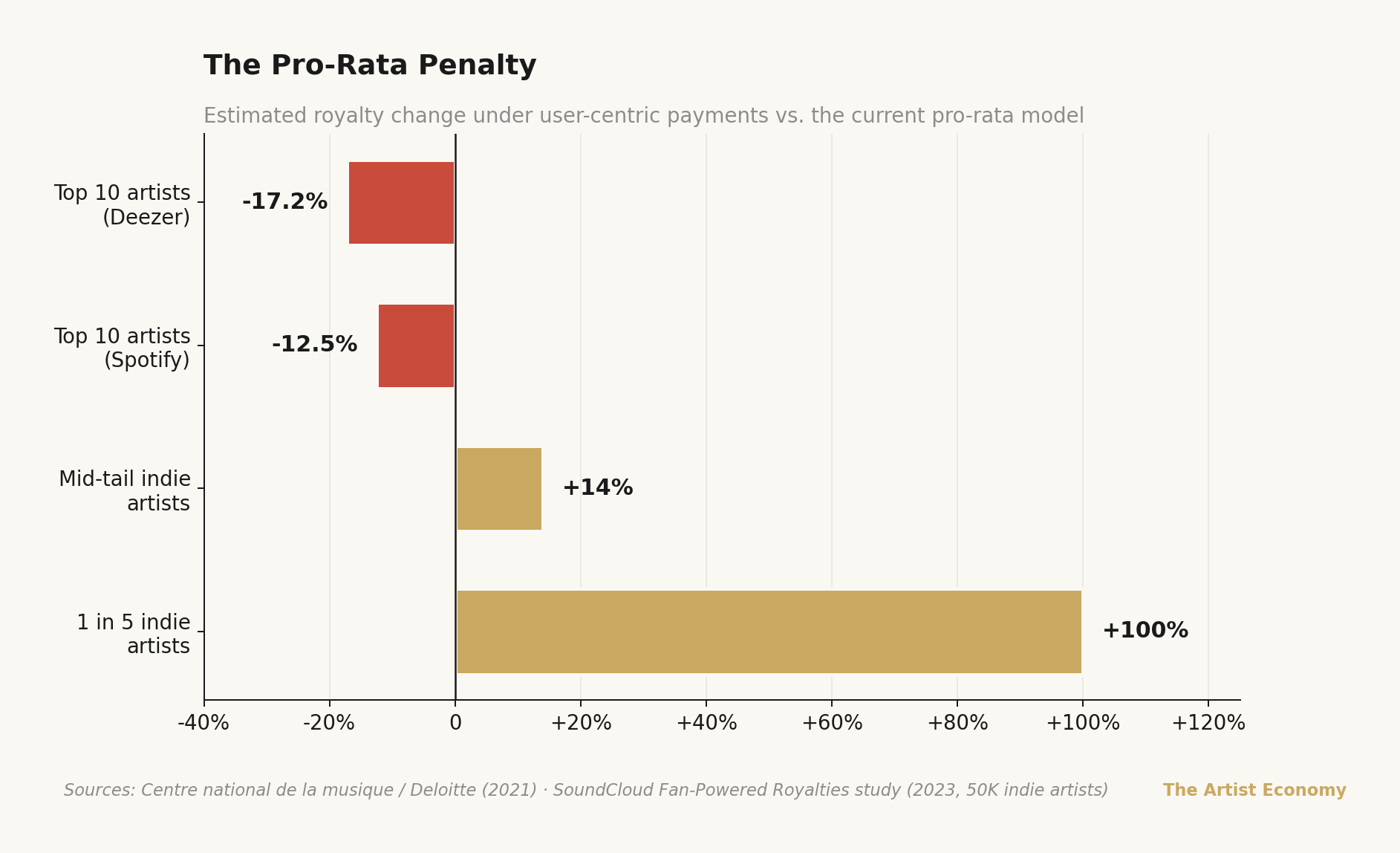
SoundCloud has been doing this for five years now, and it works. It also explains why the major labels keep quietly defending pro-rata while publicly endorsing the more vague “artist-centric” model. Pro-rata is a regressive tax that subsidizes the catalog they already own at the expense of the long tail.
Right now, Spotify treats every artist’s catalog as a single undifferentiated firehose. Free or paid listener — same content, same access.
Why not steal the Substack model? Let the catalog stay free if the artist wants. But give artists the option to gate specific releases, demos, alternate versions, early drops, or commentary tracks behind a paid subscription tier. Value delivered, value received. An energy exchange between the artist and the fan.
If Spotify rolled this out tomorrow, a large chunk of the superfan-platform categories that are making money off the platform would lose a lot of their weight overnight. The DSPs already own the relationship with the listener. The only reason artists are bolting on third-party tools is because the platform refuses to build the obvious feature. Artists would adopt this tool on day one along with the operators advising them.
Why isn’t Spotify using the data that we drool and boast about in December of each year with “Wrapped” and integrating group chats and online communities around it. The data is just collecting dust the other 364 days of the year. Spotify already knows I listened to Mac Miller for 31,411 minutes over the last twelve years. What it doesn’t do is connect me to the other people who did.
Build it. Group chats, forums, live discussion threads — gated by listening data. If you’re in the top 2% of War on Drugs fans, you get into the room with the other top 2% of War on Drugs fans. I used to be in a Pink Floyd Facebook group where someone posted about The Wall every day for twelve years straight. The depths of that album that I’ve gone into and learned from that group is incredible. That’s a community that Spotify could have owned and didn’t.
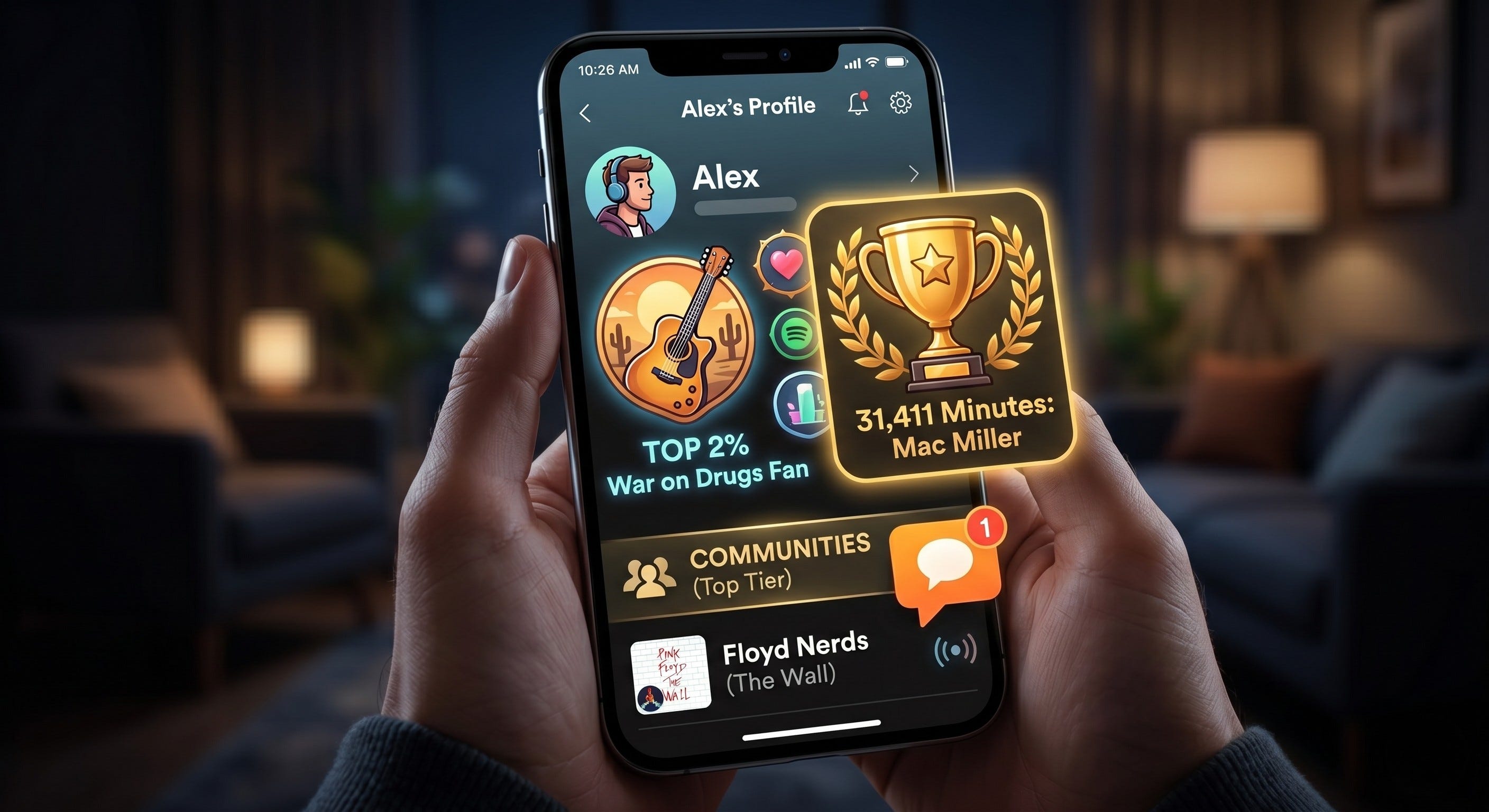
I’d go even further and add badges, achievements, and tokens to each Spotify profile. Add the “I’ve listened to Pet Sounds 400 times” flair you can pin to your profile. I poke around my friends’ Spotify profiles looking for new music all the time. Spotify has been sitting on the social layer of music for fifteen years and refuses to build it because they think they’re in the audio business. They’re actually in the fandom business and they just don’t know it yet.
This one I picked up from Shain Shapiro’s recent piece in Making Places Better. The mechanism: charge $1 per track at upload.
Run the math from the artist’s side. How many tracks is any working artist actually putting out per year? Ten, maybe fifteen. That’s a $10–$15 annual cost. The price of a cocktail. Functionally free.
Now run it from the spam side. An AI farm uploading 10,000 tracks a month is paying $120,000 a year for the privilege. An extinction-level event for the business model.
Shapiro takes the idea further and proposes pooling that revenue into regional music-ecosystem trusts: grants, studio space, infrastructure for the places where the music actually originates. That’s where he and I diverge. I don’t think the revenue is the point. The point is the friction at the door. A dollar isn’t funding anything meaningful at scale, and once you start designating where the money goes, you’ve imported a whole policy fight on top of an otherwise clean intervention.
Keep it surgical: $1 to upload. The KYC requirement from solution one handles the identity layer. The dollar handles the volume layer and eliminates the margins of the slop farms.
It’s the most boring of the five ideas and probably the most effective.
I wouldn’t fight the algorithm. The algorithm is fine. Discoverability has never been higher and that is genuinely Spotify’s gift to culture. I wouldn’t kill the free tier. The funnel from free to paid is the entire business. I wouldn’t try to compete with the majors. Spotify’s biggest shortcoming is that they’re failing the relationship that they have with the people making and consuming music, not that they have too much music. These solutions would solve most of those problems.
The thesis underneath all five of these is the same one I’ve been writing about for two years now. The streaming era was the great democratization. What it didn’t produce was a royalty model, a fan-monetization layer, or a community layer that actually distributes the democratized market to the people who built it.
The fix isn’t to burn Spotify down completely, let’s just build a Spotify that doesn’t need a class of operators, consultants, and superfan tools to compensate for its design flaws. That’s the platform I’d build.
If Spotify is reading…none of these ideas are proprietary. Take them all. Build the better version. Or don’t, and watch the operator class build it around you. I want artists to win, you should too.
