


By Olivia Snaije, Contributing Editor
Recycled shipping containers have been used for a multitude of functions, from simple or designer homes, to hotels, restaurants, emergency medical facilities, and schools. But this may be the most inspired use yet: Magic Box, a Mongolian NGO (non-governmental agency) has hatched a program to turn old shipping containers into a constellation of children’s libraries throughout rural Mongolia. And they now the program will catch on anywhere children need books, and a place to call their own.
The project traces its roots back to 2019, when Magic Box co-founder Tsolmon “Tom” Bayaraa opened a coffee business called Nitro B housed in old shipping containers in Ulaanbaatar, the Mongolian capital. Soon after opening, Tom said he noticed that a lot of children were coming into the café.

Tsolmon “Tom” Bayaraa (l.) and Oyunchimeg “Oyunaa” Bayarsaikhan.
“The kids asked me if they could do their homework in the café and tutor each other,” he says.
On paper, Mongolia has what UNESCO calls a remarkable literacy rate of nearly 99%. But there are structural problems in schools, and an overwhelming lack of books available for children in rural, or underprivileged areas. And Tom quickly realized that the nine and ten-year old kids coming to his café had no place where they could complete their homework or simply hang out.
In Mongolia’s public schools, there are usually three different levels of classes held in rotation in a single classroom, which means the classroom is always in use, he explains. Moreover, winters in Mongolia are notoriously cold.
Tom let the children stay in the café to do their schoolwork, and soon after began sketching out an idea for a children’s library, which, like his coffee business, could be built in a shipping container.
Later that year, Tom—who is also the CEO of Nepko Kids, the children’s imprint founded by his wife Oyunchimeg “Oyunaa” Bayarsaikhan, who serves as editor and is a former copyright manager for Nepko, Mongolia’s largest publisher—traveled to the Asia regional conference of the International Board on Books for Young People (IBBY) in China. There, a Japanese participant told him how, after the Hiroshima atomic bombing, people organized to provide children with food, clean water, and books.
The message, Tom says, was clear to him: “books are as important as food.”
‘I Want People to Copy Me’
This was the inspiration Tom needed. When he returned to Ulaanbaatar, he got in touch with a friend who ran an NGO. “We found sponsorship, collected money, then insulated a shipping container and bought tablets and books and computers and opened the first Magic Box.”
Then, they did something a little unusual: They submitted a tender. “Usually, it’s a government submitting a tender. But we did the opposite. I said whichever government province will take care of the upkeep of the Magic Box; I will give it to them. We received 72 applications. Many said they would pay for electricity and a librarian. I said, ‘that’s nice, but there is the upkeep too.’”
Tom and his team decided to give the first Magic Box to a remote province 1,400 kilometers from the capital near the Chinese border where there were 700 children.
Mongolia’s population is very young, Tom adds. Nearly half the population is under 25 years old.
 They drove through the Gobi Desert, across rivers and over rocks. When they arrived “the kids were so excited they started running after the truck and when we began to set up, we were surrounded by children,” Tom recalled. There is no internet and generators provide electricity. Tom didn’t think the children would want to read but they did. In fact, he says, they were hungry for books.
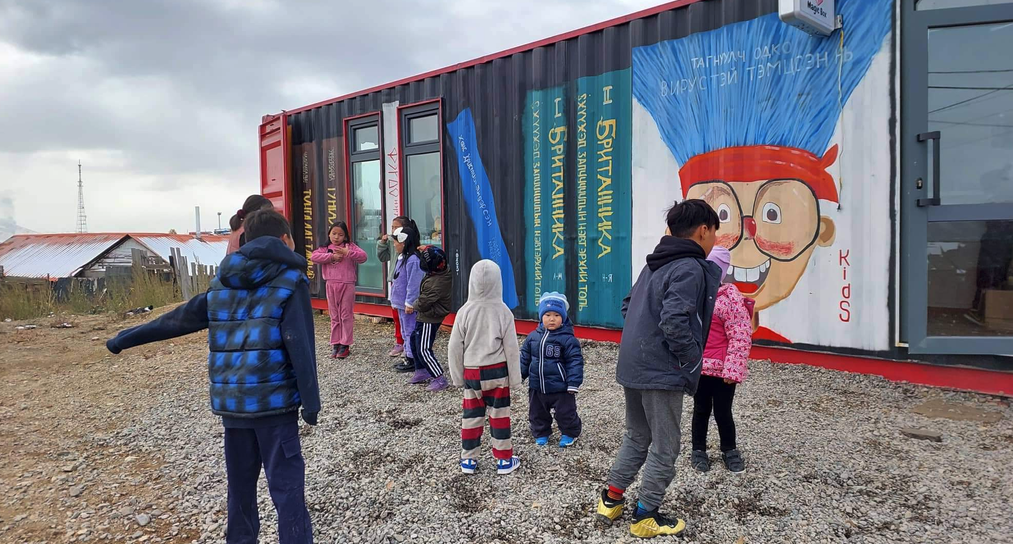
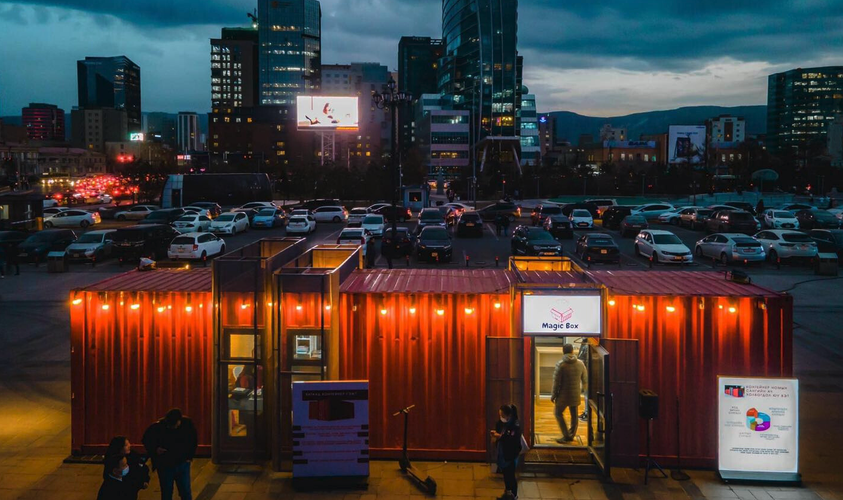
There are now 13 Magic Boxes operating in Mongolia: three in Ulaanbaatar and 10 in rural areas. It costs about $20,000 to outfit one Magic Box. The 30 square-meter shipping containers are insulated, there is floor heating and air conditioning, and 40-50 children can read, study, work and play inside.
Tom also got Mongolian companies to invest in the Magic Box project and realized he could sell advertising space on the shipping containers, getting contracts with the local Pizza Hut or DHL. Magic Box also benefitted from a recent law that was passed giving tax incentives to companies donating to libraries. Mercedes, Pizza Hut, and KFC all donated money.
Tom would like his Magic Boxes to become global. There are so many advantages to the Magic Boxes, including the fact that shipping containers are cheap to outfit, and can be installed anywhere. Ideally, he says, there should be a library a ten-minute walk away for all children. These libraries become local community centers as well.
“Anyone can do it,” he says. “I want people to copy me and just call them Magic Boxes.”
