

India Scores Just 2 Out of 32 on Climate and Health Commitments; Air Pollution Concerns Missing – Indian PSU

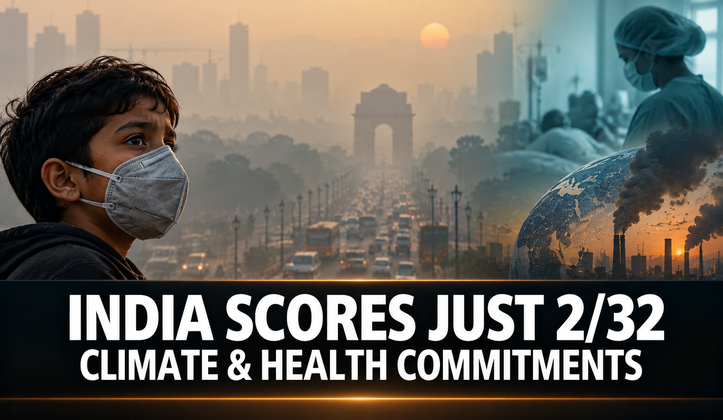
India has scored just 2 out of a possible 32 points in a new international assessment of how governments integrate public health and air pollution concerns into their national climate commitments, raising serious questions about whether the country’s climate planning adequately addresses the health risks faced by its population.
The latest Healthy Nationally Determined Contributions (NDC) Scorecard, published by the Global Climate and Health Alliance (GCHA), places India alongside Japan and New Zealand among the lowest-scoring countries for recognising the links between climate change and human health.
The report highlights a significant gap in India’s climate commitments: despite the country’s substantial burden of air pollution-related mortality, its national climate plan does not refer to air pollution considerations, according to the assessment.
The findings put the spotlight on the need to bring public health, clean air and emissions reduction more firmly into India’s climate policy framework.
India among lowest-ranked countries
The scorecard assesses the climate plans of 132 countries that submitted their 2035 climate commitments to the United Nations Framework Convention on Climate Change (UNFCCC) before August 1, 2026, under the Paris Agreement. The European Union’s joint submission was also assessed.
India, Japan and New Zealand each scored just two points out of 32, indicating limited recognition of the relationship between climate change and human health in their national plans.
The assessment also notes that the emissions reduction targets of India and Japan have been rated as inconsistent with the Paris Agreement by Climate Action Tracker. The report warns that inadequate climate ambition and insufficient health-focused planning could leave populations exposed to worsening risks.
Other major economies also performed poorly. South Korea scored four points, Russia six, Brazil seven, while Australia, China and the United Kingdom each scored nine.
The findings underline a broader challenge: economic size and global influence have not necessarily translated into climate commitments that adequately protect public health.
Developing countries lead the scorecard
Colombia topped the assessment with 29 points out of 32, followed by Nigeria with 25 and Cambodia with 24. Paraguay and Timor-Leste scored 22 points each.
Significantly, 19 of the 20 highest-scoring countries were low- and middle-income economies.
The report identifies Nigeria as an example of a country combining strong attention to health with climate ambition aligned with its fair share of emissions reductions. Paraguay and Nigeria also have National Short-Lived Climate Pollutants Plans in place, while Moldova is developing one.
The results suggest that integrating health into climate policy is not merely a question of economic resources. It also depends on whether governments explicitly recognise the health consequences of pollution and climate change and translate that recognition into actionable commitments.
Air pollution and climate change: a double burden
The report highlights the failure of many countries to take full advantage of measures that could simultaneously reduce global warming, improve air quality and protect public health.
Only five countries—Cambodia, Chile, Colombia, Costa Rica and Paraguay—have set targets to reduce black carbon, a pollutant associated with both air pollution and global heating.
The assessment also draws attention to other short-lived climate pollutants, including methane, hydrofluorocarbons (HFCs) and tropospheric ozone. Cutting these pollutants can deliver near-term climate benefits alongside improvements in air quality and public health.
According to the alliance, rapid action against short-lived climate pollutants can slow warming, reduce immediate health risks and generate cost savings. At the same time, deep reductions in carbon dioxide emissions remain essential to limiting long-term warming.
For India, the findings make the integration of clean-air objectives into climate planning particularly important, given the report’s assessment of the country’s air pollution mortality burden.
Health cannot be treated as a separate climate issue
The GCHA argues that health is often addressed primarily through climate adaptation measures, such as preparing healthcare systems for extreme weather. However, it says governments must also recognise the health benefits of emissions reduction and air pollution control.
The scorecard evaluates national climate plans across eight categories: health impacts, air pollution, health-sector action, health co-benefits, just transition, integrated governance, economics and finance, and monitoring and implementation.
Each category carries up to four points. The assessment considers whether countries identify health risks, specify pollution-related measures, outline healthcare adaptation and mitigation, recognise benefits across other sectors, and establish arrangements for financing and monitoring implementation.
The framework is intended to help policymakers identify gaps in their climate plans and compare their progress with that of other countries.
Funding remains a major obstacle
The report warns that climate commitments will not deliver their intended benefits without adequate finance and implementation.
Citing the latest State of Global Air Quality Funding report, the alliance says outdoor air quality receives less than 1% of development funding, even as air pollution is associated with economic losses equivalent to 5% of global GDP through health impacts, lost productivity and reduced life expectancy.
The report stresses that developed countries have a responsibility under Article 9.1 of the Paris Agreement to provide climate finance to developing countries. Such funding is needed to turn national commitments into effective action, including adaptation measures that protect vulnerable populations and healthcare systems.
The findings are also relevant to preparations for COP31, which the alliance sees as an opportunity to bring national priorities into global decision-making on climate finance and emissions reduction.
A policy challenge for India
India’s score of two points raises a fundamental policy question: how effectively are the health consequences of climate change and air pollution reflected in the country’s national climate commitments?
The scorecard does not, by itself, measure every aspect of India’s environmental or public health programmes. It assesses the contents of national climate plans against a defined set of health-related criteria.
Nevertheless, its findings identify a clear gap in the way India’s climate commitments address air pollution and the links between environmental degradation and human health.
The challenge is to ensure that climate action is assessed not only in terms of emissions targets, but also by its ability to improve air quality, reduce preventable health risks and protect people from increasingly severe climate impacts.
For a country facing significant air pollution challenges, integrating health objectives into climate policy could help align environmental action with the everyday concerns of citizens.
The central message of the scorecard is clear: climate commitments must translate into measurable action that protects human health, and clean air must be treated as an essential part of climate policy rather than a separate concern.
The writer of this article is Dr. Seema Javed, an environmentalist & a communications professional in the field of climate and energy
