

India’s Electronic Manufacturing Services (EMS) Opportunity at a Strategic Growth Juncture: KPMG in India Report

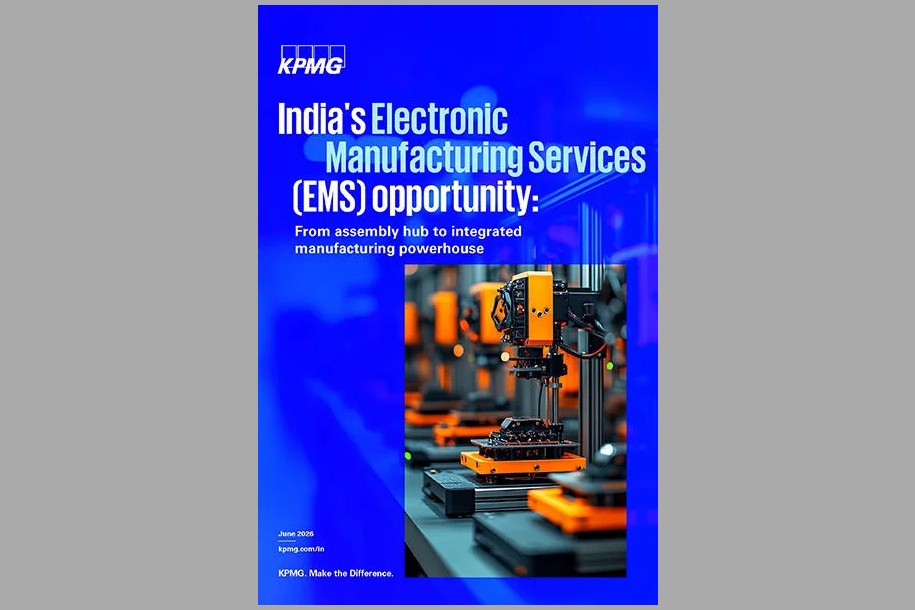
MUMBAI: Amid a once-in-a-generation rewiring of global electronics supply chains, driven by geopolitics, resilience priorities and rising technological complexity, KPMG in India’s report India’s Electronic Manufacturing Services (EMS) opportunity- From assembly hub to integrated manufacturing powerhouse highlights a sector at a critical inflection point—where scale has been built, but value chain depth remains limited.
The report analyses the global EMS landscape and India’s evolving role across market growth, segment prioritisation, value chain dynamics and structural constraints, assessing the shift from a high-volume assembly base to an integrated manufacturing ecosystem.
Globally, electronics manufacturing is moving from cost optimisation to resilience-led, multi-node supply chains, with EMS players evolving into strategic partners for OEMs. For India, this is a significant but time-bound opportunity. The EMS market has grown from ~USD 10–12 billion in FY20 to USD 40–45 billion in FY25 and is expected to exceed USD 150 billion by FY30, driven by domestic demand, policy support and China+1 strategies.
However, this growth reflects a “scale without depth” paradox. While India leads in high-volume assembly, particularly in mobile and consumer electronics, its presence in higher-value areas such as design, components and IP ownership remains limited.
Value creation increases significantly with deeper integration—from assembly to design-led and system-level capabilities—making capability building across engineering, supply chains and product development a strategic priority.
Structural constraints persist, with 80–95 per cent import dependency across critical components limiting domestic value addition and margins. Addressing these gaps will be critical as policy incentives taper.
The report also highlights the need for segment prioritisation: while consumer electronics anchors scale, long-term value will come from higher-complexity segments such as automotive, industrial, and aerospace and defence, where certification depth and engineering intensity drive durable advantage.
Rohan Rao, Partner, Automotive & Lead, Electric Mobility, KPMG in India said “India’s EMS sector has reached a pivotal moment where the foundations of scale are firmly in place, but the next phase of growth will be defined by depth. As global supply chains reconfigure towards resilience and multi node manufacturing, India has a time bound opportunity to move beyond assembly led growth and build integrated, design driven capabilities. Realising this potential will require sustained investment in component ecosystems, engineering depth, and supply chain sophistication to unlock higher value participation in global electronics manufacturing.”
Raghavan Viswanathan, Partner, M&A Consulting, KPMG in India, said “The trajectory of India’s EMS industry will be determined not just by how much capacity it builds, but by where it chooses to compete. While consumer electronics will continue to anchor scale, long term value lies in higher complexity segments such as automotive, industrial, and aerospace, where certification depth, precision, and engineering capabilities create durable advantage. The transition from capacity led to capability led growth will be critical for India to emerge as a globally competitive electronics manufacturing hub.”
Key insights from the report include:
- The global EMS market is estimated at USD 640–650 billion in 2025 and is projected to exceed USD 1 trillion by the early 2030s, driven by connectivity, electrification and OEM outsourcing
- India’s EMS market has scaled rapidly to ~USD 40–45 billion in FY25 and is expected to surpass ~USD 150 billion by FY30, supported by exports, policy incentives and supply chain diversification
- India currently accounts for approximately 5–6 per cent of global EMS manufacturing, indicating significant headroom for growth
- High import dependency typically ranging from ~80 to over ~95 per cent across critical components, continues to limit domestic value addition and ecosystem maturity
- India’s EMS sector remains concentrated in assembly-led manufacturing, with limited penetration in design, component manufacturing and IP ownership
- Policy interventions have been a critical growth enabler, with ~USD 19.5 billion in cumulative incentives aimed at strengthening the electronics manufacturing ecosystem
- Sustained competitiveness will depend on transitioning from capacity-led growth to capability-led growth, including localisation, certification depth, and design integration
Together, these insights point to an industry at a strategic crossroads. India’s EMS sector can evolve along multiple trajectories—from an assembly-led growth model to an integrated manufacturing node, or further into a globally competitive electronics ecosystem with deep component capabilities and design-led innovation.
The next five to ten years will be decisive. Realising this potential will require coordinated action across government, EMS players and global OEMs—focused on building component ecosystems, strengthening workforce capabilities, investing in engineering and design, and deepening integration across the value chain.
