

Indraprastha Gas Limited Signs Green Fuel Pact with Noida Authority; City Garbage to Power Household Kitchens – Indian PSU

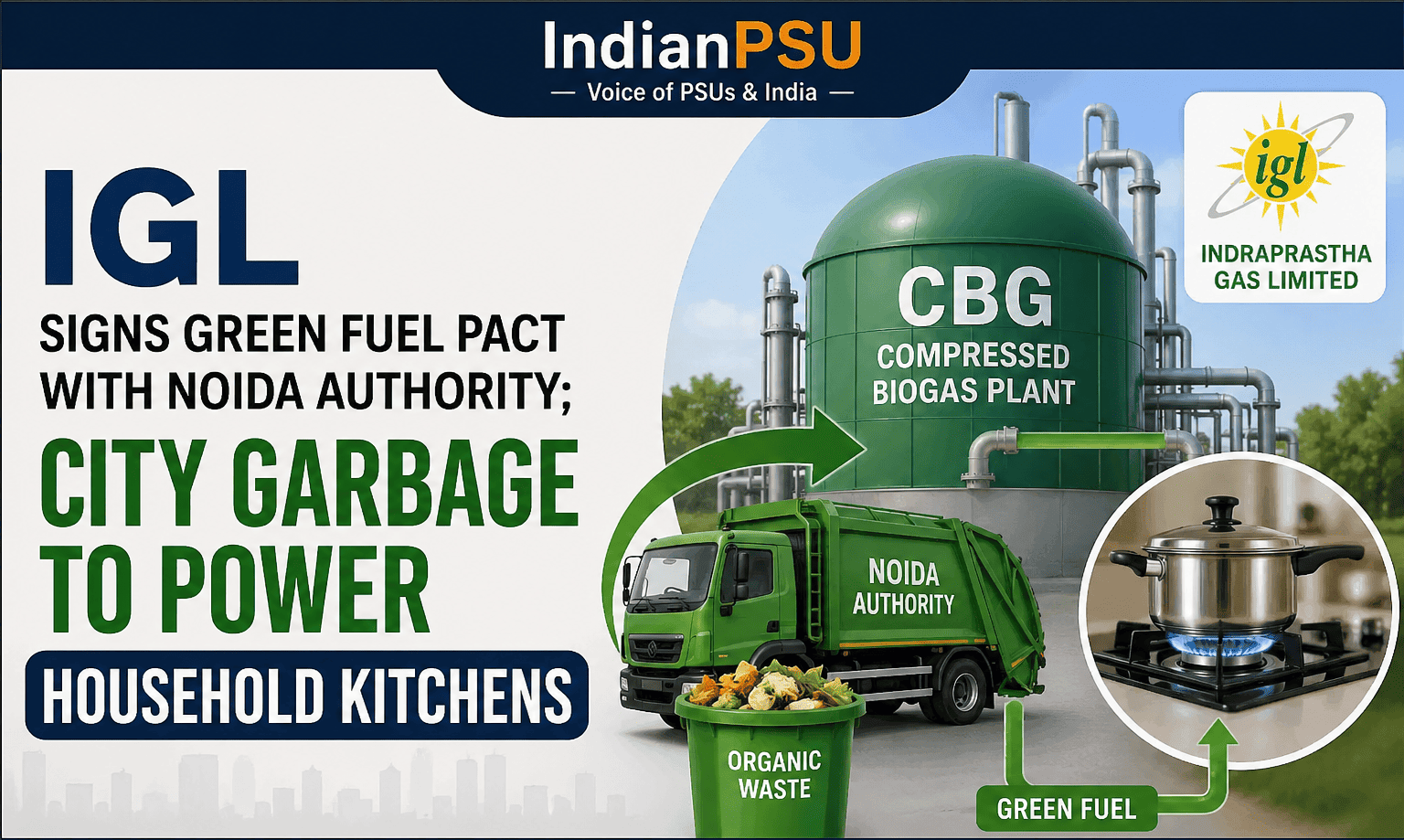
In a major clean-energy and urban waste management initiative, Indraprastha Gas Limited (IGL) has signed a Letter of Intent with Noida Authority for setting up a 300 tonnes-per-day Compressed Biogas (CBG) plant that will convert the city’s organic garbage into green cooking fuel, bio-manure and cleaner municipal infrastructure.
The project marks one of the most ambitious waste-to-fuel urban circular economy models in Uttar Pradesh, under which kitchen waste and biodegradable municipal garbage generated daily across Noida will no longer merely head to dumping grounds — but will return to citizens in the form of usable cooking gas supplied through IGL’s gas distribution ecosystem.
The formal agreement was signed at the Noida Authority headquarters in the presence of Noida Authority CEO Krishna Karunesh and IGL Executive Director (Business Development, Corporate Strategy & Gas Sourcing) Sanjeev Kumar Bhatia.
Waste Will Become Fuel, Fertiliser and Fiscal Savings
Officials said the proposed facility will scientifically process nearly 300 TPD of organic municipal solid waste and convert it into:
- Compressed Biogas / Bio-CNG (Green Fuel)
- Organic Bio-Manure
- Reduced landfill residue
The biogas generated is expected to be fed into the city gas network, enabling a direct clean-energy loop where urban waste gets monetised as domestic fuel.
Equally significant is the by-product stream: the plant will also generate organic manure that can be deployed in agriculture, landscaping and green belt development.
This means Noida will derive a triple dividend:
- scientific disposal of wet waste,
- renewable energy generation,
- and creation of commercially useful by-products.
Rs 250-Crore Green Infra Push to Cut Landfill Dependence
The total investment in the project is estimated at around Rs 250 crore, making it one of the region’s major municipal clean-energy infrastructure investments this year.
At present, Noida generates nearly 800 to 1,000 tonnes of municipal solid waste daily, a figure expected to rise sharply with urban expansion. A significant portion of wet waste is presently transported outside the city for treatment, resulting in substantial logistics expenditure and mounting environmental costs.
Authority officials estimate that transport and dumping of waste impose a recurring fiscal burden, while untreated organic waste contributes heavily to methane emissions and leachate contamination.
With the new CBG plant coming up within the city ecosystem, Noida expects:
- major reduction in waste transportation cost,
- sharp decline in landfill dependency,
- lower greenhouse gas emissions,
- improved compliance with scientific waste processing norms.
Noida Authority to Provide Land, IGL to Build and Run Plant
As per the LoI, the Noida Authority will provide suitable land parcel and ensure regular supply of segregated biodegradable waste for uninterrupted plant operations.
Indraprastha Gas Limited, one of India’s leading city gas distribution companies, will undertake development, operation and maintenance of the facility either directly or through its authorised project partners, leveraging its nationwide clean-energy infrastructure expertise.
The company has in recent months accelerated its national expansion into the compressed biogas and renewable gas segment as part of its diversification beyond conventional PNG and CNG business.
Part of Noida’s Larger Zero-Waste City Mission
CEO Krishna Karunesh described the project as a crucial component of Noida’s long-term Zero Waste City roadmap.
Urban planners say the Authority is now building a multi-layered waste-to-energy ecosystem that includes:
- a 300 TPD wet waste to CBG plant,
- a 900 TPD mixed waste-to-green coal facility,
- and several decentralised waste processing units.
Taken together, these projects are intended to structurally dismantle the city’s dependence on open dumping and conventional landfill disposal.
Bigger Message: Urban India’s Garbage Economy is Becoming an Energy Economy
The Noida-IGL partnership carries significance beyond municipal sanitation.
It signals a larger governance shift in which Indian cities are beginning to treat waste not as a disposal liability, but as a monetisable renewable energy resource.
If executed on schedule, Noida could emerge as one of the first urban centres in North India where:
household garbage → municipal bio-processing → piped green cooking fuel – becomes a visible and replicable civic-energy cycle.
That would make this not merely a waste management project, but a template for future city gas-linked circular energy infrastructure in India.
