


A month ago, I wrote a post called “Why You’re Not Writing.” I wrote it in part to figure out why I’m not writing.
Sure, I’ve been writing essays, substack posts, the usual scribbled diary entries—I’ve even tried my hand at a screenplay. But for the last five months, I haven’t been writing fiction.
When I fretted about this to my partner for the nth time, he very gently said: “I haven’t seen you excited about a book in a long time. When you’re not reading anything you like, it’s hard to get excited about writing.”
I think there’s truth to this. I am so frustrated with contemporary literary fiction. Everything I’ve tried lately has been, not just bad in the sense of “Oh, that book didn’t really come together in the end,” but bad in the sense of “I can’t imagine why anyone would give this book more than five minutes of their time.”
This has been true of books that win major prizes, books that get roundly praised by the critical apparatus, books that are heralded with a slew of publicity and media attention.
Which makes me feel, at worst, crazy, and at best, alone.
So I’m going to talk through the opening pages of two literary novels by prominent writers. I’m going to subject them to the same scrutiny that I would the sample pages of a querying writer. And I’m going to make the case for the gut feeling I had upon reading both of these openings: This Is Not Good.
And you can tell me whether or not you agree.
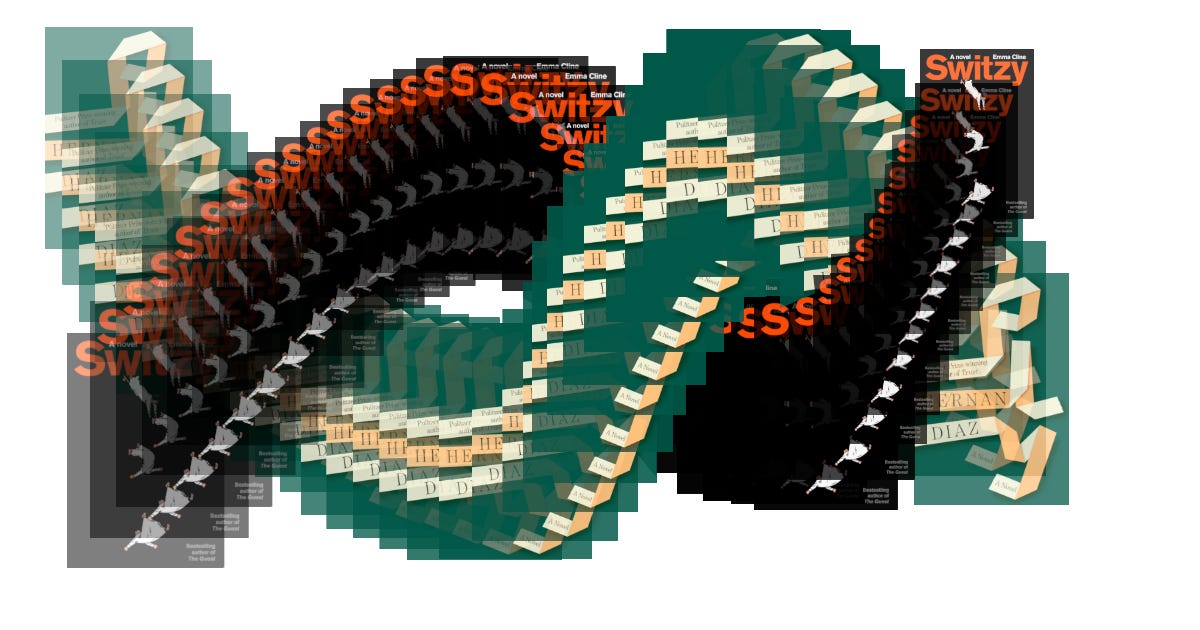
The books in question:
Is it fair to judge these novels by their first pages? Yes, I think so. I argue the point in more detail here, but my basic reasoning is:
-
the first page is the one the author has worked hardest on & edited the most
-
so if there are problems on the first page, you can bet those problems will be present (& magnified) throughout the rest of the novel
-
the first page is meant to stand on its own—no context needed
-
the first page is meant to hook the reader—so this is the writer at their most intentional, & their most inviting
Switzy has been longlisted for the Booker Prize. Hernan Diaz won the Pulitzer Prize for his last novel. If querying writers are to be judged by the opening pages of their novels, surely these bestselling novelists can be put to the same test.
Here is the first page of Switzy by Emma Cline:
It was always nighttime there. Or in his memory he had only ever been there at night, the cobblestone streets and the strangely empty sidewalks, the black vastness of the lake as seen from the back seat of a town car. It was a city that existed in a perpetual hush, a chilly dark. As if the place had been built for these kinds of shadowed errands.
There would be snow on the ground. The middle of February. The flat, sad month. Like a house when no one is home.
*
The steady hum of the plane’s engine carried them along. The window shades were all closed. A flat-screen showed news without sound. David played solitaire on his phone. The green meadow of the background pulsed against the black and red and white cards.
Click. Click. Click. Drag. Click.
The cards flipped all at once, scrolling across the screen. Chaos that resolved itself into order and then back into chaos, in need of order, future order.
He put his phone down.
All right. What do we notice?
Well, it’s boring. Nothing is happening. Emma Cline can’t possibly expect to hook us with the story here (a man plays solitaire on his phone), so she must expect to hook us with the language.
So let’s take a look at the language.
The language definitely has that “literary sound” to it, and for a lot of readers, that’s enough. But I notice that Emma Cline seems bent on describing things in a way no one has described them before, whether or not she needs to. We keep veering off into detours of Highly Original Description, warranted neither by the story nor by the thing being described:
The middle of February. The flat, sad month. Like a house when no one is home.
David played solitaire on his phone. The green meadow of the background pulsed against the black and red and white cards.
The cards flipped all at once, scrolling across the screen. Chaos that resolved itself into order and then back into chaos, in need of order, future order.
When I read passages like this, it’s as if I can hear the writer’s internal monologue as she pauses at the keyboard, searching for the next juicy phrase:
The middle of February. [Okay, time to evoke what February feels like. Should I go for a splashy adjective? No—how about two ordinary adjectives in an unusual combination.] The flat, sad month. [That’s good. But is it good enough? Let’s keep going.] Like a house when no one is home. [Nailed it.]
And:
David played solitaire on his phone. [Lest anyone think this is boring, I’m going to describe solitaire, so that the familiar is rendered totally new and strange.] The green meadow of the background [oh, that’s good] pulsed [phone screens kind of pulse, right?] against the [you’re expecting more high-flying imagery, but here’s where I’m going to shock you with stark simplicity] black and red and white cards.
And:
The cards flipped all at once, scrolling across the screen. [Yep, that’s solitaire. But how to make it seem profound?] Chaos that resolved itself into order [good, but kind of a basic insight—let’s double down] and then back into chaos, in need of order, future order. [Now if that doesn’t vibrate with potential subtext, I don’t know what does.]
Emma Cline can write a good sentence. I read her novel The Guest and liked it. But here, all her literary powers are bent on describing:
I don’t need her help to visualize February or solitaire, nor am I convinced by her portrayals of either.
Is February like a house when no one is home? It’s a short, weird month, and often sort of a downer. It’s the Tuesday of months. But when I read “Like a house when no one is home,” I don’t feel the truth of it. My reaction is “Huh,” not “Yes!!”
Her description of solitaire feels a little more true to life, but… who out here has never played digital solitaire? Did we really need to delve into solitaire as a priority visual? What is gained from all those sentences about solitaire that wasn’t gained from “David played solitaire on his phone”?
The most effective paragraph here is the first, as Emma Cline is describing something that actually needs her powers of description: a city. (Cities exhibit more variety than solitaire.)
It was always nighttime there. Or in his memory he had only ever been there at night, the cobblestone streets and the strangely empty sidewalks, the black vastness of the lake as seen from the back seat of a town car. It was a city that existed in a perpetual hush, a chilly dark. As if the place had been built for these kinds of shadowed errands.
The first two sentences work for me. “The lake as seen from the back seat of a town car” is especially interesting—I like the idea that everything looks different from the back seat, and that we can’t properly picture the lake without imagining it through a car window.
At “chilly dark,” though, I start to get suspicious. “A perpetual hush, a chilly dark”—is this important, or are we just tossing adjective-noun pairs around?
And then she really loses me here: “As if the place had been built for these kinds of shadowed errands.” Shadowed errands refers to something we can’t possibly know about, so the only thing “these kinds of shadowed errands” communicates is: “You don’t know what I’m talking about, and I’m not going to tell you yet.”
It’s an attempt to generate suspense by withholding information, and it’s about as sophisticated as the old standby that crops up in genre fiction: “I had never been quite the same since the accident… but I didn’t want to think about that now.”
On the first page of a novel, I need to be convinced that I’m in good hands. That this writer is in command of their story—that they’re taking me somewhere good.
But on the first page of Switzy, I see a writer repeatedly indulging in unnecessary description at the expense of her story. I lose trust that she’s going to tell me what’s important (shadowed errands) or leave out what’s unimportant (flat, sad month).
Without that trust, I have no reason to keep reading.
You probably think I’m being too harsh. Switzy is a long and complex novel that tracks the unraveling of a mind—maybe the later pages will justify this slow, vague, broody opening!
So what if they do? The first page of a novel must justify itself.
Emma Cline’s publisher agrees with me. Here’s a line from the promotional letter included with the advance copy of Switzy:
It’s all so finely calibrated—not a false note, not a word out of place—and I think you’ll feel that from the very first paragraph.
You may enjoy the first page of Switzy more than I do. But I defy anyone to argue that not a word is out of place on this first page. None of these words have earned their place:
As if the place had been built for these kinds of shadowed errands.
The flat, sad month. Like a house when no one is home.
Chaos that resolved itself into order and then back into chaos, in need of order, future order.
All these literary-sounding sentences strike a false note, because I don’t care yet. A man is playing solitaire on a plane. Emma Cline can pair adjectives with nouns. Nothing on this first page makes me sit upright and think: I want to know more about that.
Okay. Let me catch my breath—
—and then let’s read the opening of Hernan Diaz’s Ply:
Even at night, the bridge throws a shadow on the river—a black lane where the otherwise shimmering waters seem to deepen. I am invisible gliding down that narrow eclipse. No one can see me from above; no one can spot me from the shore. The whir of the propeller slicing through the current vanishes under the city’s hum that rolls over the river like a mist. The boat and I become nothing. A possibility no one considered.
Still, I sensed a disturbance in the dark as I cruised across the wide stream and through the late-summer night. How is it that one can feel when one’s being watched? What is that touchless prodding that is also a pulling in space itself?
I cut the engine, allowed myself to drift to the edge of the bridge’s shadow, took out my binoculars, and checked for other craft or a presence on the riverbank. The downstream breeze, laced with the smell of clay, burning wood, and the wolfish call of loons, was a reflection of the river. I’ve learned not to look too closely at what the water carries, but that night I inspected all the vague shapes floating by. Some of them were seals. The slick curve of a dolphin hooked itself into the surface. Ducks, bobbing in an iridescent row, slept with their heads turned back and their beaks tucked under their wings.
The opening of Switzy was bad in subtle ways, which a reader who trusts Emma Cline could willingly overlook, hoping that within a couple pages Cline might settle down and start telling an actual story.
The opening of Ply is just bad, verging on unintelligible.
Let’s start with the verb tense problem. We open in present tense: “I am invisible gliding down that narrow eclipse. No one can see me from above; no one can spot me from the shore.” Then, abruptly, a shift to past tense: “Still, I sensed a disturbance in the dark as I cruised across the wide stream and through the late-summer night.”
My undergraduate students often write this way, and I often tell them: Please pick a verb tense and stick to it. But let’s give Hernan Diaz the benefit of the doubt. Maybe the first paragraph describes how this narrator generally feels when they cruise down the river. Then the second paragraph narrows down to a specific night in the past. Clumsy, but intentional.
Oh, wait a second:
Still, I sensed a disturbance in the dark as I cruised across the wide stream and through the late-summer night. How is it that one can feel when one’s being watched? What is that touchless prodding that is also a pulling in space itself?
We have chosen a specific moment in time. We didn’t get there with any particular grace, but at least we made it official: we’re in scene now. And yet, one sentence after entering the past-tense scene, Hernan Diaz feels compelled to offer more general thoughts in the present tense.
This opening makes such a mess of verb tense and timeline that sentences like the following are actively baffling:
I’ve learned not to look too closely at what the water carries, but that night I inspected all the vague shapes floating by.
Let’s try to parse this. We have a narrator speaking in retrospect, looking back on that night, however long ago. So in a sense we’re dealing with two characters: Narr-Pres, the present-tense narrator, who is still alive and well and recollecting; and Char-Past, the past self of the narrator, who is living out the events of that night.
Based on all the statements made in the present tense, what do we know about Narr-Pres?
And what do we know about Char-Past, from all the action taking place in the past tense?
How is it possible for the present-tense narrator to be still under the delusion that they are invisible gliding down the river, when they are narrating to us a remembered night on which they were not invisible? If they’ve learned not to look closely at shapes in the water, did they learn that before or after this long-ago night when they did look at shapes in the water?
Whatever. I’ve already given more thought to this than the author did. Moving on.
There are so many objectionable sentences on this first page that it feels almost mean to quote them. But that’s not going to stop me today.
The downstream breeze, laced with the smell of clay, burning wood, and the wolfish call of loons, was a reflection of the river.
The breeze is laced with two scents and one sound. This is jarring as far as parallel structure goes, but okay, let’s try to imagine a breeze laced with the calls of loons.
Now let’s try to imagine this breeze (already burdened with the weight of two scents, one sound) as a reflection of the river.
What is this even supposed to mean? That the river, like the breeze, is laced with 2scents1sound? That the breeze, like the river, is… moving? Downstream? Which we already knew?
Trying to interpret this sentence is a joke. It has no meaning. It’s just supposed to sound good.
Speaking of saying something meaningless in an attempt to sound good:
The boat and I become nothing. A possibility no one considered.
(Yes, no one considered that you could possibly be gliding down the river, except for the person actively watching you from the bank.)
What is that touchless prodding that is also a pulling in space itself?
(Touchless prodding I can barely accept—sometimes you do get that jabbing feeling that you’re being watched—but if you’re going to characterize that feeling as a prod, why would you also call it a pulling in space itself? You gotta cover both bases, the metaphor and its opposite?)
The slick curve of a dolphin hooked itself into the surface.
(Fair enough, but who cares?)
What kills me is that these sentences have sacrificed meaning to sound good, and they don’t even sound that good. Here’s one that combines bad rhythm with mixed metaphors:
The whir of the propeller slicing through the current vanishes under the city’s hum that rolls over the river like a mist.
Just to be clear, we’ve got a whir (sound) from a propeller slicing through the current (visual), which then vanishes under a hum (sound) that moves like a mist (visual).
I feel like I’m driving over speed bumps every time I read that sentence.
Okay, so the first page of Ply is dreadful, and the first page of Switzy is disappointing. Why does this matter? Why am I mouthing off about it in public?
Because this keeps happening. I keep picking up new, hyped, high-profile literary novels, reading the opening pages, and going: “Agh!”
And yet these writers never get taken to task. Okay, sure, maybe they have to face the occasional mixed review. But mostly, their novels are welcomed with critical acclaim. I can’t tell you how many times I’ve read a bad novel by one of these literary giants and looked up reviews, only to find that everyone is singing its praises.
This feels like gaslighting. We, amateur and aspiring writers, are told that we need to subject our writing to the highest scrutiny. We edit, we refine, we reconsider, we obsess over the first page, the first sentence. We hope it’s true that great writing really does rise to the top. We cross our fingers that we’ll become one of the chosen few.
Meanwhile, what are those chosen few doing? Phoning it in.
When I read literary novels like Switzy and Ply, all I can feel is that the writers are stalling for time. If they really had something urgent they wanted to communicate, they wouldn’t waste sentences on how slick dolphins are or how drab February is.
The question driving these opening pages is not: “What does it mean to live a good life?” or “What do we owe to people?” or “What can be saved from the ravages of time?” The question I hear is: “Have I impressed you yet?”
If I thought this problem was specific to Switzy and Ply, I wouldn’t bother writing about it. I would just get rid of the books and move on. But the missteps in these openings feel so familiar to me. They exemplify a trend in literary fiction that I’ve come to hate: Describing Unimportant Things in Unnecessary Detail In Order to Sound Smart.
I’m tired of reading fiction whose first (and sometimes only) mission is to impress me. I won’t get dramatic and say that all this intellectual posturing is ruining fiction—but it is ruining fiction for me.
When I was in my MFA program, one of my faculty advisors gave me the same recurring note in the margins of my stories: “Need?” As in, do we need this line? Is this important? Does this actually mean anything? Are you just trying to sound smart?
I’m being hard on Emma Cline and Hernan Diaz because they should know better than I did when I was a 27-year-old MFA candidate. If I poke your sentence, does it hold strong, or does it crumple? If it crumples, why is it in your novel?
I would like to believe that, if I sat down with these two writers, I could point to any one of their opening sentences, and they could explain why that sentence is essential to the story, fully considered, meaningful on a first read and a fifteenth read.
And maybe, if I actually read both novels in full, I would argue myself that these openings make perfect sense in the context of the pages that follow.
But I’m not going to read these novels. Because I read the first pages as closely as I could stand, and I didn’t see anything worth sticking around for.
I believe that our literary superstars should be held to the same standard as every other writer. Actually, I believe they should be held to a higher standard. These big-name writers have every resource—they’re working with important editors at important imprints—they probably got huge advances for these books—they’ll probably sell tens of thousands of copies.
The first page should therefore be good. The whole novel should be good. If it’s not good, we should talk about it.
So here I am talking about it.
If there’s any call to action here, it’s the same one I made in this post:
I want to read literary sentences that 1) are true to life and 2) matter to the story. (In that post, I argued that literary sentences should also “surprise,” but I’m happy to waive that requirement as long as the sentences are both true and meaningful.)
I guess my other call to action is: can we start writing critical reviews again? All the hype and the praise and the kowtowing are only serving to make me distrust the critics. I don’t want to be conned into buying another bad book. The critics don’t have to share my views, but I would like them to at least engage these novels with scrupulous care, arguing for or against the writers’ choices, not taking those choices as gospel.
And my final call to action (whoops, I had three) is this: I would love it if literary writers could cut the stalling and pontificating and instead write novels that are fun. Good novels are fun! The classics are fun! Not fun in the sense of cheaply entertaining, but fun in the sense of watching a brilliant mind wrestle with life’s great problems.
I do not want to watch a brilliant mind wrestle with the problem of how to describe solitaire in a way that feels fresh. It’s not fun anymore. It hasn’t been fun for a long time.
You disagree? You’re furious with me? I embody everything that’s wrong with everything?
Thanks anyway for hearing me out!
