


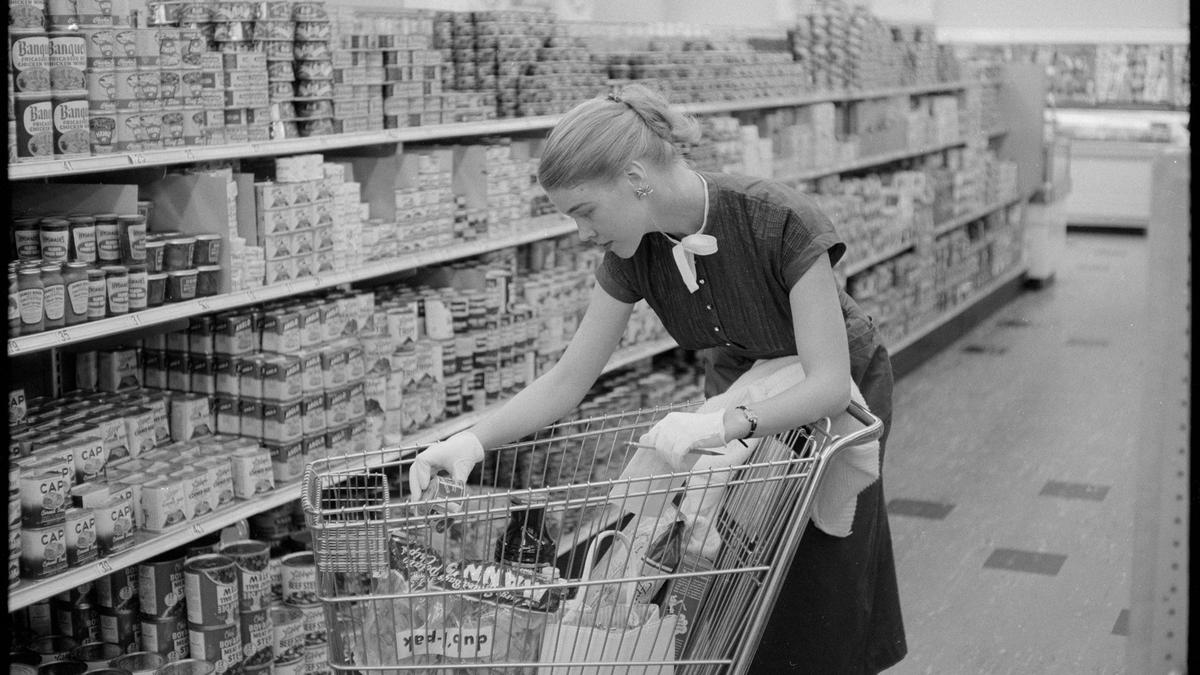
‘It’s logistics.’ I often use this common phrase when planning and coordinating my everyday life. Work projects, social gatherings, medical appointments, household repairs, doing the shopping… Planning and coordinating such mundane tasks always takes up more of my time and attention than I would like. When I call it ‘logistics’, I tacitly acknowledge that everyday modern life is as complicated as shipping goods or positioning armies, logistics’ traditional tasks. And who shoulders most of these unpaid chores and labours of love? Across all demographics, it’s women. How did we get here? And how do we redistribute the burden? Suggestions lie in an unusual place: a women’s history of logistics.
It began in the 19th century, when the concept of logistics arose to explain Napoleon’s conquest of Europe. ‘Logistics’ became the science of supplying soldiers and moving them into strategic position on battlefields. Though the practice began before, under the Napoleonic Code of law, they were entitled to bring their wives, who were regarded as their legal property. Following behind the marching troops, wives supplied the little extras of life: tobacco, alcohol, clean clothes, sex. Some women even found themselves on the front lines, administering shots of brandy before a charge, then dragging the wounded to safety. The theorist Paul Virilio called this new figure ‘the logistical spouse’. As property of their husbands, these informal logisticians were obliged to follow them wherever they went.
Soldiers Taking a Break by a Female Sutler by Adrien Moreau. Courtesy Wikipedia
‘As with the commander of an army, or the leader of any enterprise, so is it with the mistress of a house.’ This was the opening line of Mrs Beeton’s Book of Household Management (1861), the bestselling manual and cookbook that served as a reference work for generations. As militaries modernised and the middle class grew, women became metaphorical generals of domestic operations. A counterpart of the male corporate manager, the bourgeois wife spent her husband’s income to keep the house well stocked and in good order. The book’s author Isabella Beeton espoused early rising, cleanliness, frugality, and the canny management of accounts and family entertainment. Most of her advice has endured the transitions from handmaking food and clothes to operating appliances like washing machines and, in the age of apps, ordering everything online. Though women gained civil rights, incomes and greater independence throughout the 19th and 20th centuries, and though men were more often opening sales territory rather than fighting to gain actual territory, women still did all the work of logistical spouses.
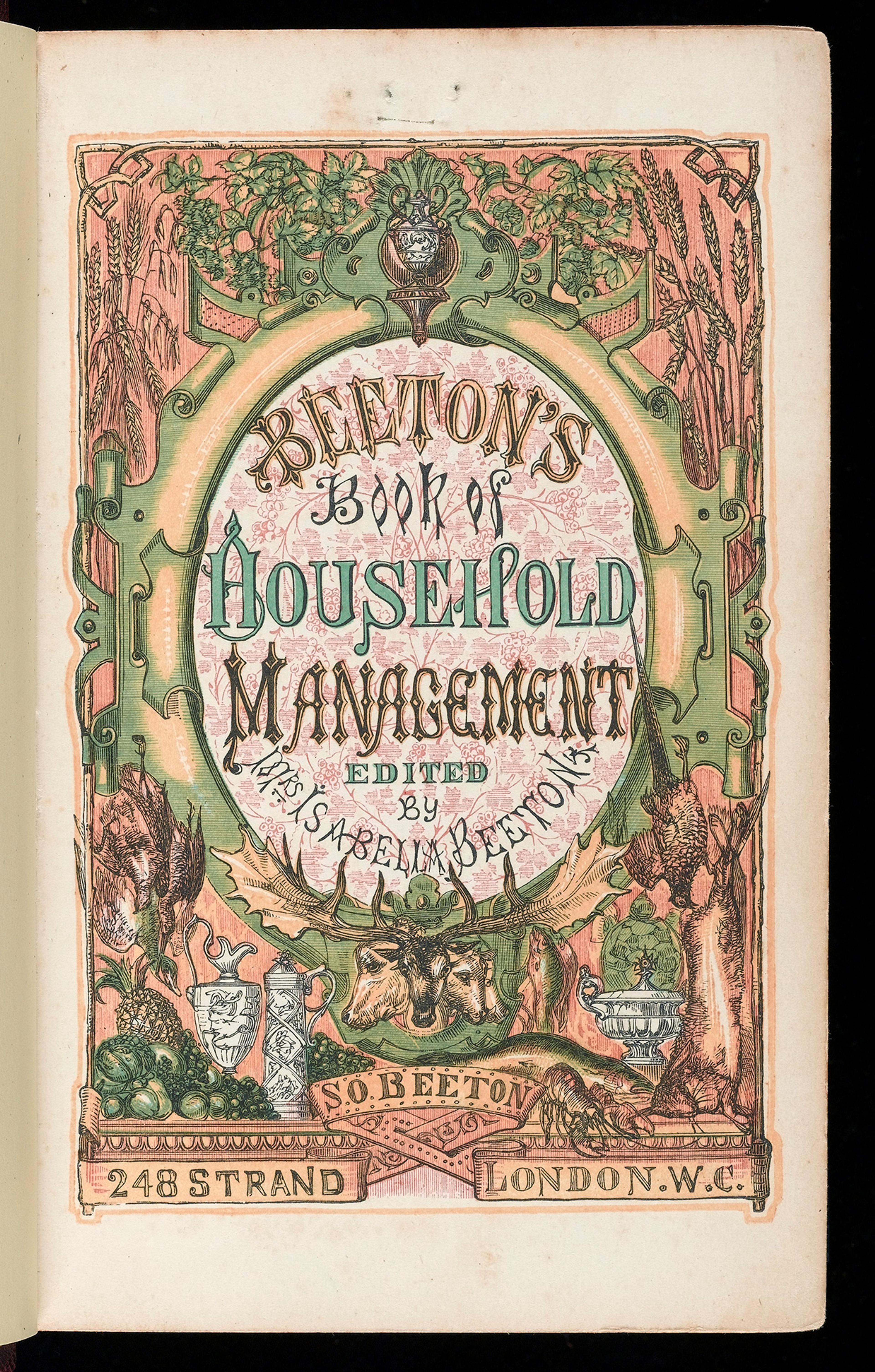
The title page of Mrs Beeton’s Book of Household Management (1861). Courtesy the Wellcome Collection
Large mid-century families gave them the chance to flaunt their organisational abilities, demonstrating how domestic efficiency mirrored industrial efficiency. No one reflected this synergy better than Frank Gilbreth, an industrial engineer, and his wife Lillian, an engineer and psychologist, who together invented the flow chart – and had 12 children, inspiring Cheaper by the Dozen, a 1948 autobiography and several film adaptations. The Gilbreths conducted motion studies on workers, breaking down tasks into numerous small movements to arrive at the most efficient process. ‘[A]n unnecessary motion is money lost forever,’ they wrote. Merging their household with their management laboratory, they tested their theories on their children, who bathed quickly, soaping their limbs in a regimented order. While doing so, they listened to German and French lessons on Victrola phonographs installed in their bathrooms. Before going to bed, they initialled charts to certify that they had completed their homework, brushed their teeth, and washed their faces. They were children, but they bore uncanny resemblances to anonymous workers or mass-produced items. They revealed the logistical spouse’s maternal function: child-rearing meant not only supplying the household and coordinating the family, but manufacturing and training efficient workers for the capitalist order.
Such crimes and allegations are a feature of patriarchal, misogynist households, not a bug
The logistical spouse is the lynchpin of middle-class standing, and its trendiest iteration is the tradwife who makes her own bread and cleaning fluids. When combined with Christian patriarchy, it commands media viewers across all platforms. Take the reality TV programme 19 Kids and Counting (2008-15), in which Michelle and Jim Bob Duggar, devout Baptists who shunned birth control, managed their enormous brood. Michelle wrote the foreword to Kim Brenneman’s Christian home management manual Large Family Logistics (2010), which offered systems for raising and homeschooling numerous children, such as timed chores, pairing them with a buddy, and giving each child additional attention on the same day each week. In the Duggar world, God was the ultimate family planner and domestic logistician: by trusting in him, the details would work themselves out.

The Dugger family in 2007. Courtesy Wikipedia
Yet 19 Kids and Counting unwittingly undermined Christian logistics: the show ended with the scandal of the Duggars’ eldest son having molested several of his sisters and a babysitter. He was later convicted and sentenced for possessing child pornography; more recently, his brother was arrested on charges of sexually abusing a nine-year-old girl. Such crimes and allegations are a feature of patriarchal, misogynist households, not a bug. The Christian logistical mother’s labour supports such regimes of power, directly and by example. All the feeding, clothing, organising, educating and indoctrinating of the children does not guarantee their safety from each other. Modelling such subservience for girls trains them to assume unpaid logistical work, including the supplying of sex in marriage, in an echo of the Napoleonic Code. On 19 Kids and Counting, the over-large Christian family flaunted its divine logistics but couldn’t explain its own lack of grace.
The dark undercurrent of the logistical wife who stands by her man doesn’t always require a traditional household. Consider Ghislaine Maxwell, the logistician behind Jeffrey Epstein’s sex trafficking operation. It involved more than 1,000 victims, many of whose passports Maxwell confiscated as she booked them on the private jet to the island. As Epstein’s girlfriend and pimp, Maxwell supplied sex directly and by proxy. Her crimes underscore the conceptual kinship between procurement, the branch of logistics involving sourcing, and a procurer, a person who arranges sex work. Maxwell’s labour was valuable. Data from the enterprise likely allowed Epstein to blackmail clients, make new connections and close deals.
From the battlefields of Europe to middle-class households and sex trafficking, women’s logistics has one thing in common: performing organisational and supply work for men who have capital, status and control. Men make the money and women spend it; men make the decisions and women coordinate the details. This basic pattern began in the 17th century, with the rise of European capitalism. States forbade women from independently accessing their wages, coercing them instead to produce more workers. As they bore more children, women continued to perform all kinds of work. But with their activities no longer remunerated, they became dependent on men, losing even more rights. Along with transatlantic slavery, free women’s labour propped up a faltering capitalist system. The logistical spouse serves her man not just to fulfil gendered expectations, but to survive capitalist brutality. The worse it gets, the more women forgo paid labour to care for vulnerable children and elders who would otherwise be abandoned. As the theorist Silvia Federici has shown, this unvalued labour counts for ‘most of the work on the planet’.
What would a fairer and more equitable world look like at all levels – international, national, community, household and relationship?
How could the burden be redistributed? In the late 2010s, the conversation centred on the unequal emotional labour of managing the heterosexual household. This labour involved logistics because the frustration and overwhelm came from constantly remembering all the household details and taking the lead in ensuring its smooth operation. Though not at perfect parity, LGBTQ+ households tended to divide logistical labour more evenly; but men in heterosexual partnerships seemed incapable of receiving the message and cultivating the initiative. As one divorced man ruefully put it in a viral essay published on HuffPost in 2016: ‘She wanted to be my partner, and she wanted me to apply all of my intelligence and learning capabilities to the logistics of managing our lives and household.’ Some households tried to equalise logistical labour by dividing domestic maintenance and childcare tasks. Blogs and lifestyle columns modelled how couples could transfer duties from a working mother’s column to a father’s. Then the COVID-19 pandemic hit, and the burden of educating children at home during lockdowns fell on women, who sacrificed their own careers and mental health to keep households functioning smoothly. In cases where her wages or salary was less than her husband’s, it made economic sense for the woman to step back from her work, taking a career hit and redoubling the preexisting economic injustice. Masculine intransigence, economic inequity, and conservative traditionalism retrenched. Some heterosexual women seemed to give up all hope, turning to tradwife content. Others appear to be avoiding men altogether.
What’s the answer? Instead of adopting social media trends and dumb life hacks, we should approach the problem from the long view, and with a political vision that comes from knowing our history. Most women want a fairer, more equitable world; many men say they do, too. What would that look like at all levels – international, national, community, household and relationship? What if something that looks like a relationship or household issue is actually a wider one? What if it had a name and a history? Starting to see logistics as something I do every day has helped me better understand my labour not just in my household but in my community, culture, and country. Now that I recognise the organisational skills I have built up over a lifetime of unpaid practice, I can more consciously decide where and how I want to direct them. This is the kind of emotional, intellectual and logistical labour that may just eventually pay off.
