


Between the 10th and 13th centuries, the monks at the Great Lavra Monastery on Mount Athos, Greece, sporadically broke down a 6th century manuscript and reused its pages as binding material and flyleaves for other texts. In time, Codex H effectively disappeared. These new volumes were spread across Europe and it was only through the enterprise of a sharp-eyed 18th century French monk that researchers today have been able to locate the lost folios among libraries in Italy, Greece, Russia, Ukraine, and France.
All the same, while the general content of Codex H, which contains a copy of the Letters of St. Paul, was generally known, its layout and precise wording seemed irretrievable. Not so. A team of researchers from the University of Glasgow has now successfully recovered 42 previously lost pages from the important early New Testament manuscript. The tool that has made 1,500-year-old Greek scripture suddenly visible is multispectral imaging, which allowed researchers to identify traces of ink that are virtually invisible to the naked eye.
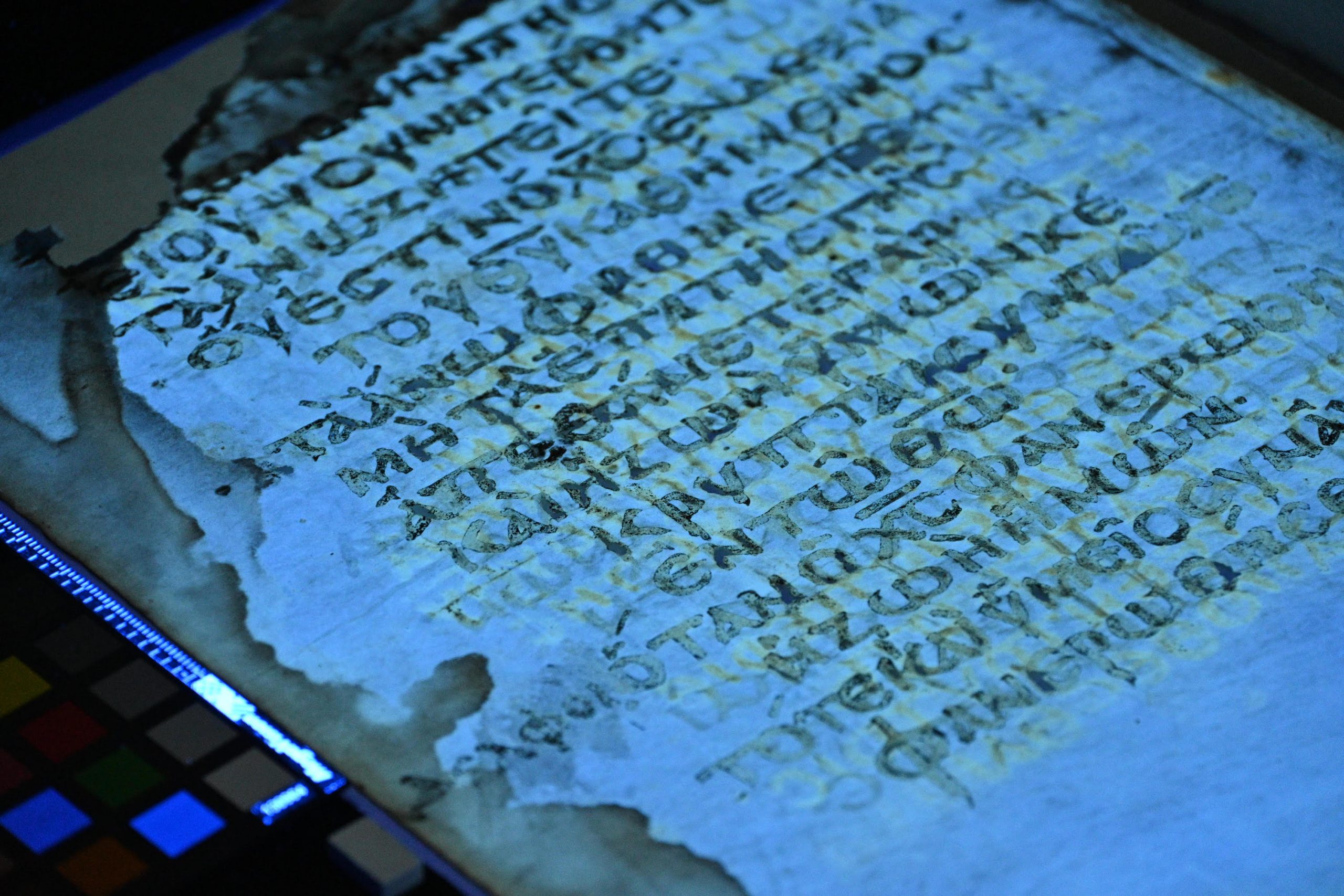
The breakthrough arrived when the team, led by the divinity and biblical criticism professor Garrick Allen, realized that at one point in time the manuscript had been re-inked. This meant that chemicals in the reapplied ink had been transferred onto neighboring leaves. These left what researchers called “ghost impressions” that created a mirror image of the original text.
Multispectral imaging and carbon dating were conducted on Codex H. Photo: courtesy Damianos Kasotakis
“In partnership with the Early Manuscripts Electronic Library (EMEL), researchers used multispectral imaging to process images of the extant pages, in order to recover ‘ghost’ text that no longer physically exists, effectively retrieving multiple pages of information from every single physical page,” researchers wrote in a statement. “To ensure historical accuracy, the team also collaborated with experts in Paris to perform radiocarbon dating, confirming the parchment’s 6th-century origin.”
Although the text of the Letters of St. Paul itself is already known, the version revealed through multispectral imaging is organized differently from modern counterparts. It features the earliest known use of the Euthalian apparatus, a complex system of prologues, chapter lists, and quotation markers that allowed the reader to find their way before the advent of page numbers or indexes. Furthermore, the inclusion of corrections and annotations shows how monks at the Great Lavra Monastery interacted with manuscripts, modifying them over time, rather than simply copying them down.
Though only fragments of Codex H are salvageable today, the scholars believe the original manuscript may once have contained hundreds of pages, many of which were reused and repurposed as they fell into disrepair. While 19th century collectors in Europe bemoaned this practice, seeing it as barbaric, it has inadvertently led to the survival of texts such as Codex H.
“Codex H is such an important witness to our understanding of Christian scripture,” Allen said in a statement. “To have discovered any new evidence, let alone this quantity, of what it originally looked like is nothing short of monumental.”
