


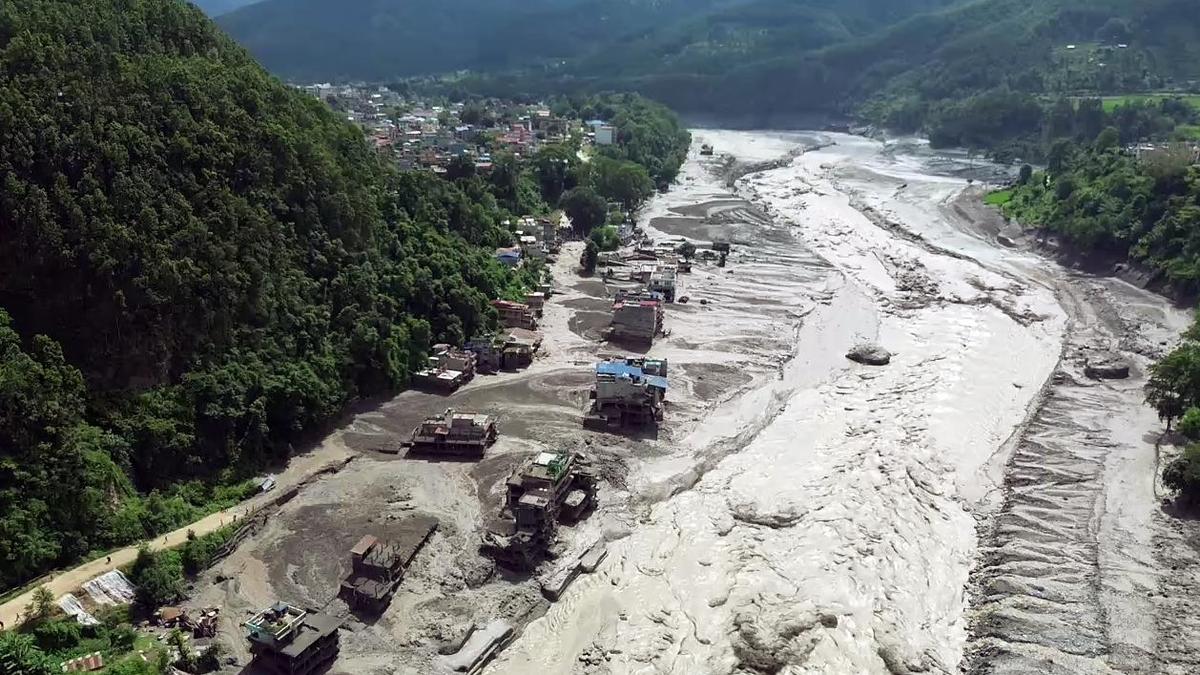
KATHMANDU : Dozens of people were dead and hundreds of others – many of them foreign tourists – were missing on Wednesday night, hours after massive flash floods and landslides engulfed a border area between China and Nepal. Chinese state media reported that the disaster struck Nepal at around 9am, spilling over into Gyirong county in the Tibet autonomous region, causing “major casualties and missing persons” at a border checkpoint in the county, which is administered by the city of Shigatse. Footage circulating online showed a landslide descending on the Gyirong Port checkpoint in seconds as people on the ground fled, before mud and debris obscured the camera. The South China Morning Post could not independently verify the video. Gyirong Port is Tibet’s main foreign trade port and handles the vast majority of China’s trade with Nepal.
Quoting a rescue command centre in Gyirong, state broadcaster CCTV reported that by 8pm three people were dead and 265 were missing after the landslide in the county. Shanghai-based news outlet The Paper quoted Nepalese police as saying 97 people had been killed and 54 rescued in Nepal.
In Nepal, 384 tourists and travellers were missing – 93 Nepalese and 291 foreigners, according to the Nepal Tourism Board. The board said the missing foreigners included citizens from India, Australia, the United States, Britain and the Netherlands. The nationalities of 111 individuals had yet to be confirmed. The Kathmandu Post quoted Rijan Bhakta Kayastha, a professor at Kathmandu University and climate researcher, as saying that an ice avalanche falling into the upstream section of the Lhende Khola River might have created a surge of water sweeping downstream, causing a flash flood in the Bhotekoshi River. Kayastha noted that the initial assessment was based on preliminary findings between Nepali and Chinese scientists.
Meanwhile, Nepal’s disaster management agency said it had received similar findings, but emphasised that the assessment was initial and that official efforts remain focused on search and rescue. Chinese President Xi Jinping ordered local authorities to “spare no effort” in the search and rescue mission, evacuating residents, promptly treating the injured and minimising casualties. Xi also called for monitoring and early warning systems to be strengthened, and prevention of secondary disasters.
Soldiers and personnel from the People’s Armed Police, a paramilitary law enforcement agency, had arrived at the scene for emergency rescue and disaster relief operations. The authorities have closed the road leading to the Gyirong checkpoint for the next seven days.
State-owned construction and emergency response firm China Anneng Construction Group sent 200 emergency personnel as well as geologists and engineers to the site, with 100 more on standby for deployment, according to state news agency Xinhua. The team deployed to the disaster zone brought construction machinery and advanced equipment, including reconnaissance drones, 3D laser scanners and life detectors, the report said.
China’s embassy in Nepal had activated its emergency response mechanism and checked on Chinese nationals and enterprises in the disaster zone, the mission said in a statement.
It also called on the Nepalese government to conduct full-scale rescue operations. China Newsweek reported that about 60 Chinese personnel were working for the Tibet Tianlu construction company on a highway repair and improvement aid project near the port when the disaster struck. A family member of one employee was quoted as saying that the company’s office was just 3km (1.9 miles) from the customs building at the port and he had lost contact with his wife and the entire team.
More than 10 Chinese workers employed on other construction projects were also living in nearby low-rise factory buildings, which were all swept away, the man said.
China is Nepal’s second-largest trading partner, accounting for roughly 16.9 per cent of the country’s total trade. It is also a major source of imports for the Himalayan country. China allows trade and transit through six border points, five of which are in Shigatse, the second-largest city in Tibet.
However, disruptions caused by flash floods earlier this year had left hundreds of vehicles stranded and contributed to a 24 per cent drop in electric-vehicle imports in Nepal’s financial year ending in mid-July, local media reported. In 2018, China announced that it would build what it calls a Trans-Himalayan Multi-Dimensional Connectivity Network with Nepal – involving railways and communication links – as part of the Belt and Road Initiative.
For Nepal, this network could be a lifeline. The landlocked nation has suffered multiple devastating, months-long economic blockades imposed by New Delhi – most notably in 1969, 1989, and 2015 – which choked off vital supplies of fuel, medicine and food.
For this reason, Kathmandu views Beijing as an indispensable strategic counterweight to its southern neighbour. Nepal joined the Belt and Road Initiative in 2017, but progress on related projects has been slow, constrained by weather disruptions, poor local infrastructure and geopolitical friction. A cornerstone project, the proposed Rasuwagadhi-Kathmandu Rail Line that would connect Gyirong with Kathmandu, remains at the planning stage.
