

Ministry of Coal Unveils ‘AAROH’, India’s First Comprehensive Report on Scientific Mine Closure – Indian PSU

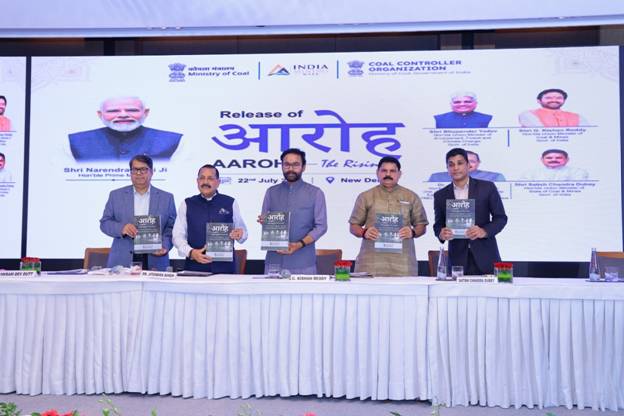
The Ministry of Coal has released ‘AAROH: Annual Report on Mine Closure’, India’s first comprehensive publication documenting scientific mine closure and mine repurposing practices, marking a significant step towards sustainable mining and ecological restoration. The report showcases the transformation of 42 scientifically closed coal mines into environmentally restored and socially productive landscapes.
The report was unveiled at a high-level event attended by Union Minister for Coal and Mines G. Kishan Reddy, Union Minister of State (Independent Charge) for Science & Technology Dr. Jitendra Singh, Minister of State for Coal and Mines Satish Chandra Dubey, German Ambassador Dr. Philipp Ackermann, senior government officials, industry leaders, academia, and international stakeholders.
Developed by the Coal Controller Organisation, AAROH documents the scientific closure of 42 coal mines, featuring structured reclamation, ecological restoration, sustainable land use, and community-oriented initiatives. Each mine profile includes before-and-after visuals, key closure interventions, post-mining land-use outcomes, and QR code-enabled documentary videos highlighting the transformation journey.
The publication also highlights the evolution of India’s mine closure framework, covering initiatives such as the RECLAIM Framework, L.I.V.E.S. Framework, SUVIKALP – Mine Repurposing Tool, and SUVIKALP Samvaad, all designed to promote scientific assessment, stakeholder participation, and sustainable post-mining development.
A major highlight of the event was the signing of an Implementation Agreement between the Ministry of Coal and Germany’s Deutsche Gesellschaft für Internationale Zusammenarbeit (GIZ) to strengthen Indo-German cooperation on scientific mine closure. Supported by Germany’s Federal Ministry for Economic Cooperation and Development (BMZ) and co-financed by the European Union, the EUR 10 million project will run for four years, focusing on mine repurposing, technical capacity building, knowledge exchange, and adoption of global best practices.
Addressing the gathering, G. Kishan Reddy said India has fundamentally changed its approach to mine closure under the leadership of Prime Minister Narendra Modi, viewing it as the beginning of new opportunities rather than the end of mining. He said 42 coal mines have already been scientifically closed, including 33 during the past year, and the government has set a target of scientifically closing 147 more mines over the next two to three years.
The Minister announced that the government has created a dedicated corpus of over ₹40,000 crore (approximately USD 5 billion) for scientific and progressive mine closure. He also revealed that, for the first time, 25 percent of approved mine closure costs have been earmarked for community development, creating an estimated investment potential of nearly ₹10,000 crore over the coming decade.
Highlighting successful examples from West Bokaro, Bishrampur, and the Viveknagar Solar Project, Reddy said reclaimed mine lands are now being repurposed for renewable energy, eco-tourism, water conservation, agriculture, community infrastructure, and sustainable livelihood generation. He emphasised that the India-Germany partnership would combine global expertise with India’s scale and implementation capabilities to create a robust model of scientific mine closure.
Dr. Jitendra Singh described scientific mine closure as an example of the circular economy, stating that degraded mining areas are being transformed into productive assets through ecological restoration, afforestation, renewable energy, and community-centric initiatives. He reiterated India’s commitment to achieving its Net Zero target by 2070.
The Ministry said the release of AAROH reinforces India’s commitment to responsible mining, ecological restoration, technological innovation, and sustainable post-mining development, contributing towards the national vision of Viksit Bharat 2047.
