


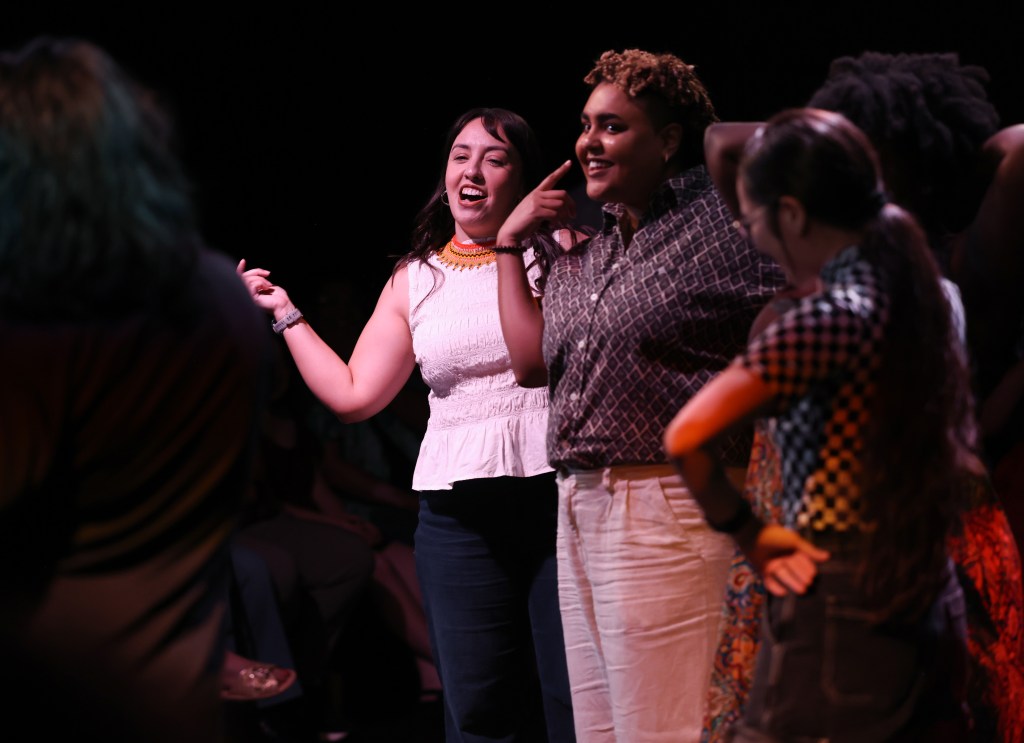
Rudy Mendoza is ready for the show to start. He bounces up and down on the balls of his feet, grinning in front of the full house at the Kimball Arts Center.
“¿Cómo estamos?” he roars, and the crowd roars back, listos beyond belief for the evening’s entertainment to begin.
Every month, Mendoza hosts El Showcase at Collaboraction Theatre in Humboldt Park. Although Chicago is a city where you can practically pick a location at random and be assured an improv show will be going on nearby, this show manages to stand out: El Showcase is performed in both Spanish and English, often simultaneously, by the students of Bilingual Improv School.
Mendoza is the founder of Bilingual Improv School, the city’s only improv program for both Spanish and English speakers. The school grew from Mendoza’s own frustrations in Chicago improv classes. Despite the fact that, according to the most recently available census data, nearly a third of Chicagoans are Hispanic or Latino, Mendoza often found himself one of only a few Latino learners in a given classroom — if there were even any others at all.
After he and several other Latino improvisers formed the bilingual improv team Antojitos, Mendoza hoped to give more performers the opportunity to find a similar community. So, in March 2025, he offered drop-in classes at Logan Square Improv to students who wanted to try playing in either language.
The school has grown exponentially since. There are now three full levels of classes for bilingual students. He has a roster of seven other teachers. In July, an entirely Spanish-speaking class, taught by improviser Licinio Garcia, will begin.
In founding the school, Mendoza purposely connected with the art form’s past. Improvisational comedy as taught at Bilingual Improv School — as well as at iO and CIC — began in Chicago thanks, largely, to two women who worked within the multilingual immigrant communities of the early 20th century: Neva Boyd and Viola Spolin. Boyd, a sociologist who trained social workers at Hull House, believed children learned best through play and encouraged the use of storytelling and game playing when working with them. This was especially important at Hull House, where there was no guarantee that any two children might even speak the same language.
Aretha Sills, Spolin’s granddaughter and herself a writer and teacher of improvisational theater and creative writing, said that Boyd would “travel the world gathering traditional children’s games, like the Alan Lomax of traditional games,” then take these games back to Chicago to teach social workers “how to go into the community and work with groups of all kinds, using play.” For Boyd, play went beyond the physical actions of running or jumping. Sills said that Boyd believed that working toward a common goal “teaches kids how to be part of a group, a community and a democracy.”
Spolin worked closely with Boyd in the 1920s, training to be a social worker herself. She also studied the techniques of renowned acting teacher Konstantin Stanislavski, who often asked performers to improvise as the characters they play in order to better understand their roles. Spolin joined the Chicago branch of the Works Progress Administration’s Recreational Project as a drama supervisor in the late 1930s. Working with children and adults whose English capacities were limited, she had to create a method that would facilitate communication across ethnic and linguistic barriers while forgoing scripts and other written material.
So, she mixed Boyd’s methods with Stanislavski’s theories to create a system of her own that she eventually codified as what she called Theater Games. The goal was to teach, through spontaneous discovery, the formal rules of theater without having to explain aloud each and every one of those rules.
“She called her system of actor training … a non-verbal system,” Sills explains, “because it’s purely experiential, purely learned through play.”
Eventually, Spolin’s son, Paul Sills, took these games and had adults perform within those confines. He co-founded a group known as The Compass Players, which eventually spun off another troupe known as The Second City, where he served as founding director.
Aretha Sills noted that Bilingual Improv School’s mission harkens back to Spolin’s original goals of fostering community and communication. “When you don’t feel like part of the common culture or the common language, it makes it even doubly intimidating” to attempt something like improvisational comedy, she said. But creating opportunities for students to play and “not worry about performance” helps people move “past that barrier and into a space of pure play.”
“To open up improvisation to everyone is, it’s just lovely and wonderful,” Sills says, “and the true intention of improvisational theater.”
Mendoza agrees. “I love this art form,” he said during his curtain speech following El Showcase. “But it hits different when it’s your culture represented on stage. It hits different when it’s in a language that you grew up hearing.”
The school welcomes students of any linguistic background, whether they are improving their English as a native Spanish speaker, improving their Spanish as a language learner, or getting back in touch with their heritage.
“The T-shirts we have say ‘sin pena,’ ‘without shame,’” Mendoza explains. “Come as you are.”
Laura Santana had never done improv before signing up for level one earlier this summer. A self-proclaimed “no sabo kid” (that is, a person whose family spoke Spanish, but who never learned it fluently for themselves), the software developer initially took the classes to improve her Spanish language skills while meeting new people. Now, however, she’s hooked into the comedy world, eagerly awaiting the beginning of her level two class while encouraging anyone to take a chance on the art form.
“If you want to get better at improv, you want to get better at your Spanish, or just get out of the house,” she says. “Anybody should come.”
Her teammate Celina Hernández agrees. A fellow first-timer, Hernández, who grew up speaking Spanish, says the theater’s commitment to “sharing different cultural references, speaking different languages at varying levels of experience” while ensuring that all players will be “super supportive of whatever it is that you say, even if you’re not sure” made for a great learning experience, and speaks to why classes remain full.
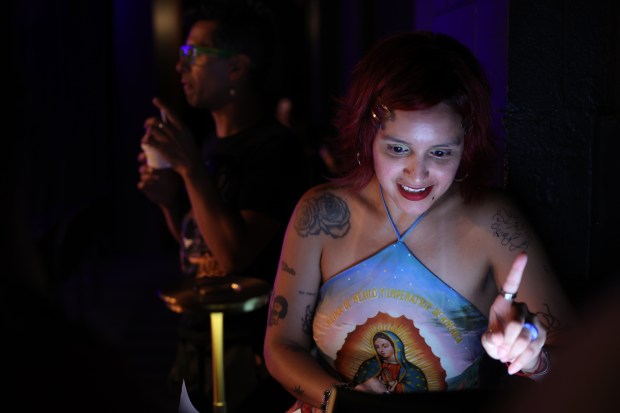
The community the school nurtures extends beyond the show itself. Photographer Rye Oakwynn shot portraits in the lobby. Josh Hernandez, owner of Niyah’s Ice Cream, sold treats from his cart all evening long. Kendra Jamaica, an event producer and performer with comedy group ESCÁNDALO!, ran the ticket booth.
After the show, Jamaica chatted with audience members, looking around proudly from her perch at the door.
“Showing up for people is community,” Jamaica said, both onstage and off. A well-balanced show, in which all the players look out for one another while still shining as individuals, demonstrates how “We can all be main characters and take care of each other.”
“Our mission is to make improv accessible,” Mendoza said as El Showcase came to a close.
By the looks of their quickly-filled classes and shows, Bilingual Improv School (bilingualimprovschool.com) is succeeding in that mission.
Ryan P. C. Trimble is a freelance writer.
