

NICDIT Apex Meeting reviews industrial corridors, accelerates BHAVYA and manufacturing push

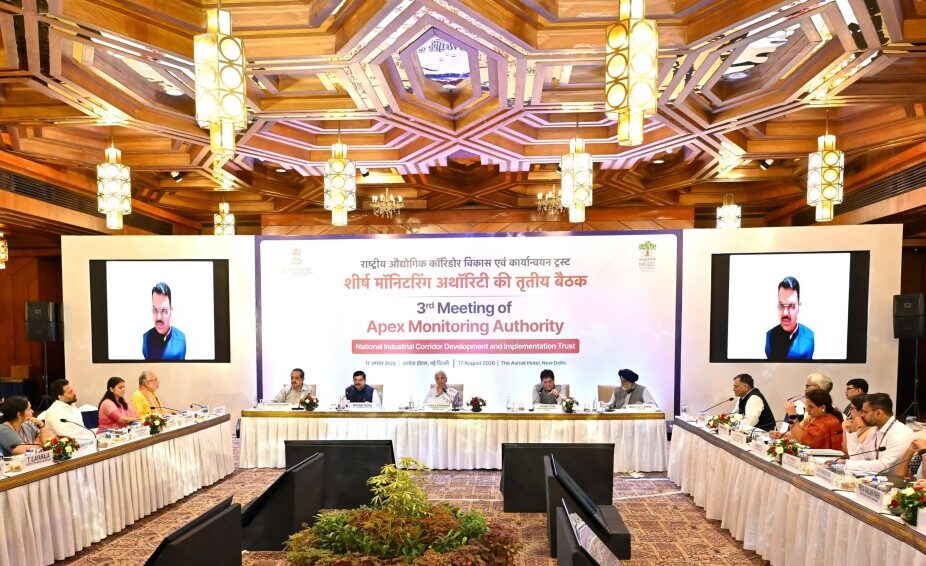
NEW DELHI : Union Minister for Commerce and Industry Shri Piyush Goyal participated in the 3rd Meeting of the Apex Monitoring Authority of the National Industrial Corridor Development and Implementation Trust (NICDIT), chaired by Union Minister for Finance and Corporate Affairs Smt. Nirmala Sitharaman.
Union Minister for Ports, Shipping and Waterways Shri Sarbananda Sonowal, along with Chief Ministers, Deputy Chief Ministers and Ministers from participating States, also took part in the deliberations and shared valuable inputs on accelerating industrial development and strengthening investment ecosystems across the country.
The meeting reviewed the progress of projects under the National Industrial Corridor Development Programme (NICDP) and deliberated on implementation priorities for the next phase of industrial corridor development. Discussions focused on translating approvals into faster execution, timely completion of infrastructure, land allotment, investment mobilisation and commencement of production.
Focus on Faster Industrial Corridor Development
The Apex Authority emphasised that industrial corridors must evolve into globally competitive, investment-ready manufacturing ecosystems, supported by high-quality infrastructure, multimodal connectivity and efficient logistics.
Smt. Sitharaman stressed that the next pipeline of industrial land and infrastructure should be developed well ahead of the exhaustion of existing industrial land inventory. She also called for resolving bottlenecks relating to land, connectivity, utilities, statutory clearances and the powers of project Special Purpose Vehicles (SPVs) to ensure timely implementation.
The meeting further highlighted the importance of pursuing industrial corridor development in the spirit of ‘Team India’, with greater convergence between Freight, Industrial Development, Railways and Expressways—an integrated approach described as the FIRE Corridors.
BHAVYA to Accelerate Investment-Ready Industrial Infrastructure
A major focus of the discussions was the rollout of the Bharat Audyogik Vikas Yojana (BHAVYA), the Government’s flagship initiative to develop 100 plug-and-play industrial parks across the country.
BHAVYA has a financial outlay of ₹33,660 crore over six years, from FY 2026-27 to FY 2031-32. The scheme is designed to create investment-ready, world-class industrial infrastructure that enables investors to establish manufacturing operations with greater speed and ease, thereby expanding India’s manufacturing capacity.
The scheme places emphasis on plug-and-play infrastructure, integrated planning, investment promotion and efficient project implementation, with States and project entities playing a critical role in providing land, external infrastructure, utilities and other enabling facilities.
PM GatiShakti and Integrated Industrial Planning
The meeting also underlined the importance of PM GatiShakti in ensuring integrated planning of industrial corridors and supporting infrastructure.
Industrial development is increasingly being planned around multimodal connectivity, enabling seamless movement of raw materials and finished goods while strengthening India’s logistics competitiveness. The Government’s broader National Industrial Corridor Development Programme aims to develop futuristic industrial cities with plug-and-play infrastructure and multimodal connectivity capable of competing with leading global manufacturing and investment destinations.
Shri Piyush Goyal called for faster and outcome-oriented implementation of industrial corridor projects, with greater emphasis on timely investment and operationalisation. He also stressed that BHAVYA and future industrial developments should be aligned with PM GatiShakti and pursued through an integrated area-development approach.
Strengthening India’s Global Manufacturing Position
The deliberations assume significance as India seeks to strengthen its position as a globally competitive manufacturing and investment destination. Modern industrial corridors, world-class infrastructure, efficient logistics and ready-to-use industrial land are expected to help attract domestic and global investors while enabling industries to integrate more deeply with global value chains.
Beyond physical infrastructure, the industrial corridor ecosystem is also being positioned around skilling, worker housing, healthcare, public transport and other social amenities, ensuring that industrial growth is supported by a sustainable and inclusive development framework.
The meeting reaffirmed the Government’s commitment to creating an enabling environment for manufacturing-led growth, investment generation, employment creation and technological advancement.
The coordinated efforts of the Centre and participating States are expected to provide further momentum to India’s industrial corridor programme and accelerate the development of new manufacturing clusters and investment destinations.
With the rollout of BHAVYA, continued implementation of NICDP projects and greater integration through PM GatiShakti, the Government is seeking to build a future-ready industrial ecosystem that can attract large-scale investment, generate quality employment and enhance India’s competitiveness in global manufacturing.
The deliberations reaffirmed the Modi Government’s commitment to building a globally competitive manufacturing ecosystem and advancing India’s journey towards a prosperous and self-reliant Viksit Bharat.
