


I spent all of dinner begging them to send the pitch decks I swore I needed to write the smackdown on the non-profits I had been waiting all summer to write. Ok, fine: “begging” is a bit dramatic. But I was breaking bread with a Broadway money-man, so dramatics are the default language. I swore discretion and not to become the sort of person who obtains a capitalization packet and immediately starts workshopping adjectives.
The answer was a resounding “maybe.” The confidentiality warnings for sharing this information made the NSA look easygoing (although under Pushup-Pete, the security protocols are probably similar).
As I awaited the co-producer to finish having a conscience, my apartment descended into a third-world country. During the savage swamp-like heat of August, my plumbing spontaneously combusted. My landlord treated my bombardment of maintenance requests with the kind of smug apathy slumlords reserve for threats of legal action, which is to say: he ignored them. The rhythms of my bowel movement were soon dictated by local liquor licenses. I would cross 9th Avenue, dodging taxi cabs, bikers and that stupid Waymo that keeps circling my block, run into the bar across the street and bark at the bartender that I would order a $12 Stella upon my return as I ran to the back to use their facilities. I kind of enjoyed the theater of it all.
About 2 days later, sitting on a Craft+Carry’s toilet, drained from either the cross-street sprint or the constipation, an email appeared. The subject line: Don’t Say I Never Did Anything For You.
I laughed, ran home, and made it halfway up my stairs before realizing that I forgot to pay my tab. Between the bathroom beers and nights spent pretending to read just to bait a girl into making eye contact, I figured my debt was paid.
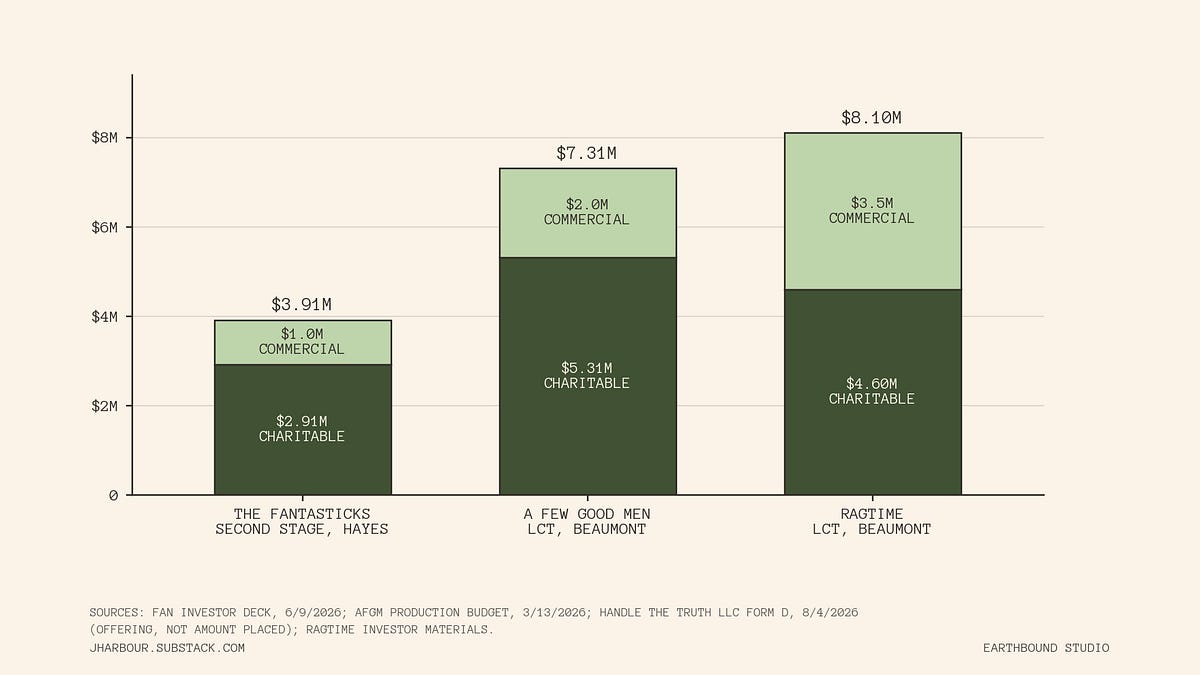
The first page placed the budget numbers I had been looking for directly over the poster art for The Fantasticks. Purple watercolor, stars, a moon. Beneath it all: $3.91 million.
A fun little aside, the budget page reads “COMMERICAL EXPENSES FOR HAYES SUMMARY.” I won’t be the one to tell the GMs that they spelled the word justifying their paycheck wrong…
Second Stage is contributing $2.5 million, with another $400,000 in reserve. The commercial side put in $1 million, but raised an additional million, with half of that ($500,000) reserved specifically for transferring the production elsewhere.
The money to be distributed to Second Stage was labeled Loan to Not For Profit, with a tiny asterisk that led to the smaller phrase: NFP Non-Recourse Loan. “Non-recourse” means that the investors’ exposure stopped with their contributions. On the flip side, investors could receive up to 25.6% of profits, post-recoupment.
I couldn’t see where the company was getting the 25% figure. Nothing in the materials tied it to time or some escalating return. Then I did the dumbest math possible: 1 million ÷ 3.91 million = 25.6%
Then I looked at Ragtime’s recoupment chart. Same thing. $3.5 million in outside capital divided by an $8.1 million capitalization = 43.2%. The interest rate on the “loan” is just the investors’ share of the capitalization. I looked at that and thought:
This looks a lot more like equity than debt if you ask me.
But I was getting ahead of myself. I had the documents and the employees involved with these shows told me the arrangements were more sinister than they looked. My confirmation bias eventually ran into a much more annoying question: what’s the big deal?
After a lot of weed and a lot more time spent staring at my monitor while Geese’s entire discography rung out in my ears, I eventually produced a thesis that I thought was strong enough to walk into my Tuesday seminar with weaponized white male syndrome, ready to “well actually” the room. The grand idea: Broadway’s nonprofits had become commercial theaters in charitable drag. I titled the article “The Abrogation of the Throne.” I’m ashamed that I was so desperate to write something that I grasped at the easiest villain available.
To my surprise, or detriment, the people sitting across the table weren’t just passive targets for my own hubris, but equally as engaged in the conversation. All to say, this was a really fun way to find out I’m the most annoying person in the room. As the conversation began and I stepped on my high horse to lecture about the institutional misgivings of these companies, someone stopped me in my tracks and asked:
What are they supposed to do instead?
The question, written before me on the page, really doesn’t feel that revolutionary. Which is exactly why it bothered me so much.
How did I not think of this?
They went on to make the very point that with institutional giving down, nonprofits have essentially been strong-armed into this decision. My weeks of work, coupled with a raging headache from two all-nighters, was answered with the simple defense of… survival. I spent the remaining 83 minutes of our seminar scribbling a manifesto like a mad man on my 8×11 spiral notebook. Apologies to whoever was sitting next to me and had to witness that.
If these institutions were really facing an existential financial situation, “they’re acting commercial” wasn’t much of a fair, nor novel, accusation. The question soon turned to:
Once commercial capital entered the nonprofit stream, whose risk did the nonprofit’s advantages reduce, and who captured the resulting value?
It’s important to first see HOW desperate the institutions actually are.
Since 2019, Lincoln Center’s net assets rose $4.3 million ($167.4M → $171.7M); Roundabout’s rose $23 million ($117.8M → $140.8M); and MTC’s rose from $36.3 million to $52.9 million (a $16.6M increase).
Second Stage fell from $44.2 million to $34.1 million: a $10.1 million loss.
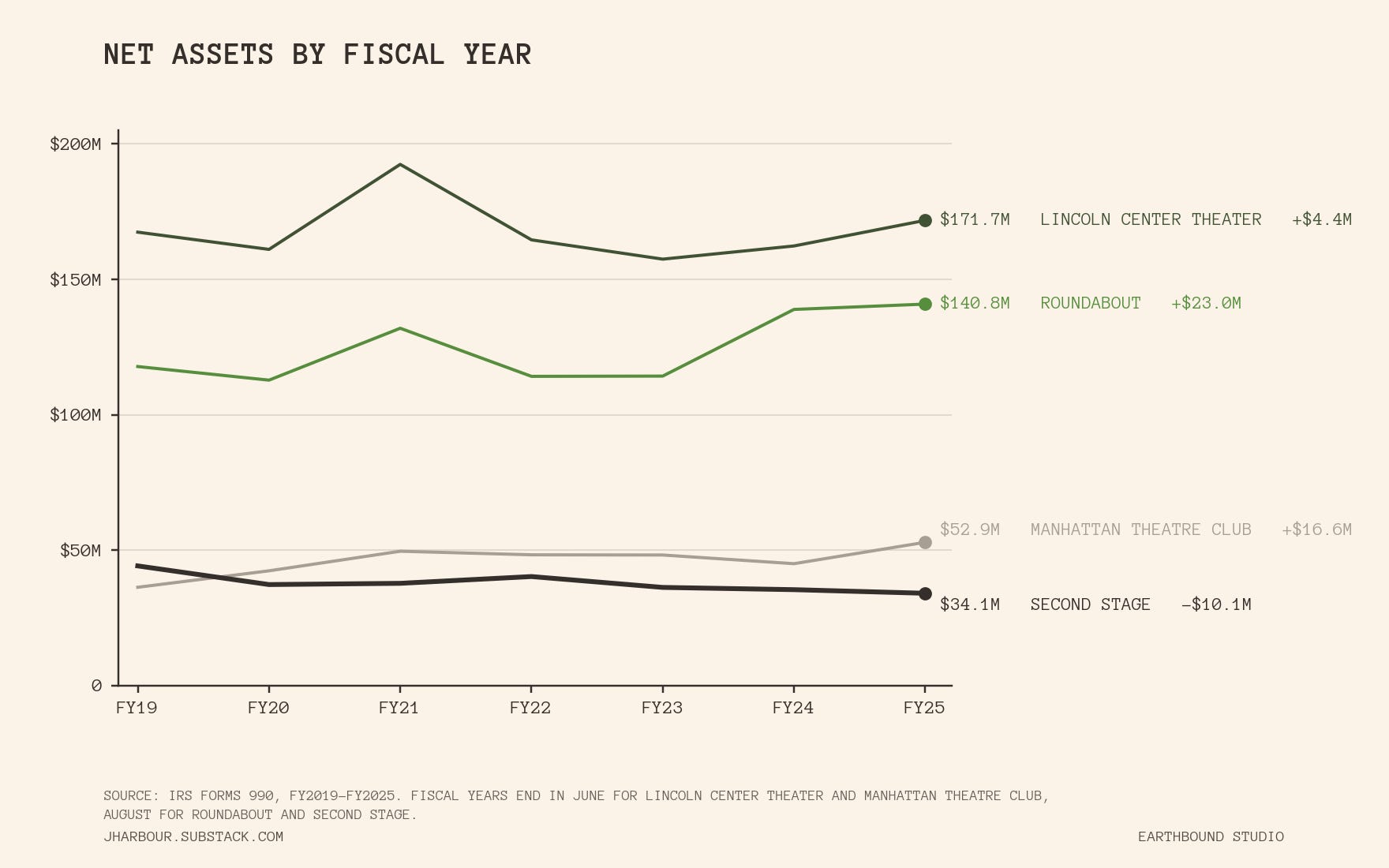
So much for a monolithic theory of “the nonprofits.”
Except net assets are a pretty shitty way to really look at a company’s financial health. A company can look richer on paper because its building appreciated or the S&P had a good year, even while its box office collapsed. In 2023, Lincoln Center’s assets were 94% of its 2019 level while revenue from ticket sales was only 35% of that same year ($16.41M against $46.34M). That trend extends to a non profit theater’s other revenue stream: donors. Nationally, inflation-adjusted ticket income remained 29 percent below 2019 levels while trustee giving fell 28 percent.
And these spaces have only gotten more expensive to operate. In 2021, LCT reported $1.66 million in program service expenses against $70,000 in revenue from ticket sales. Second Stage: nearly 3 million with no revenue at all. While regional theaters can reduce their season to cover some of the operating costs, a landlord with real estate in Midtown cannot make the extortionate costs of the building disappear.
Though Second Stage did exactly that. Two years ago, it ended its lease at the Tony Kiser, its Off-Broadway theatre on West 43rd Street. Its annual occupancy expense fell by $800,000 between 2022 and 2025. It shed the smaller room where new work is usually developed, rented space from an organization whose auditor had raised substantial doubt about its ability to continue functioning (Signature), and retained the Broadway house eligible for a larger state subsidy.
Returning to The Fantasticks: the commercial million is only the first layer.
I won’t belabor the details of the credit here. But I will call attention to the actual language of the statute. A production qualifies if it is a “for-profit live, dramatic stage presentation.”
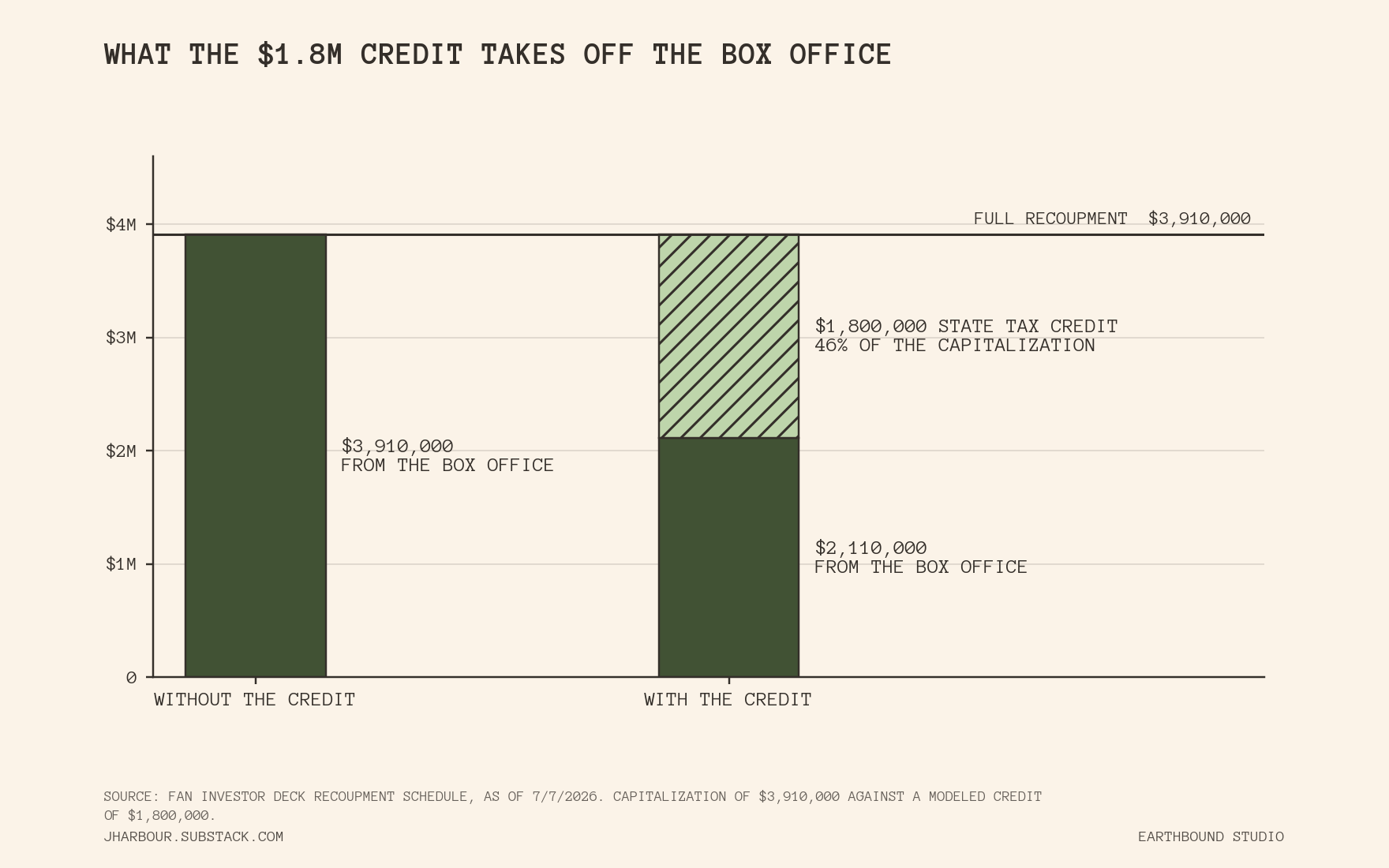
On The Fantasticks, A $1.8 million credit is the difference between financial success and failure in four of six scenarios modeled in the recoupment chart. No one is saying “the state is de-risking our investors,” but after looking at the deck, the impression was unavoidable.
Per Ben Waterhouse’s awesome article, non profit productions, boosted by enhancement money, employ actors in their Broadway houses under a LORT agreement rather than the standard Approved Production Contract. When Ragtime began performances, the LORT A+ actor minimum was $2,020 per week. The APC’s was $2,717. Ragtime had a cast of 33 and was originally a 14-week engagement. That price difference is worth $322,000; nearly 4% of the show’s $8.1 million capitalization.
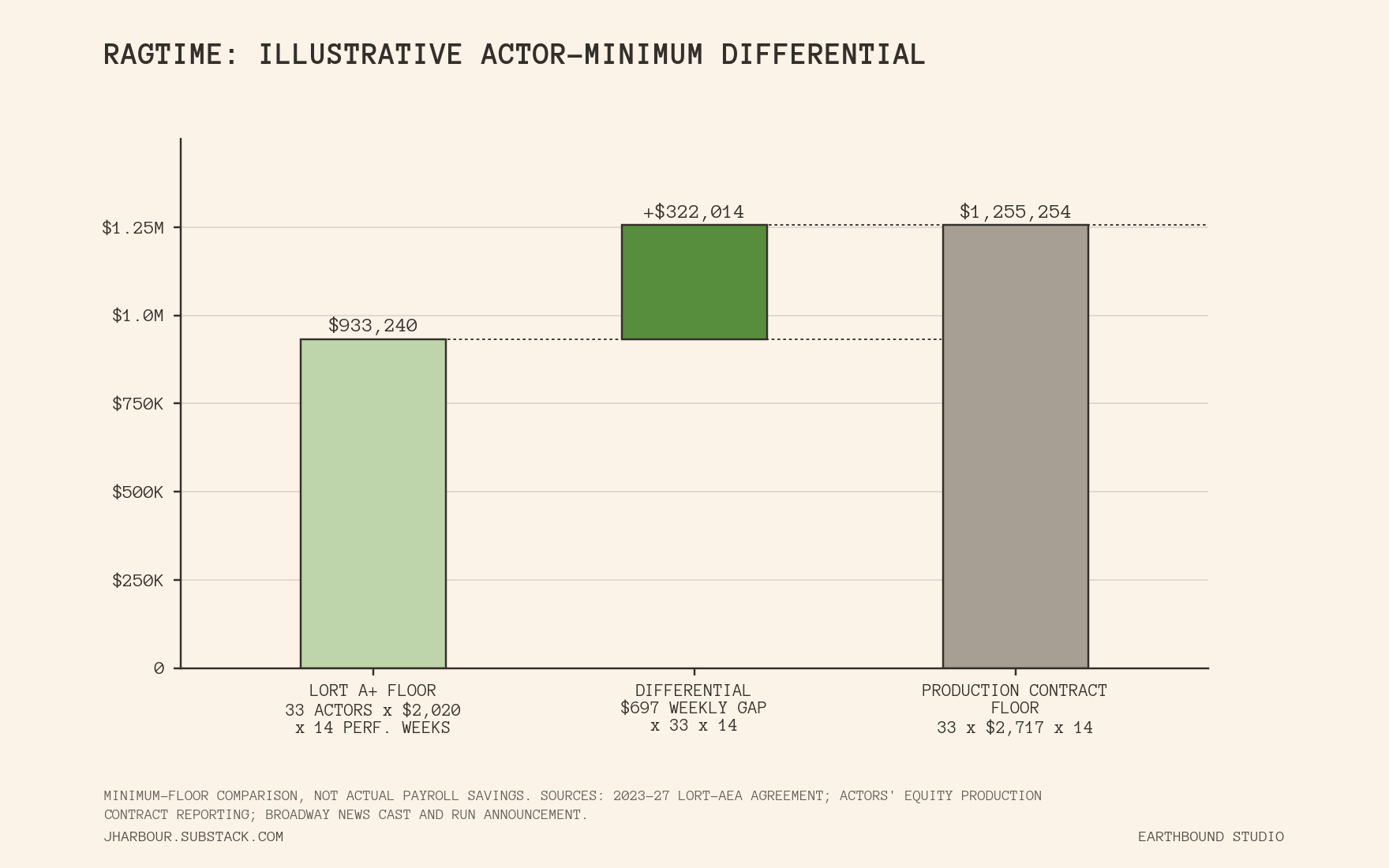
Add four more weeks of rehearsal and the number rises to $414,000 before even including stage managers or payroll taxes.
The AEA CBA does have safeguards in place for when a nonprofit production extends. At the Beaumont, an extension beyond the originally scheduled run triggers APC minimum salaries. Once Ragtime extended, the higher floor applied going forward. By May, Ragtime had repaid about half of its outside investors’ stakes.
But actors are not backpaid for the discount they took during that 14-week window. Commercial capital can recoup and continue into profits during this time period. In fact, that’s the whole game plan.
The cast only gets a competitive salary in the marketplace AFTER the show is already proven to be popular, underwriting the riskiest phase without ever being retroactively compensated for the risk they quietly absorbed.
I can defend the lower nonprofit wage floor when it buys something the market ordinarily will not. Even then, calling it a collective wager is generous; only producers and investors participate in the upside. The bargain becomes much harder to justify in an enhanced revival with a recognizable title. Discounted labor is no longer financing artistic discovery. Every dollar saved on an actor’s salary shortens the road to recoupment, improves the commercial partner’s economics, and converts a concession negotiated for nonprofit theater into a subsidy for private gain.
Truthfully, I don’t really care if a revival appears on a nonprofit stage or if it uses enhancement money to help get new work off the ground. But the intersection of these types of shows are when the problems emerge: when the advantages of a certain tax status are used as a safety net for a recycled crowd-pleaser with commercial capital at the table.
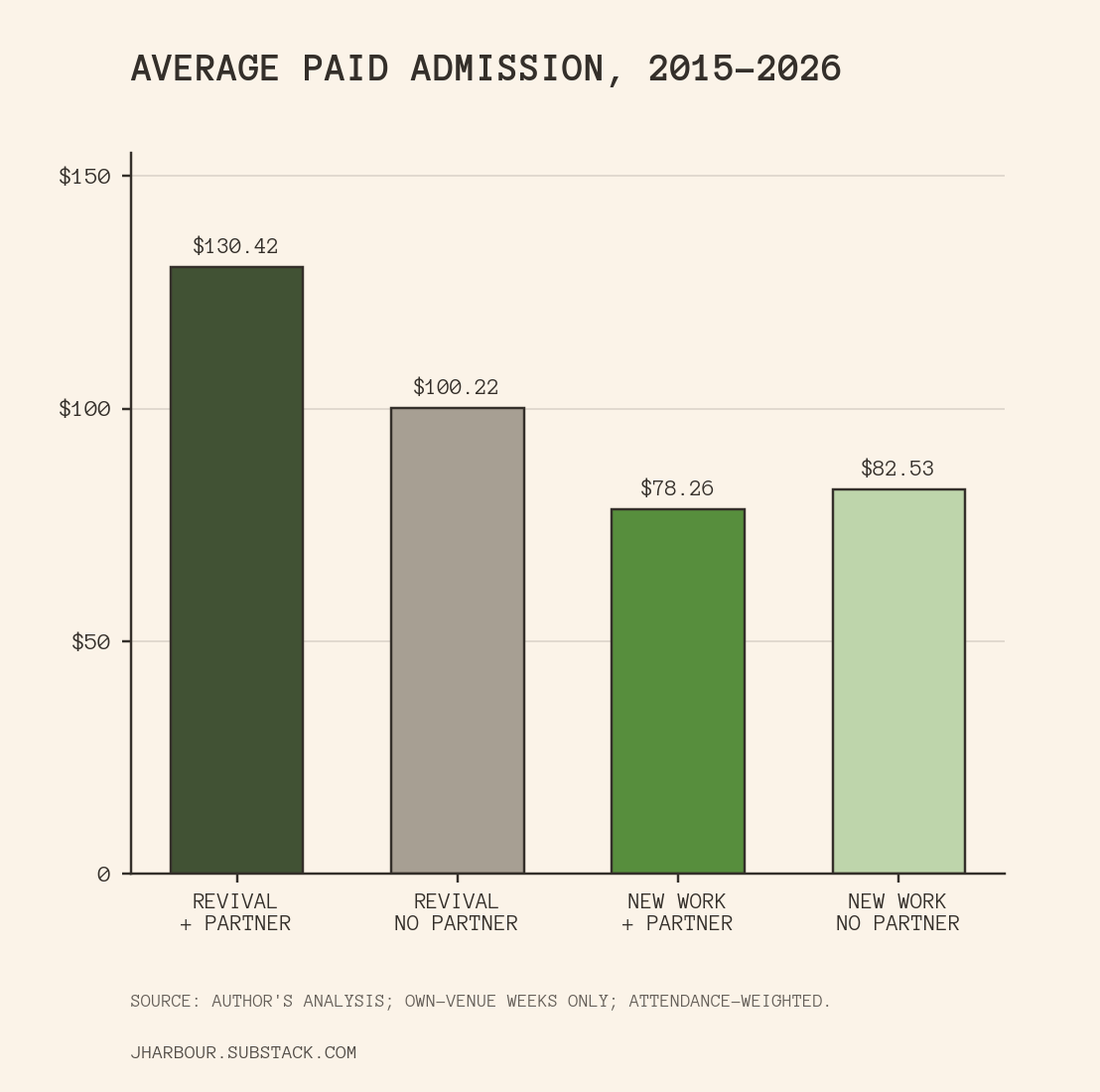
When the perks of being a non profit are used to incubate a privately controlled commercial asset, it unlocks an asinine double-scam. Us, the citizens, pay for the commercial industry to beta test the work with our tax dollars (work, mind you, that was already successfully developed back when Y2K still meant the collapse of society rather than a birthday-party theme for girls in the West Village), and then turn around and pay full market price just to see it actually happen on those same subsidized stages. For new work, an outside partner does not tend to correspond with higher ticket prices: about $78 per paid admission, compared with $83 without one. But interestingly, partnered revivals average a $30 price increase ($130 vs. $100) when there is an outside partner.
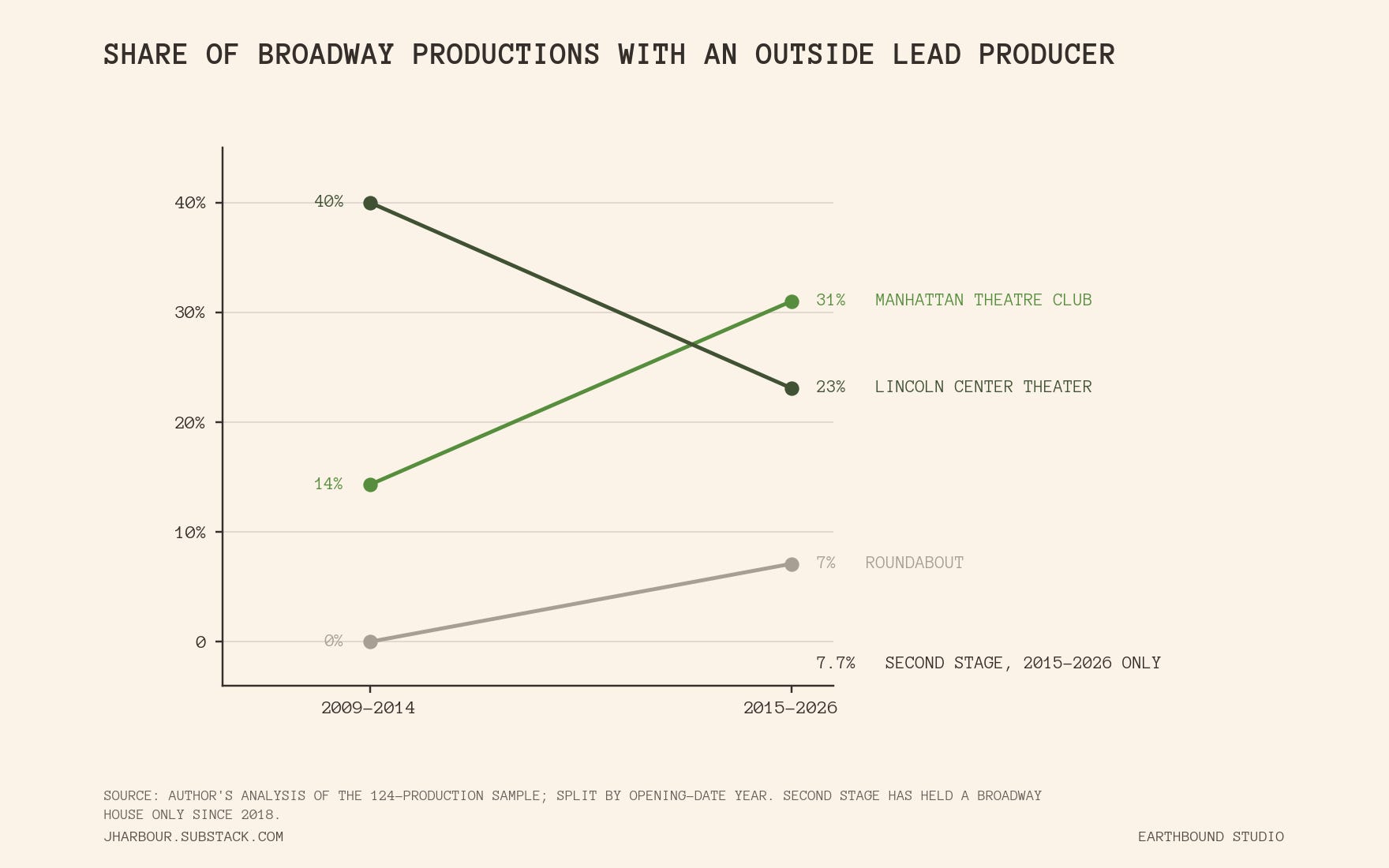
Sure, but it’s no stretch to say the market does respond positively when a familiar property is being presented. And the institutions themselves have all embraced it in their own unique ways. Since 2015, Roundabout has had an outside lead producer on roughly 7% of its Broadway productions, compared with 31% at MTC and 23% at LCT. These theaters are essentially the same; commercial partnership is therefore not an unavoidable condition of survival. Roundabout has simply monetized its institutional advantages differently, including by leasing its Broadway theaters to commercial productions such as &Juliet and Fat Ham.
Faced with financial pressures, a familiar title becomes the easy choice, especially when there are ancillary monetization streams through legible transfer opportunities, like the Ragtime tour, and greater capacity to sustain premium prices. But if financial pressure steers a nonprofit toward the same properties the commercial market already values, the state granted benefits of “charitable status” only reinforces market preferences rather than correcting for its failures.
Just look at the Beaumont. The headline musical two seasons ago was Floyd Collins, technically a Broadway debut but classified as a revival (also an enhanced production); Ragtime followed; and this year, A Few Good Men and The Sound of Music. All revivals. Lear deBessonet described LCT as a home for “thrilling, important new plays and new musicals” as well as “exquisite revivals.” You can’t exactly nail her on the crucifix for a broken promise; she always claimed they would do a little of this, a little of that. And sure, Lincoln Center might toss a few bread crumbs towards the weird new play on its smaller stages. But it’s pretty obvious who the favorite child is when the biggest stage and the deepest pockets are exclusively going to shows that were made when people still had to use MapQuest to get to the theater.
Most of my favorite new plays were developed in this ecosystem. Stereophonic (my all-time #1) arose at Playwrights. Will Arbery’s Heroes of the Fourth Turning. Samuel Hunter’s A Case for the Existence of God made two men discussing a mortgage feel like the most important thing I had watched since my mom forced me to watch a VHS tape of my own bris to “prove that this world will start carving pieces off you before you can even walk.”
According to Oskar Eustis, the utopian dream of revolutionaries like Zelda Fichandler and Mac Lowry has disappeared. Eustis’s obituary hasn’t been received well by the industry, to say the least. Critics like Howard Sherman framed this as an “evolution,” while Brett Bernardini romanticized a decentralized grassroots movement upstream from the elite organizations. I normally am public advocate #1 for an argument like Bernardini’s, but I worry that he overlooks who actually controls the reservoir. New work development, the bedrock of the nonprofit movement, has been pushed toward institutions with the least protection from failure. Clubbed Thumb’s 2026 Summerworks presented three brand-new plays: Titans, Derangements, and The Family Dog. HERE premiered Dream Feed and Parched. Even the Atlantic has devoted its entire 2026–27 mainstage season to four world premieres. Yet none of these have the money, real estate, or margin for failure of the organizations increasingly retreating from that work.
I am not trying to claim that this proves the field is healthy. Smaller companies continue to incubate new work despite their financial precarity. Romanticizing this would be a nice happy ending about scrappy downtown artists, instead of the more gruesome, realistic story about institutional failure.
I agree with Oskar that these mega-institutions have capitulated toward the boogey man, AKA capitalism. Where we disagree is on the consequence:
A funeral does not erase the deceased’s obligations.
The institutions that inherited the buildings, endowments, tax advantages, and discounted labor do not get to keep the assets while disclaiming the public debts attached to them.
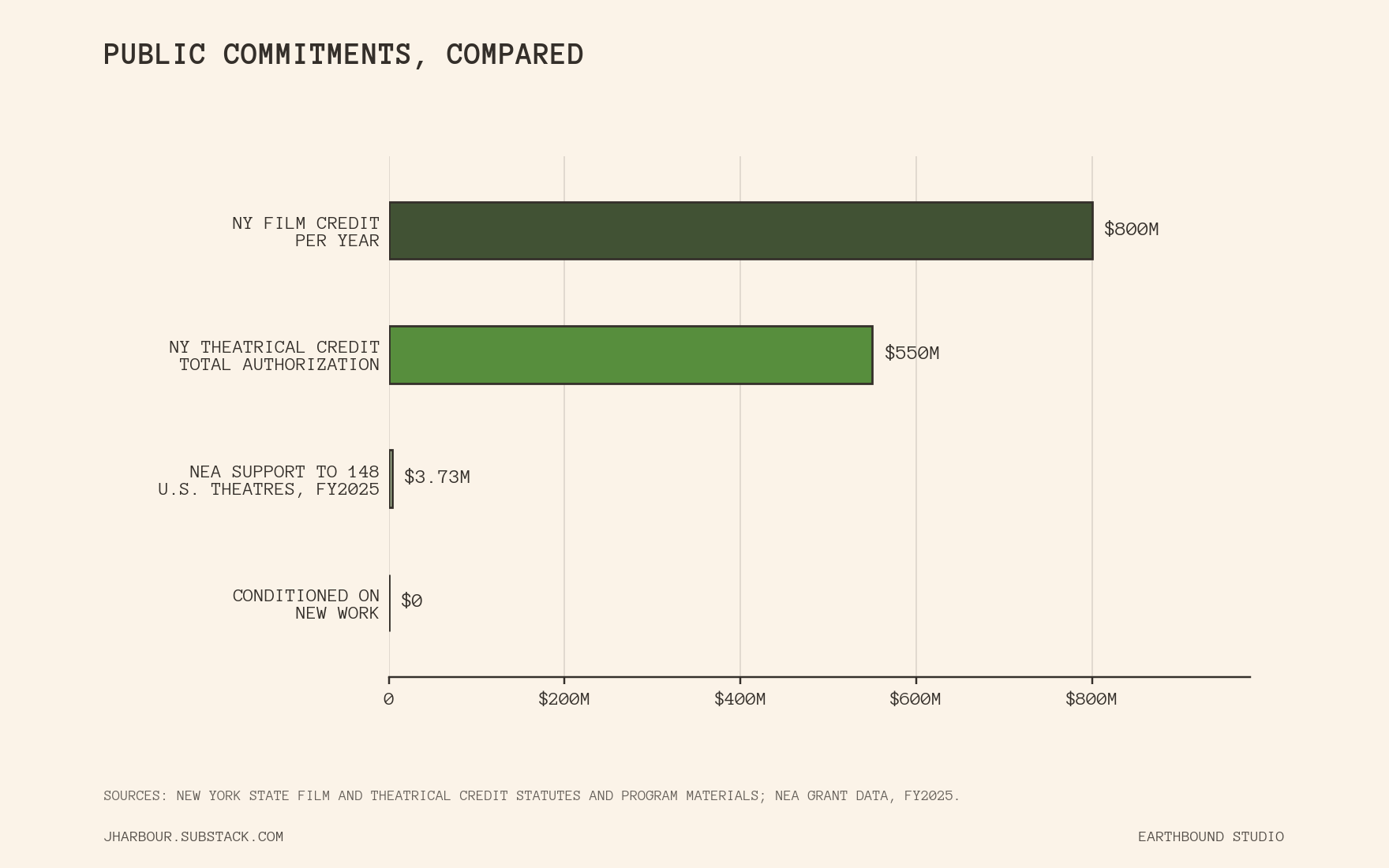
NY State does have a $100 million annual independent-film credit. Why can’t it do the same for indie-theater making original work? The tax credit in its current incantation does allow qualifying productions under Level 2 to claim up to $350,000 in a tax credit. But it does not distinguish between new work and revivals, and given how quickly the last round ran out, it does not guarantee that the program will even exist by the time a project entering development today is finally ready to qualify. And then from an optics perspective, the state would be asking taxpayers to subsidize nonprofits to assume artistic risk, then subsidize commercial producers to assume the risk those nonprofits relinquished. Moreso, any lobbyist would laugh you out the room if you tried to finesse more money from Albany after it just granted the theater industry $550,000,000. Know when you’re ahead.
One revival does not break the nonprofit bargain. Neither does one commercial partner or one tax credit. The mission disappears more quietly than that. Every individual choice can be defended. After enough of them, the only thing nobody can afford is the work the institution was built to produce.
I’m going to be honest: I can’t really think of a solution here. And I hate being the guy who bitches and moans about something to only end the article with no answer. It makes complete sense to me why Second Stage and Lincoln Center would make these choices. I also can’t help but empathize with the up-and-coming artist screaming from his rooftop in Bushwick that his work is being obscured for the security of a musical whose cultural moment passed several decades ago. Admitting that both people have a point counts as personal growth. I hate it.
But I cannot shake the provocative possibility that these institutions deserve to die. No, not the “institution” of non-profit theater. Let’s not be hyperbolic here. But the buildings themselves. Public funding has receded even as the privileges accumulated under the old bargain remain. Those privileges were not lifetime-achievement awards. If an institution can survive only by redeploying those advantages toward the same properties commercial producers already know how to sell, then preserving the organization may no longer preserve its purpose. The fictitious answer is to keep every institutional body alive indefinitely. Perhaps the real answer it is to let some structures fail and ask whether their resources could be inherited by something more capable of honoring the bargain that created them.
