

One-Third Of Global Wildlife Habitats Face Extreme Climate Events By 2085, Warns Major Nature Study – Indian PSU

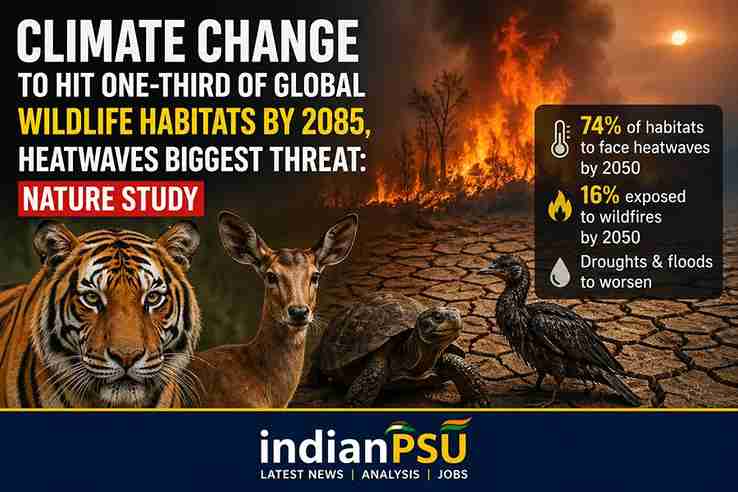
A chilling new global study has warned that more than one-third of wildlife habitats on land could be battered by multiple extreme weather events by 2085, dramatically accelerating biodiversity loss and pushing thousands of species closer to extinction if fossil fuel emissions are not cut rapidly.
Published in the prestigious journal Nature Ecology & Evolution, the study finds that climate change is no longer only a story of gradual warming — it is increasingly a story of compounding heatwaves, wildfires, droughts and floods striking wildlife habitats in quick succession, leaving ecosystems with little time to recover.
Researchers analysed exposure risks across 33,936 terrestrial vertebrate species — including amphibians, birds, mammals and reptiles — spread over 794 global ecoregions, and concluded that under the current medium-to-high emissions pathway, 36% of species’ habitats will face multiple extreme climate shocks by 2085. However, if the world rapidly cuts fossil fuel use and keeps warming below the Paris Agreement threshold of 2°C, the figure could be limited to less than 10%.
Heatwaves Emerging As The Biggest Killer
Among all projected threats, extreme heatwaves emerge as the most widespread and devastating hazard for wildlife.
The study projects that by 2050, nearly 74% of the geographic range of terrestrial vertebrates will be exposed to heatwaves, compared to just 18% in the year 2000. By 2085, that exposure could soar to 93% if current warming trends continue.
This means:
- 9,434 bird species,
- 4,729 mammal species,
- 6,849 amphibian species, and
- 9,155 reptile species
could see at least half of their habitat range repeatedly hit by severe heatwaves within the next 25 years.
Scientists point to the deadly 2019–20 Australian heatwave, which killed more than 72,000 flying foxes, as a stark warning of what such future extremes could look like on a much larger global scale.
Species with restricted habitat ranges are expected to be the worst sufferers. For instance, the study notes that the Carnaby’s Black Cockatoo population plunged by nearly 60% after the 2011 Western Australian heatwave.
Wildfires, Droughts And Floods To Compound The Damage
The study says wildlife is not merely facing one climatic shock at a time.
By 2050, researchers project:
- 16% of habitats exposed to wildfires
- 8% exposed to drought
- 3% exposed to river floods
with many regions likely to experience these disasters sequentially or simultaneously.
Such “compound extremes” are especially lethal because habitats weakened by one event become dramatically more vulnerable to the next.
This was seen during Australia’s catastrophic 2019–20 Black Summer bushfires, where plant and animal species recorded 27% to 40% sharper declines in areas that had already been hit by prolonged drought.
In another grim example, the 2020 Pantanal wildfires in Latin America are estimated to have killed nearly 17 million vertebrate animals, making it one of the deadliest wildfire disasters for wildlife in recorded history.
Southeast Asia Identified As A Future Biodiversity Crisis Zone
While species-rich regions such as the Amazon Basin and tropical Africa remain highly vulnerable, the study singles out Southeast Asia as an emerging epicentre of climate-linked biodiversity collapse, particularly due to the rapid intensification of heatwaves and wildfire frequency.
The region hosts some of the world’s richest concentrations of threatened birds, reptiles and amphibians, many of which already survive in fragmented habitats.
Scientists warn that repeated climate extremes in such fragile ecosystems could trigger local extinctions, collapse of breeding cycles, food chain disruption, and permanent habitat abandonment.
Climate Change Now A Direct Extinction Multiplier
The report underlines that climate vulnerability of wildlife depends on three interlinked factors:
- the degree of exposure to extreme events,
- biological sensitivity of species, and
- their ability to adapt or migrate.
The problem, researchers say, is that current conservation planning across the world still largely focuses on habitat loss and long-term warming averages, while extreme weather shocks remain grossly underestimated in biodiversity risk assessments.
Lead author Stefanie Heinicke of the Potsdam Institute for Climate Impact Research noted that climate change should no longer be seen as a slow-moving phenomenon.
Instead, she argues, sudden bursts of deadly heat, fire and flood may become the defining force reshaping wildlife survival across continents in the coming decades.
Emissions Cuts Still Offer A Narrow Window
Despite the alarming projections, scientists say the study also offers one important takeaway: the worst biodiversity losses are still avoidable.
A rapid transition to net-zero emissions and aggressive fossil fuel reduction could reduce the share of wildlife habitats exposed to multiple extreme events from 36% to roughly 9% by the end of the century.
In simple terms, the future of thousands of species may now depend not only on protected forests and sanctuaries, but also on how quickly the world decarbonises its energy systems.
The writer of this article is Dr. Seema Javed, an environmentalist & a communications professional in the field of climate and energy
