

ONGC Reports 30% Rise in Consolidated Profit, Plans ₹30,000 Crore Capex for FY27 – Indian PSU

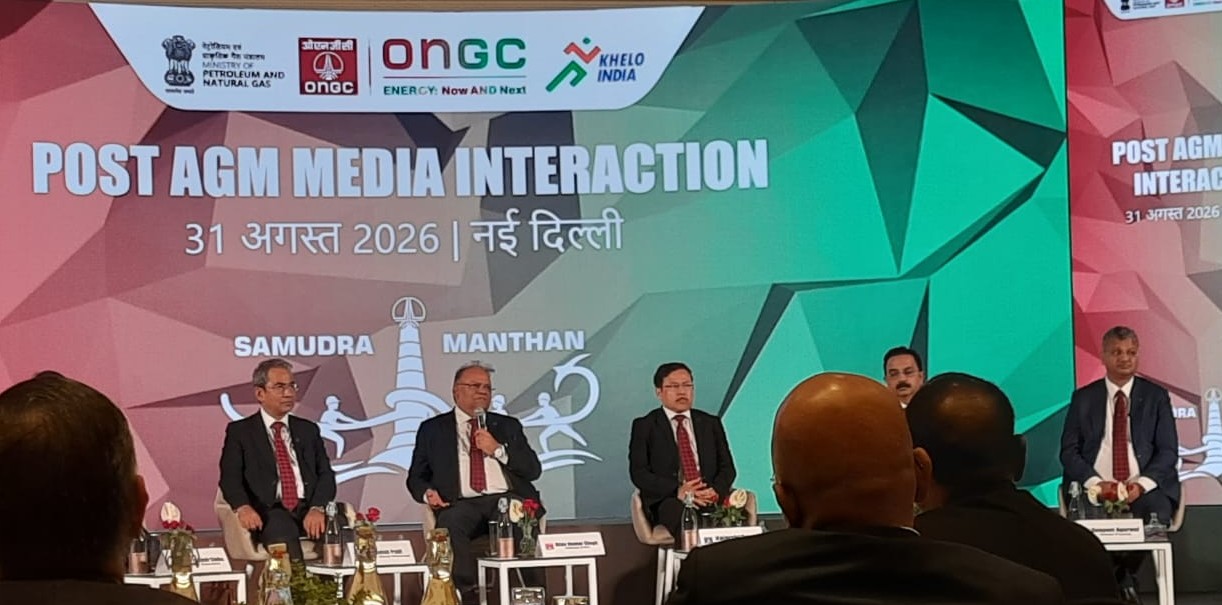
For ONGC, Samudra Manthan is not merely an exploration programme—it is a long-term bet on discovering the country’s next major hydrocarbon resources and reinforcing India’s energy sovereignty: said Chairman ONGC, Arun Kumar Singh.
Oil and Natural Gas Corporation (ONGC) is placing deepwater and ultra-deepwater exploration at the centre of its long-term growth strategy, as the state-owned energy major seeks to unlock new hydrocarbon resources while strengthening production from existing assets. The company’s latest corporate presentation highlights an ambitious exploration campaign, major investments, technology-led production enhancement and a parallel push into green energy.
ONGC has described deepwater exploration as a key avenue for “unlocking India’s next hydrocarbon frontier.” The company said it is expanding its presence in deep and ultra-deepwater areas because of their large resource potential, while deploying advanced seismic technology, artificial intelligence and machine learning, and basin analytics to pursue high-impact discoveries. Importantly, 68% of the total deepwater acreage awarded up to OALP-IX is with ONGC, making it the largest shareholder in India’s deepwater exploration space.
Samudra Manthan drives deepwater push
The flagship of this strategy is Samudra Manthan, which ONGC describes as India’s boldest bet on energy sovereignty, with the company acting as the nation’s flag bearer. Launched in August 2025, the campaign is planned as a five-year deepwater and ultra-deepwater drilling programme targeting more than 87 wells by FY2031.
The drilling programme is scheduled to accelerate progressively, from four wells in FY26 to eight in FY27, 10 in FY28, 20 in FY29, 22 in FY30 and 27 in FY31. ONGC has indicated approximately 5.6k MMToE of potential oil and gas resources in deepwater and ultra-deepwater areas, with the total investment required for the campaign estimated at around ₹1 lakh crore.
The Government of India has approved a total outlay of ₹84,084 crore for Samudra Manthan, or the National Offshore Exploration Scheme, covering the preparatory year FY2026-27 and implementation from FY2027-28 to FY2030-31.
ONGC’s broader exploration plan also calls for eight deepwater wells in FY27 and 10 in FY28, while more than 350 exploratory wells across onshore and offshore areas are planned up to FY30. The company intends to undertake exploration in a phased manner, combining extensive seismic campaigns, high exploration inputs and technology-led prospect identification before moving towards appraisal.
New discoveries alongside production revival
The deepwater programme is being pursued at a time when ONGC is also working to arrest production decline from mature fields. Standalone oil and gas production was 38.86 MMToE in FY26, compared with 39.25 MMToE in FY25, while production including joint ventures stood at 40.47 MMToE.
The company expects technology and asset optimisation to support higher output. It projects oil production to increase from 18.87 MMT in FY27 to 20.34 MMT in FY29, while gas production is projected to rise from 19.99 BCM to 23.03 BCM during the same period. High-intensity drilling, workovers, AI-enabled reservoir optimisation, predictive maintenance, advanced recovery techniques and real-time monitoring are among the measures identified to accelerate production.
ONGC has also engaged BP as a Technical Service Provider for mature offshore fields. For Mumbai High, the company envisages gains over baseline production of 44% in crude oil, 89% in natural gas and 60% in combined oil and gas, while the second TSP contract covering the wider Western Offshore is expected to deliver gains of 11% in crude oil, 32% in gas and 24% in combined oil and gas.
Financial strength supports the expansion
The deepwater campaign comes alongside significant investment across ONGC’s operations. The company has planned ₹30,000 crore of capex for FY27, including ₹6,095 crore for exploratory drilling and ₹9,055 crore for development drilling.
ONGC also has 26 major projects costing more than ₹100 crore under implementation, involving approximately ₹57,753 crore of investment and an envisaged lifecycle production gain of 65.8 MMToE.
Its financial position has simultaneously strengthened. Consolidated PAT rose 30% to ₹49,793 crore in FY26 from ₹38,329 crore, while EBITDA increased to ₹1,15,476 crore. Total debt declined from ₹1,53,556 crore to ₹1,42,055 crore, and the debt-to-equity ratio improved to 0.35 from 0.41.
Beyond hydrocarbons
ONGC is also preparing for the energy transition. Its renewable portfolio currently stands at 2.853 GW, with a target of approximately 10 GW by 2030, while the company has set a Scope 1 and Scope 2 Net Zero target for 2038.
Overall, ONGC’s latest roadmap combines three priorities: discover new resources through deepwater exploration, maximise recovery from existing fields and diversify into new energy. With 68% of awarded deepwater acreage, a target of more than 87 deepwater and ultra-deepwater wells by FY31, and substantial government and corporate investment, Samudra Manthan is emerging as the company’s biggest long-term bet on India’s next hydrocarbon frontier and energy security.
