


By Lisa Hirsch
In the aftermath of the San Francisco Opera Orchestra strike, audiences and journalists will pay renewed attention to the economics of opera. American opera companies range widely in terms of financial stability, but all of them face some version of rising costs squeezing income that grows at a slower rate.
You can look at the finances of San Francisco Opera and what has changed in the last 45 or so years to understand what the company is dealing with. I want to emphasize that SFO is financially healthy at the moment, owing to a combination of factors. These include efforts by David Gockley and Matthew Shilvock, the former and current general directors, to increase the company’s endowment, secure large donations (both one-time and ongoing), increase a declining subscription base, and spend money prudently.
The endowment is currently a healthy $300 million, the largest among American opera companies and larger than many or most of the big-budget U.S. symphony orchestras. For comparison — and this is exactly what you don’t want to have happen — the Metropolitan Opera, the largest opera company in the country (and actually the biggest performing arts organization in terms of budget and number of performances), has seen its endowment spent down from $327 million four years ago to $188.3 million as of the most recent form 990.
That is a four-alarm fire of an emergency for the Met, which, presumably in response, just last week announced an effort to raise a breathtaking $1.5 billion, of which they have secured pledges of about $400 million. Everyone in the opera world remembers that New York City Opera went under when its board spent the entire endowment trying to keep the company afloat. There’s a book about it, Heidi Waleson’s Mad Scenes and Exit Arias. Nobody wants to see SF Opera’s future endangered.
All of that said, here are some numbers and some history for your consideration as you think about what SF Opera, a unionized company working at the highest levels, can do to stay financially healthy.
1966: SFO put on 19 productions and toured to Los Angeles and Sacramento. Seven operas were produced under the rubric Spring Opera Theater and weren’t in the opera house because SF Ballet was performing there. Twelve operas were onstage from around Sept. 22 to the end of November.
I would ask you to consider the quality of all 19 productions; there were two to four performances of each opera and when you put on 12 in two months, how much rehearsal time do they get, anyway? They were mostly well-cast, but they can’t quite be regarded as equivalent to what the company puts on now.
Here are some figures that David Gockley provided to Janos Gereben in 2014, for publication in San Francisco Classical Voice, about the past and anticipated future at San Francisco Opera; the last line was, of course, projected at the time:
Operating budgets Subscribers Ticket sales as a % of total budget
1980 $11 million 165,000 58.7%
2015 $75 million 93,000 32%
2022 $92 million 80,000 29%
In 1980-1981, SFO put on 21 operas plus a concert. In 2015-2016, it put on 11 plus two concerts. In the current and last two seasons, it presented six operas plus four concerts (Opera in the Park, Opera Orchestra concert, Chorus Concert, Pride Concert). The 1980-1981 and 2015-2016 seasons each included a double bill of two short operas.
You can verify these figures from the company’s IRS Form 990s. These are public and viewable at ProPublica Nonprofit Explorer, though they don’t go back to 1980. SFO’s centennial season took place in 2022-2023, and they spent approximately $93 million that year.
Currently, SFO says that ticket sales cover about 14% of the budget. The vast majority of the rest comes from fundraising and draw from endowment.
Many people will suggest that more performances are the answer but given that ticket sales cover only 14% of the overall cost of putting on opera, every extra performance requires 86% of its budget to come from other sources.
Earlier in this century, SFO was putting on about 70-75 performances per season on an annual budget of $70-$75 million, so let’s say that each performance cost roughly $1 million. Of course, this includes things like the cost of heating or cooling the opera house, office supplies, salaries, payments to solo singers (who are not employees of SFO), the orchestra, the chorus, all other employees, health care, and so on.
This season and last, the company will be putting on around 45-48 performances of six operas plus several concerts on an annual budget of nearly $90 million, or about $2 million per performance.
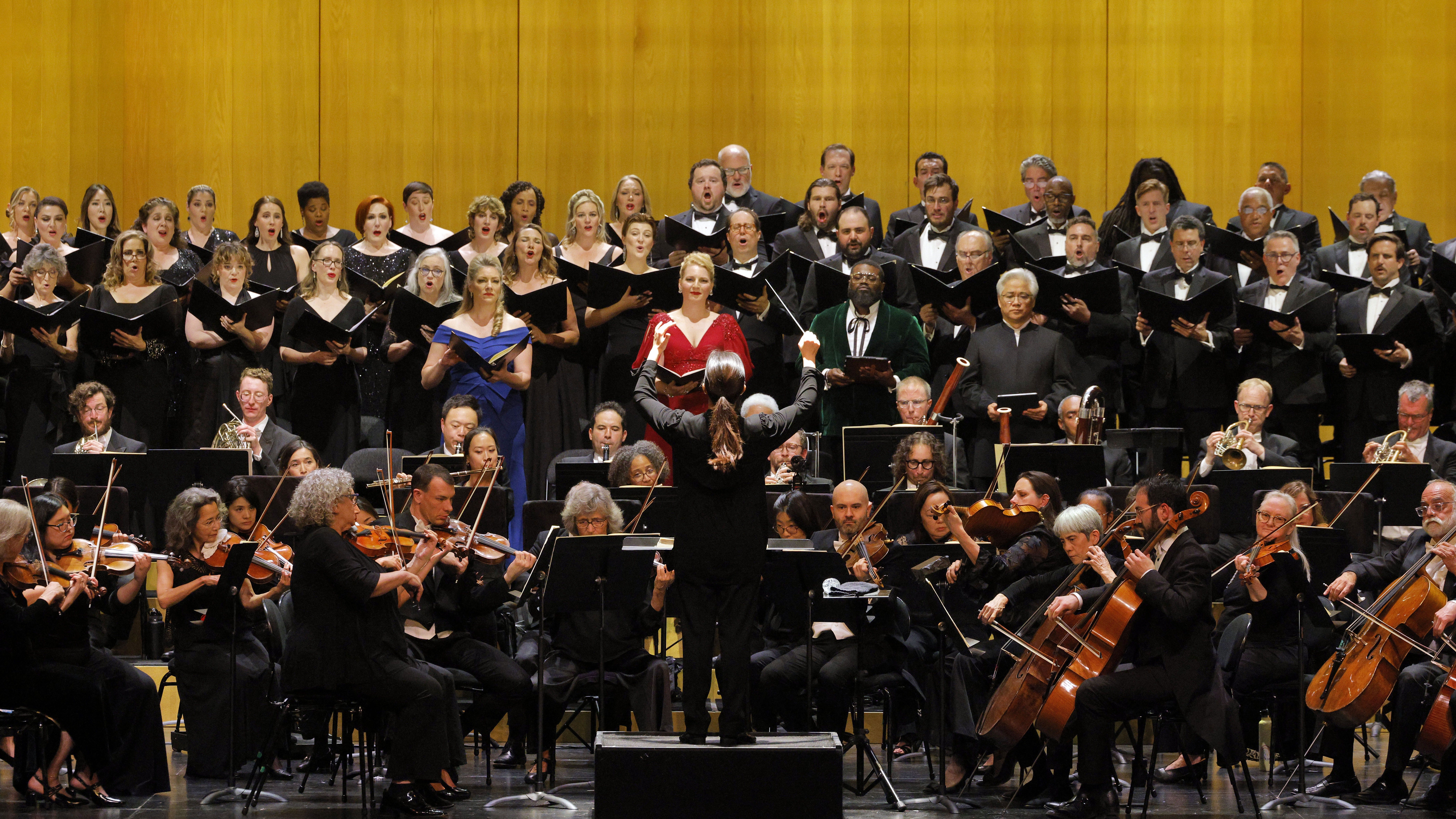
I believe that all employees at arts companies should be paid equitable wages that they can live on. The Bay Area is a fantastically expensive place to live. At the same time, opera is expensive to put on, since it involves, for a typical production, an orchestra ranging in size from 40 to 108 (hello, Elektra! SFO produced it in June with only about 95 in the pit), a chorus of up to 100 (hello, Les Troyens!), a conductor, and numerous backstage professional support staff running wigs, costumes, makeup, set changes, lighting and video, and the administrative apparatus to support everything that’s onstage.
Where should the money come from? Members of the current generation of billionaires are remarkably uninterested in the arts. That is too bad, because when you have $300 billion at your disposal, writing a check for, say, $50 million/year is pretty easy! But so far, they’re not really stepping up to the plate, with a few exceptions.
It is true that SFO has had some success here. Dr. and Mrs. William Coughran are donors at a level that means they’re contributing at least $1 million/year (Bill Coughran was a Google VP). Jensen and Lori Huang — he’s the CEO of Nvidia — have recently committed to several years of donating $5 million annually. Yes, that isn’t much out of their wealth, but it’s a very helpful percent of SFO’s annual budget.
The U.S. government provides some smallish grants to particular projects, but unlike in Germany, there’s little direct support for the ongoing operations of arts companies (and of course no indirect support like universal health care). And as we’ve learned, the federal government isn’t dependable: the current administration might be on the verge of taking a literal wrecking ball to the Kennedy Center after wrecking its programming.
So, again: where’s the money coming from for this fabulous and expensive art form?
