


Support CleanTechnica’s work through a Substack subscription or on Stripe.
Or support our Kickstarter campaign!
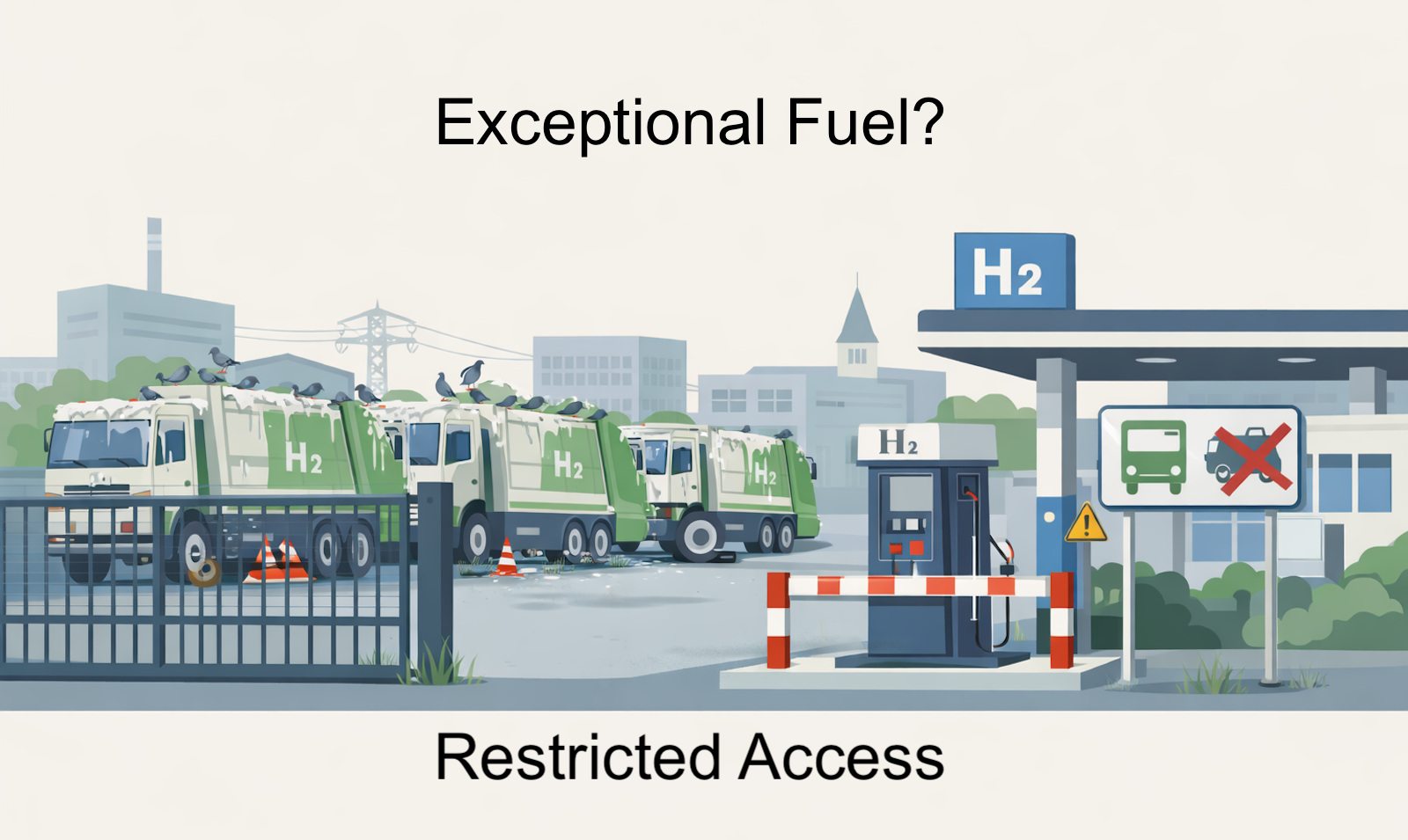
The recent case in Bielefeld, where seven hydrogen garbage trucks sit idle because they cannot legally refuel at a nearby hydrogen station for buses, is a small story that exposes a large and structural problem. The vehicles were purchased with public funds, the refueling station was built with public funds, and both were intended to reduce emissions from municipal services. Yet the trucks cannot use the station because it was funded under a program restricted to public passenger transport. The nearest alternative hydrogen station, an 80 km round trip away, closed at the end of 2025 because it had virtually no customers, as with all public hydrogen refueling infrastructure, hence the dwindling number of refueling stations globally.
The next closest option would require a 180km round trip for refueling, consuming well over half of the trucks’ nominal 300km range, leaving only 30 km of range available for collecting trash. The result is not a temporary inconvenience but a complete operational standstill. This outcome is not the result of poor execution by the city. It is the predictable result of how hydrogen infrastructure is financed, regulated, and justified. While German satirical sites are enjoying this, the municipality isn’t.
What makes the Bielefeld case important is not its novelty but its familiarity. Similar hydrogen fleet pilots across Europe have followed the same arc. Vehicles are procured at high capital cost, often in the range of €750,000 to €950,000 per heavy truck once subsidies are included. Refueling infrastructure costs several million euros per station, depending on compression, storage, and dispensing capacity. Early operation relies on a narrow set of assumptions about station availability, vehicle utilization, and fuel supply. When any of those assumptions fail, the system does not degrade gracefully. It stops working.
Battery electric fleet deployments rarely show this pattern. They tend to scale incrementally, absorb changes in usage, and continue operating even when conditions are not ideal. When a failure mode appears repeatedly across countries, vehicle types, and funding programs, it is not an anecdote. It is a structural signal.
The underlying mechanism sits in public funding and subsidy law rather than in vehicle technology. Public money is almost always earmarked for a specific purpose. In Germany, funding streams such as Regionalisierungsmittel are legally defined for public passenger transport. Once those funds are used to build infrastructure, the asset becomes legally bound to that purpose. The funding decision is accompanied by a grant notice that specifies eligible users, eligible activities, and compliance requirements. Deviating from those conditions is not a matter of common sense or local discretion. It is a violation that can trigger repayment of funds, sometimes with interest, years after commissioning. Municipal finance officers and city utilities are well aware of this risk. They act accordingly.
This matters because hydrogen infrastructure is usually the primary object of funding rather than an incidental upgrade. A hydrogen station is a standalone energy supply system with high upfront cost and—by design—low utilization in early years. To justify that cost, funders narrow the use case. The station is for buses, or for trucks, or for a pilot fleet. That narrow justification becomes a hard legal boundary. In Bielefeld, the station was funded as public transport infrastructure. Garbage trucks, even though they are municipal vehicles with similar duty cycles and similar climate benefits, fall outside that boundary. Allowing them to refuel would expose the city to subsidy clawback risk. The rational response is to leave the trucks parked.
Electric charging infrastructure operates under a different institutional logic. Electricity is a general purpose energy carrier with an existing universal distribution network. Charging infrastructure is much cheaper and typically funded as an incremental upgrade to that network or as end use equipment that enables electric vehicles. Even depot charging for electric buses is rarely classified as exclusive infrastructure. The chargers are connected to the public grid, billed through standard tariffs, and capable of serving any compliant vehicle. If an electric garbage truck uses a charger originally justified for buses, it is still drawing electricity from the same grid, under the same emissions accounting, and with no selective economic advantage. Auditors see continuity, not deviation.
This distinction is not trivial. In subsidy and state aid analysis, electricity remains electricity regardless of the vehicle drawing it. Hydrogen does not. Hydrogen stations exist only because hydrogen vehicles exist, and they must be justified accordingly. The station becomes the scarce, subsidized asset rather than the vehicle. That flips the compliance logic. Electric charging enables vehicles. Hydrogen refueling defines them. Once defined, the definition cannot be flexed without legal and financial risk.
The result is that hydrogen pilots are almost always stitched together from narrow, siloed funding pots. Each pot has rigid usage definitions, limited flexibility, and high audit sensitivity. Capital intensity makes this unavoidable. A hydrogen station capable of serving heavy vehicles can cost 2 million to $5 million. Early utilization may be below 20%. At that utilization rate, fuel margins cannot cover operating costs, let alone capital recovery. Public subsidy fills the gap, but subsidy demands specificity. Specificity creates fragility.
This fragility does not disappear as more hydrogen stations are built. Adding stations multiplies the problem rather than solving it. Each station needs a justification. Each justification restricts access. The system fragments into bus only stations, truck only stations, pilot only stations, and industrial only stations. None achieve high utilization. None behave like infrastructure. They behave like artifacts of policy intent.
For this pattern not to recur, hydrogen would need to cross a threshold from bespoke solution to generic utility fuel. That threshold is high. It requires a completed hydrogen backbone that connects supply and demand at scale. It requires continuous hydrogen flow, not intermittent or optional availability. It requires multiple paying users across sectors so that utilization remains high even if one segment falters. It requires common carrier rules, regulated tariffs, and nondiscriminatory access. Most importantly, it requires funding to shift from project specific grants to regulated asset base recovery, where compliance is about billing accuracy rather than usage permission.
Measured against current reality, this outcome is so unlikely that it should be completely discounted from strategic optioneering. Germany’s hydrogen backbone exists largely as a fragment of repurposed gas pipelines with limited compression, incomplete connections, and no firm supply or demand contracts. Some steel is in the ground, but hydrogen is not flowing. Building out a full utility grade hydrogen distribution system would require tens of billions of dollars in additional investment, long term political commitment, and confidence in demand that does not exist. Industrial users remain cautious. Direct electrification continues to undercut hydrogen on cost for all energy uses. Municipal fleets are retreating from hydrogen after expensive trials. Without anchor demand, regulators cannot credibly approve common carrier tariffs. Without tariffs, utilities cannot justify expansion. The system stalls.
There is a deeper contradiction at work. Hydrogen attracts policy support because it is treated as a special strategic option. It promises flexibility, storage, and sector coupling. Yet infrastructure that scales and works reliably must be boring. It must be universal, interchangeable, and governed by routine rules. Electricity succeeded because it became unremarkable. Natural gas did the same over decades of buildout. Hydrogen remains exceptional. That exceptionality is reinforced by subsidy design, regulatory caution, and market hesitation. Each reinforces the other.
This matters for municipal decision makers because the risk is not abstract. A hydrogen garbage truck parked for lack of fuel represents close to €1 million of stranded capital. Seven of them represent a write down that few cities can absorb easily. The same city could deploy electric garbage trucks for roughly €470,000 to €560,000 per vehicle, with depot charging costs measured in tens of thousands of euros per charger and grid upgrades that serve multiple uses. The electric option bends under stress. The hydrogen option snaps.
Hydrogen does make sense in certain contexts. Industrial processes that require hydrogen as a feedstock, such as ammonia synthesis or direct reduced iron, operate in closed systems with dedicated supply. Point to point pipelines, on site electrolysis, and long term contracts align incentives and utilization. Distributed fleet refueling does not share those characteristics. It depends on shared access, high reliability, and institutional flexibility. Those are precisely the areas where hydrogen currently performs worst.
The lesson from cases like Bielefeld is not that cities should execute hydrogen projects better. It is that infrastructure follows institutions, not intentions, and municipalities are incurring high risks to go with the high costs of hydrogen. When energy carriers are exceptional, as hydrogen is, their infrastructure inherits that exceptionality. When funding programs are narrow because they are for exceptional energy carriers, assets become brittle. Unless hydrogen becomes a generic utility fuel with broad distribution and routine regulation—and that’s not going to happen—, refueling access problems will persist and municipalities that deploy hydrogen fleets will be left with significant losses to absorb. The math of capital cost, utilization, and compliance makes that outcome difficult to avoid.
Support CleanTechnica via Kickstarter

Sign up for CleanTechnica’s Weekly Substack for Zach and Scott’s in-depth analyses and high level summaries, sign up for our daily newsletter, and follow us on Google News!
Have a tip for CleanTechnica? Want to advertise? Want to suggest a guest for our CleanTech Talk podcast? Contact us here.
Sign up for our daily newsletter for 15 new cleantech stories a day. Or sign up for our weekly one on top stories of the week if daily is too frequent.
CleanTechnica uses affiliate links. See our policy here.
CleanTechnica’s Comment Policy
