

PM Modi flags off Freight Trains from four WDFC Stations as India’s 2,800-km DFC Network becomes fully operational

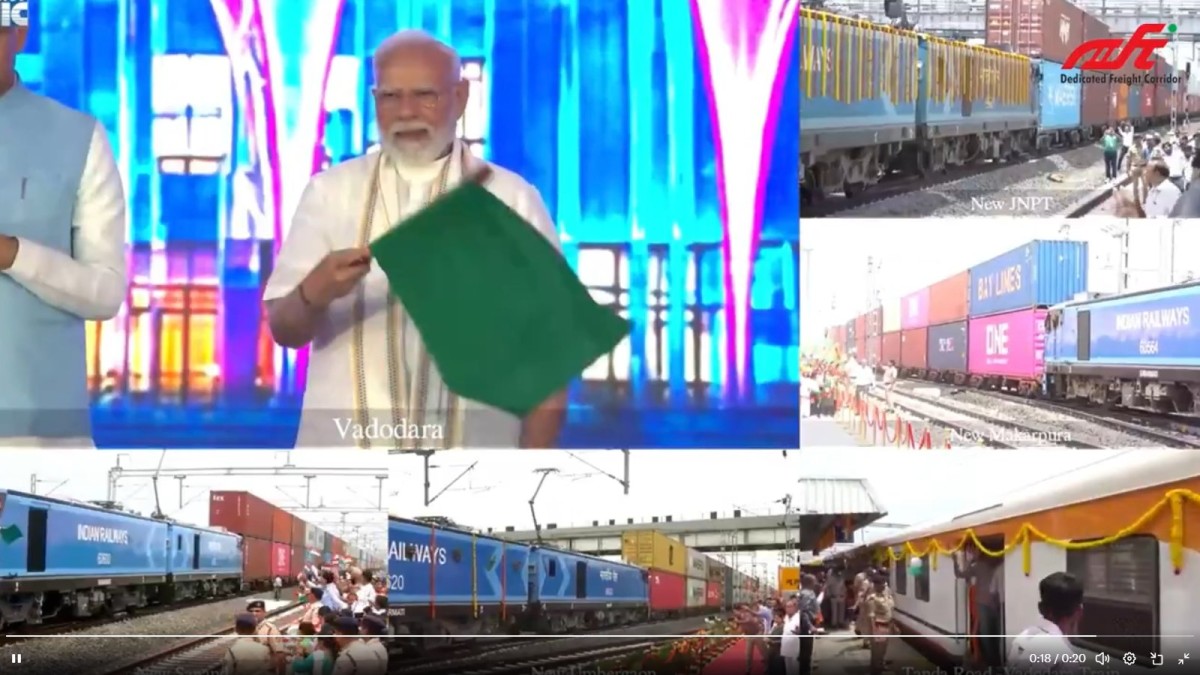
VADODARA: Prime Minister Shri Narendra Modi on Tuesday marked a major milestone in India’s freight and logistics infrastructure by flagging off freight trains from four strategic stations of the Western Dedicated Freight Corridor (WDFC) and dedicating three newly completed sections of the corridor to the nation.
Freight trains were flagged off from New Sanand (North), New Makarpura, New Umbergaon and New JNPT, marking the operational completion of the WDFC and, with it, the full-length operationalisation of India’s approximately 2,800-km Dedicated Freight Corridor (DFC) network.
The three newly dedicated WDFC sections — New Sanand (North)–New Makarpura, New Umbergaon–New Saphale and New Saphale–New JNPT — together cover around 326 route kilometres and have been developed at an investment of more than ₹20,700 crore.
Direct Freight Connectivity to JNPT
The commissioning of the final WDFC stretches establishes direct dedicated freight connectivity between the northern and western industrial hinterland and Jawaharlal Nehru Port (JNPT).
The connection is expected to provide a major boost to the movement of export-import (EXIM) cargo, strengthening the link between manufacturing and consumption centres, logistics hubs and India’s western maritime gateways.
With freight traffic moving on dedicated tracks, the WDFC is expected to improve the speed and reliability of cargo movement, reduce dependence on congested passenger rail routes and support more efficient evacuation and delivery of containers and bulk commodities from ports.
The enhanced rail-port connectivity is particularly significant for India’s growing containerised trade, as faster evacuation of cargo can help improve supply-chain predictability and reduce logistics costs.
India’s 2,800-km DFC Network Completed
India’s Dedicated Freight Corridor programme comprises two major corridors:
Eastern Dedicated Freight Corridor (EDFC): Ludhiana to Sonnagar — approximately 1,337 km
Western Dedicated Freight Corridor (WDFC): Dadri to Jawaharlal Nehru Port Terminal — approximately 1,506 km
Together, the two corridors span more than 2,800 km, creating a dedicated high-capacity freight transportation backbone across some of India’s most important industrial and agricultural regions.
Addressing the gathering, Prime Minister Modi described the completion of the DFC network as a historic achievement for 21st-century India, highlighting its importance in supporting the country’s rapidly expanding economy and strengthening its logistics ecosystem.
Faster, More Efficient Freight Movement
The Dedicated Freight Corridors are designed to separate freight operations from heavily utilised passenger railway routes, allowing goods trains to operate with fewer operational constraints.
The resulting improvement in freight movement is expected to deliver multiple benefits, including:
Faster transit of goods across long distances
Lower fuel consumption
Reduced logistics and transportation costs
Improved supply-chain reliability
Greater operational efficiency
Lower environmental impact of freight transportation
Better connectivity between industrial centres, logistics hubs and ports
The DFC network also enables the movement of Double Stack Container (DSC) trains and higher axle-load freight trains, increasing the volume of cargo that can be transported efficiently on each train movement.
DFCs Now Handle More Than 440 Freight Trains Daily
The Dedicated Freight Corridors have steadily expanded their contribution to India’s freight transportation system. The two corridors together are currently handling an average of around 443 freight trains every day, supported by improvements in average speeds, turnaround times and operational reliability.
The shift of freight traffic onto dedicated corridors is also releasing additional capacity on conventional railway routes. This enables Indian Railways to accommodate more passenger and freight services on existing routes while improving overall network utilisation.
Indian Railways Freight Loading Touches 1,670 Million Tonnes
The expansion of dedicated freight infrastructure has accompanied a sustained increase in Indian Railways’ freight loading.
Freight loading increased from 1,098 million tonnes in 2014-15 to 1,670 million tonnes in 2025-26, reflecting the growing role of railways in India’s logistics and supply-chain network.
The progression includes:
| Financial Year | Freight Loading |
|---|---|
| 2014-15 | 1,098 MT |
| 2019-20 | 1,210 MT |
| 2020-21 | 1,233 MT |
| 2021-22 | 1,418 MT |
| 2022-23 | 1,512 MT |
| 2023-24 | 1,591 MT |
| 2024-25 | 1,617 MT |
| 2025-26 | 1,670 MT |
With this growth, Indian Railways has emerged as one of the world’s largest rail freight systems, carrying a rapidly increasing volume of coal, containers, foodgrains, cement, steel, petroleum products and other commodities.
Stronger Rail-Port Integration
The completion of the WDFC is particularly important for India’s maritime and port-led logistics strategy.
The corridor connects major production and consumption centres with western ports, providing an efficient rail-based channel for moving cargo to and from maritime gateways.
The direct link with JNPT is expected to strengthen port connectivity, container evacuation and EXIM logistics, while supporting India’s broader objective of reducing logistics costs and improving its competitiveness in global trade.
For ports and terminal operators, reliable dedicated rail connectivity can also help improve cargo evacuation, reduce dwell time and facilitate more predictable hinterland operations.
Next Focus: Dankuni–Surat Freight Corridor
The government is already looking beyond the completion of the existing DFC network.
The Union Budget 2026 announced a proposed new Dedicated Freight Corridor connecting Dankuni in West Bengal with Surat in Gujarat, strengthening east-west freight connectivity across the country.
Preparation and updating of the Detailed Project Report (DPR) for the proposed corridor has begun.
The planned corridor could further expand India’s dedicated freight infrastructure and create additional connections between eastern industrial regions and western ports and manufacturing centres.
Gati Shakti and Modern Freight Infrastructure
Alongside the DFC programme, Indian Railways is pursuing a broader strategy to modernise freight logistics through initiatives such as Gati Shakti Multi-Modal Cargo Terminals (GCTs), upgraded goods sheds and policies designed to encourage private-sector investment in specialised freight wagons.
Specialised wagons are being promoted for commodities including cement, petroleum products, steel and fly ash, enabling railways to address commodity-specific logistics requirements.
The Joint Parcel Product–Rapid Cargo Service (JPP-RCS) initiative is also aimed at providing customised logistics solutions, including door-to-door parcel movement and online booking of parcel capacity through aggregators and the Virtual Aggregation Platform.
CONCOR Strengthens Door-to-Door Rail Logistics
The Container Corporation of India (CONCOR), a public sector undertaking under the Ministry of Railways, is also expanding its role in integrated freight logistics under the JPP-RCS framework.
CONCOR is providing door-to-door parcel services on the Delhi–Kolkata and Mumbai–Kolkata sectors, adding an integrated logistics dimension to India’s rail freight network.
A New Era for India’s Freight Ecosystem
The completion of the Dedicated Freight Corridor network represents a significant transformation in India’s rail freight architecture.
By creating high-capacity freight routes linking the hinterland with major industrial centres and ports, the DFC network is positioned to support faster cargo movement, lower logistics costs, improved port connectivity and greater supply-chain efficiency.
The commissioning of the final WDFC sections and direct connectivity to JNPT therefore marks not only the completion of a major railway infrastructure programme but also a crucial step towards building a more integrated, multimodal and globally competitive logistics network for India.
