


We have thousands of human-written stories, discussions, interviews and reviews from today through the past 20+ years. Find them here:

Longtime Indiana University Violin Professor Stanley Ritchie passed away on Sunday at the age of 91.
A pioneer in the early music and historical performance movement who taught and mentored hundreds of today’s top early music violinists, Ritchie started his career as a successful “modern” violinist.
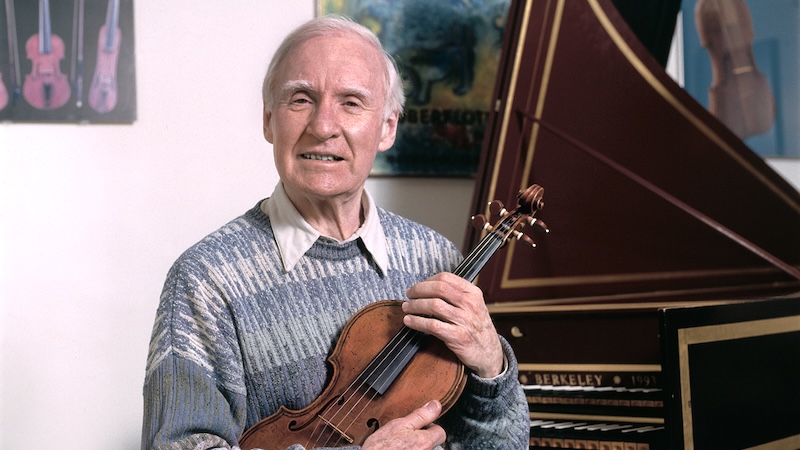
Violinist and early music specialist Stanley Ritchie. Photo courtesy of the Indiana University Jacobs School of Music.
Born in Australia, Ritchie began his violin studies in a farming town in New South Wales. Describing his beginnings to Violinist.com in a 2012 interview, Ritchie said that “When I was seven, my parents took me to the city for the first time, and as we were walking down the street in the city, I saw a violin in a shop window. I pointed at it and said, ‘I want that!’ They discussed it and said, ‘Well, it’s cheaper than a piano…’ So that was it! I took violin lessons at the local convent, the only place to take violin lessons. I had eight years of ladies all but one of whom knew nothing about the violin at all!” He added that he was “not driven from the age of three to be the greatest violinist in the world!”
Ritchie then went to the Sydney Conservatorium of Music, where the seed of his later fascination in early music was planted when he had to answer the question “What is meant by ‘style’ in music?” for a graduation exam. He graduated from the Sydney Conservatorium in 1956.
Richie then studied in Paris with Jean Fournier; then in the United States with Joseph Fuchs, Oscar Shumsky and Samuel Kissel.
He went on to serve as concertmaster of the New York City Opera in 1963, then associate concertmaster of the Metropolitan Opera from 1965 to 1970. In 1970 he joined the New York Chamber Soloists, then in 1973 played as Assistant Concertmaster of the Vancouver Symphony until 1975, when he became first violinist in the Philadelphia String Quartet (in residence in the University of Washington in Seattle). He joined the Indiana University School of Music in 1982 as professor violin, and served on the early music/historical performance faculty until 2021. In 2016 he was named distinguished professor.
Ritchie’s exploration of early music started in earnest in 1970, when he collaborated with harpsichordist Albert Fuller, leading to the 1973 founding of the Aston Magna summer workshop and festival. In 1974, Ritchie form Duo Geminiani with harpsichordist Elisabeth Wright, and their 1983 recording of the Bach Sonatas for Violin and Obbligato Harpsichord earned wide critical acclaim.
Ritchie performed with many of the day’s most well-known early music musicians, including Christopher Hogwood, Sir John Eliot Gardiner, Frans Brügghen, Roger Norrington, Malcolm Bilson, and Anner Bylsma. He was a member of the Mozartean Players for 20 years, with fortepianist Steven Lubin and cellist Myron Lutzke. He also appeared as soloist or conductor with early music orchestras including the Academy of Ancient Music, Tafelmusik, Philharmonia Baroque Orchestra, and the Handel and Haydn Society Orchestra.
Ritchie was also a faculty member of the Accademia di Musica Antica in Bruneck (Südtirol) for over 20 years and artistic director of the Bloomington Early Music Festival for 10 years. In 2009, he received Early Music America’s highest honor, the Howard Mayer Brown Award for Lifetime Achievement in Early Music.
Of playing early music, Ritchie told Violinist.com that “It’s liberating, that’s one emotion I really experienced when I took up Baroque violin. After playing so many years professionally as a violinist, I found playing Baroque violin akin to driving a sportscar. I felt physically liberated, and then eventually as I became more used to it, expressively liberated.”
The IU’s Jacobs School reported that Ritchie “taught generations of baroque violinists and historical performance majors….and his course ‘Interpreting Unaccompanied Bach’ was rarely not at capacity with a waitlist.”
Ritchie wrote several books, including Before the Chinrest—a Violinist’s Guide to the Mysteries of Pre-Chinrest Technique and Style and The Accompaniment in ‘Unaccompanied’ Bach: Interpreting the Sonatas and Partitas for Violin, both published by Indiana University Press.
You are welcome to share your memories of Stanley Ritchie in the comments below.
You might also like:
* * *
Enjoying Violinist.com? Click here to sign up for our free, bi-weekly email newsletter. And if you’ve already signed up, please invite your friends! Thank you.
Replies
