

RINL’s 459-Plot Land Sale: Will the Steel PSU Really Gain From Selling Its ‘Family Silver’? – Indian PSU

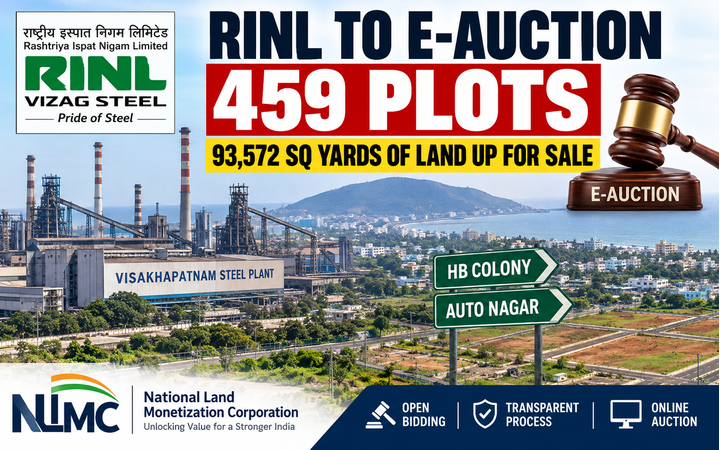
The government’s decision to put 459 RINL land parcels covering 93,572.21 square yards in Visakhapatnam under the hammer may look like a straightforward asset-monetisation exercise. But it raises a much bigger question: will RINL actually become financially stronger by selling its land — or is the company simply converting its family silver into short-term cash?
The land, located mainly in HB Colony and Auto Nagar, is being offered for outright sale through an e-auction facilitated by the National Land Monetisation Corporation (NLMC). The government describes these properties as surplus and non-core assets, with clear government titles. The auction is scheduled for October 12 and October 16.
There is, however, a financial logic behind the exercise. RINL has been under considerable financial pressure and the Centre approved an ₹11,440-crore revival package in January 2025, including ₹10,300 crore of equity infusion. Asset monetisation has also been part of RINL’s efforts to generate liquidity.
RINL’s own financial disclosures show that earlier land monetisation in Visakhapatnam generated substantial proceeds. In the first phase of an earlier auction, 72 plots covering 6.05 acres attracted bids worth ₹242.90 crore, with ₹227 crore eventually received at that stage. The company has also stated that monetisation of non-core surplus land was expected to help strengthen its financial position.
But here comes the uncomfortable question.
How much of RINL’s land can be sold before asset monetisation starts looking like asset depletion?
A land parcel can be sold only once. Once a strategically located property in a growing city such as Visakhapatnam leaves the company’s balance sheet, it cannot generate another round of proceeds for RINL. The cash received today may improve liquidity, reduce borrowings or support operations, but the underlying asset — particularly land in valuable urban locations — is permanently gone.
That is why the success of the current auction should not be measured merely by how much money the 459 plots fetch.
The bigger test will be what RINL does with that money.
If the proceeds are used to reduce expensive debt, improve working capital, strengthen operations or support investments that generate recurring earnings, the sale could arguably be seen as a sensible restructuring measure. But if the proceeds merely plug recurring cash-flow gaps without improving the company’s underlying economics, critics could reasonably ask whether RINL is simply selling assets to finance survival.
There is another interesting dimension. The current portfolio includes 456 residential plots in HB Colony and three parcels in Auto Nagar, including a larger 2,728-square-yard parcel identified for commercial and logistics use. These are not merely remote pieces of surplus industrial land; many are located within established urban areas.
That makes the valuation and final sale price particularly important.
The real headline after October’s auction may therefore not be how many plots RINL sold, but how much value it unlocked — and where that money ultimately goes.
For a financially stressed PSU, selling non-core assets can be a legitimate part of a turnaround strategy. But there is a fine line between monetising surplus assets and selling the family silver to meet the household bills.
For RINL, the 459-plot auction will provide a fresh test of where that line lies.
