


Support CleanTechnica’s work through a Substack subscription or on Stripe.
Though some US automakers have dialed down their near-term vehicle electrification plans, the general trajectory keeps pointing towards an auto market dominated by EVs. The latest example comes from the startup Rivian, which has just partnered with the leading clean energy software firm EnergyHub. The new collaboration will make it easier than ever for EV drivers to connect with money-saving programs from their local electricity provider.
Save Money, Drive An EV
Generally speaking, the TCO (total cost of ownership) for an EV has been running neck-and-neck with conventional cars if not beating them. There is no one-size-fits-all formula, though. Car & Driver dug into the TCO details last June, for example, and concluded that budget-conscious EV drivers should assess their personal situation, including access to home charging, among other factors.
A competitive TCO is just one measure of the staying power of the vehicle electrification movement. The latest survey from JD Power, for example, indicates that EV drivers are “ridiculously satisfied” with their cars, upfront cost aside. The survey found that 96% of EV drivers (meaning battery-powered vehicles, not hybrids) would consider another one for their next vehicle, whether leased or purchased.
JD Power began asking drivers about their next vehicle in 2021. The 96% mark is the highest response rate since then, despite the premature demise of the $7,500 tax credit last September. As described by JD Power, the strong showing reflects improvements in the overall EV experience, notably in access to public charging stations as well as battery technology and vehicle performance.
Still, who wouldn’t want to save money when a convenient opportunity presents itself, and that’s the opportunity presented by Rivian and EnergyHub.
The EnergyHub Difference
EnergyHub is not exactly a household name, but it has surfaced regularly on the CleanTechnica radar, partly on account of its leading role in the emerging virtual power plant movement. VPPs use advanced software to synchronize thousands of far-flung energy resources, including EV batteries, solar panels, thermostats, and any other device on a grid that uses or discharges electricity. With their relatively large battery packs, EVs can make significant contributions to a VPP.
The “virtual” in VPP refers to the ability of software to avoid the cost of building centralized, physical gas peaker plants that would otherwise be needed to meet demand spikes on the grid. Each DER (distributed energy resource) may be small, but the numbers add up. EnergyHub currently registers a total capacity of 3.5 gigawatts among 2.5 million DERs under management, spread around more than 170 utilities (see lots more VPP background here).
As applied to EV batteries, VPPs act as a managed charging system, which utilities incentivize by providing off-peak charging with lower rates. That sounds like an idea that sells itself, but not necessarily so. Drivers need to be aware that the opportunity exists, and they need to enroll. Through their new partnership, EnergyHub and Rivian aim to eliminate any obstacles for EV drivers to enroll in a VPP.
“For Rivian drivers, this will enable new opportunities to discover and participate in utility EV programs,” the two partners explained in a press release.
“For utilities, the partnership will make it easier to recruit drivers and scale cost-effective managed charging programs that unlock electric vehicles as grid resources, driving a more reliable, affordable grid for everyone,” they add.
Rivian’s Director of Advanced Energy Solutions, Andrew Peterman, also chipped in his two cents. “By integrating managed charging programs, we’re not only lowering costs for our drivers and elevating the ownership experience, but also ensuring that every Rivian on the road contributes to a more resilient and secure grid for everyone,” he said, drawing attention to the combo of personal gain and community benefit.
“Rivian’s software ecosystem and customer engagement make it easier for drivers to participate in utility programs, while grid-aware managed charging ensures EVs can serve as a resource to manage the load growth we are seeing across the country,” elaborated EnergyHub President Seth Frader-Thompson.
What Else Has EnergyHub Been Up To?
The new Rivian partnership is just the latest in a series of steps EnergyHub has taken to support EV enrollments in virtual power plants. In September, for example, the company acquired the EV-telematics startup Bridge to Renewables and its portfolio of more than 500,000 connected EVs.
Telematics refers to GPS-enabled technology that monitors the movement of vehicles. Earlier this month, CleanTechnica’s Jake Richardson got the lowdown from EnergyHub data scientist Freddie Hall and Akhilesh Ramakrishnan, the Managing Energy Associate at The Brattle Group.
Unlike passive charging incentives that deploy on time-of-use rates, telematics enables active managed charging. Described as “control algorithms implemented by distributed energy resource management systems,” active managed charging accounts for early departures, driver overrides, and other real-time variables.
“EnergyHub’s active managed charging solution allows multiple objectives to be combined, enabling utilities to reduce bulk systems costs, avoid distribution constraints, while ensuring drivers receive the charge they need by the time they depart,” Hall and Ramakrishnan told CleanTechnica.
In a report commissioned by EnergyHub, the Brattle Group found that active managed charging enables utilities to support more EVs on the grid, without having to invest in expensive new infrastructure.
Meanwhile, Rivian …
On its part, Rivian has been taking steps to widen the gap between the EV experience and conventional cars. In one recent development, last week Rivian announced that its new mobile app update is available on Apple Watch as well as iPhone. “Now you can access essential features from your Apple Watch, making it possible to leave your iPhone behind on your next adventure,” Rivian enthuses for the benefit of drivers who are trying to cut down on their screen time, or who would like to avoid purse-diving for their phone.
The Apple Watch app includes controls for doors, windows, and alarms among other features. “Gen 2 customers have passive entry; once your digital key is set up, you can just walk up to your Rivian, and it will automatically unlock as you approach, allowing you to get in and go,” Rivian adds.
Does that sound like a minor difference or a major one to you? Thoughts? Drop a note in the discussion thread.
Personally, I’m with Rivian, recalling that time when I was out on my bike for way too long in cold weather and I couldn’t get into my car until I unfroze my hands enough to dig my key out of my pocket….
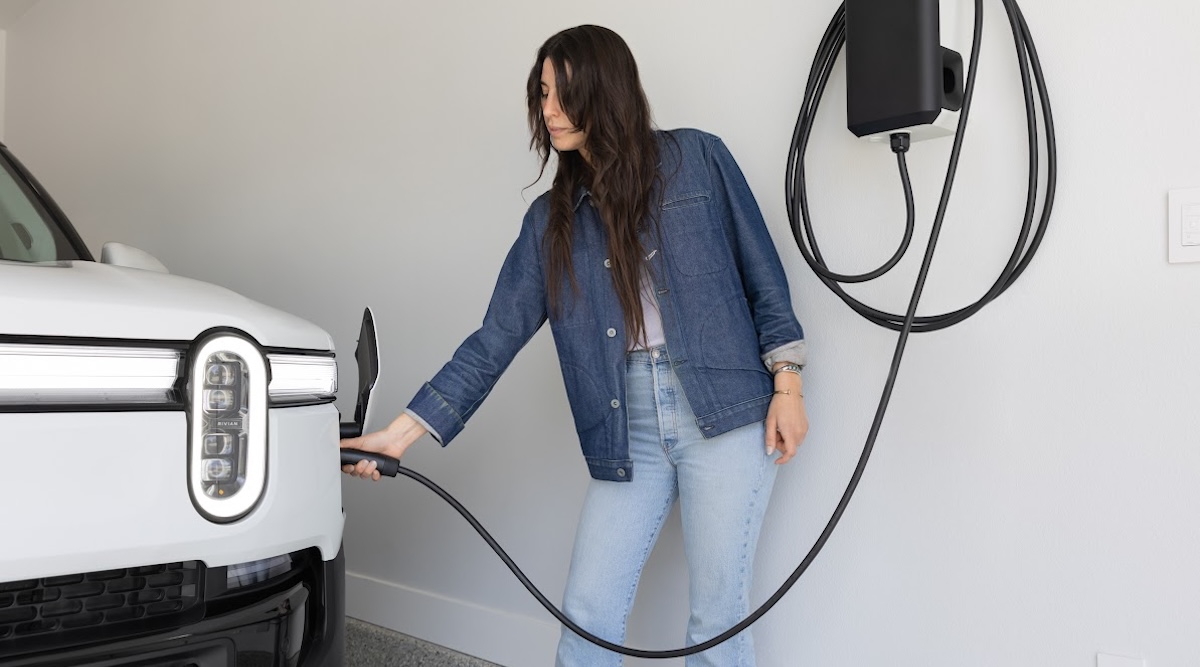
Photo (cropped): The US automaker Rivian has partnered with the clean energy software firm EnergyHub to connect more EV drivers with their local virtual power plant (courtesy of Rivian/EnergyHub via email).
Sign up for CleanTechnica’s Weekly Substack for Zach and Scott’s in-depth analyses and high level summaries, sign up for our daily newsletter, and follow us on Google News!
Have a tip for CleanTechnica? Want to advertise? Want to suggest a guest for our CleanTech Talk podcast? Contact us here.
Sign up for our daily newsletter for 15 new cleantech stories a day. Or sign up for our weekly one on top stories of the week if daily is too frequent.
CleanTechnica uses affiliate links. See our policy here.
CleanTechnica’s Comment Policy
