


Sign up for the Slatest to get the most insightful analysis, criticism, and advice out there, delivered to your inbox daily.
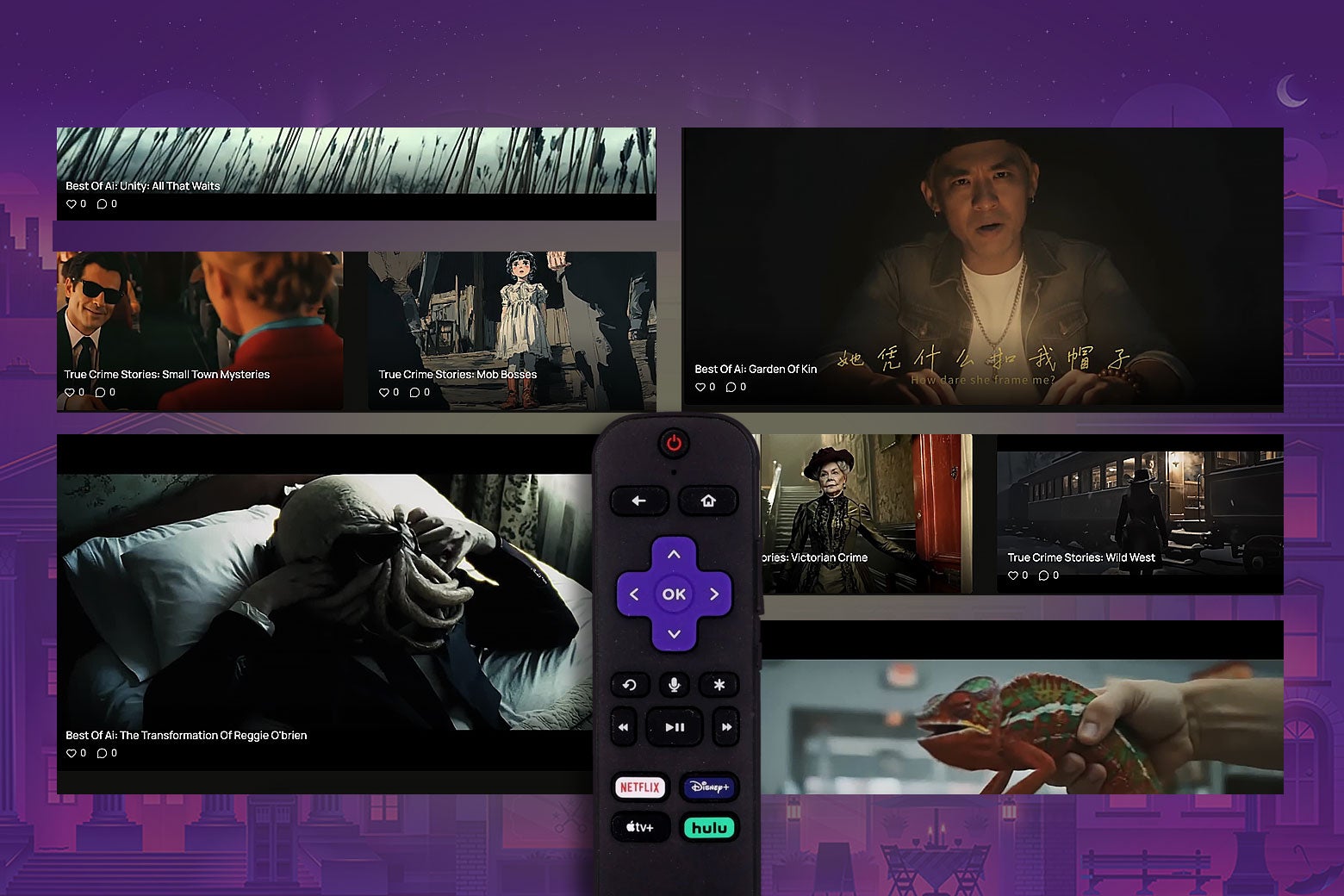
According to Roku, the future of entertainment is nonstop A.I. slop, churned out by absolute randos, playing 24/7. Welcome to its new “AI Creator TV” channel, now available on the app’s streaming service and consisting exclusively of app-generated films and shows, along with commercials that feature “synthetic performers.” The uncanny valley is live for consumption, for free, at No. 300 on the Roku Channel’s Live TV Guide.
To replicate the worst of the slop saturation afflicting YouTube, TikTok, and Instagram—sorry, “Instagzam”—is one thing, but what’s more unusual is that Roku sells this first-of-its-kind channel as an affirmation of human artists, a way to welcome more digital creators onto its network. The content here, featured as just one part of the Roku Channel’s voluminous FAST (free ad-supported streaming television) lineup, comes from Fairground, a year-old studio that distributes works from A.I. slop churners who have signed with particular studios or registered for Fairground’s in-house competitions. (The logo highlights the ai in Fairground, in case you somehow missed the point.) AI Creator TV, launched on Roku and a few other FAST providers earlier this month, claims to spotlight “over 100 of the best AI filmmakers from around the world.” In interviews, Fairground CEO Colin Petrie-Norris has promised that “we’re looking for high-quality entertainment” and that the channel will exhibit “gorgeous things,” selected by Fairground staff, that otherwise haven’t found traction because of “gatekeepers and things.”
I watched a bunch of Fairground’s AI Creator TV output over this past week to see what “high-quality entertainment” it had to offer. Having now assaulted my brain with hours of robotic narration tracks, disconcerting animation montages, and “documentaries” that couldn’t pass for the real thing if they tried, I am left desperately hoping that future A.I.-creation enterprises will employ more “gatekeepers and things”—if only for the sheer sake of taste.
One thing you have to understand about the channel’s selections up front: Few of them are “original” stories in any regard. Petrie-Morris announced that Fairground’s first products would riff on beloved public domain characters—Robin Hood, etc.—and then hopefully earn access to established IP through studio partnerships. AI Creator TV regularly broadcasts a series titled Reimagined, which showcases how A.I. enthusiasts (and the models they deploy) envision fictional protagonists such as Cinderella and Sherlock Holmes, among many others. There’s “Dracula Meets the Walkers,” a short from YouTuber DJ Marcelll that sends the famed vampire to live with a family of zombies in a modern-sitcom setting, replete with hacky jokes (“warm glass of plasma?”) and visual gags involving kids with their dang selfies and smartphones. There’s “Pinok IO,” a take on Pinocchio that puts the classic character (pronounced PIN-knock) inside a Minecraft Movie–style real world–versus–gamerverse plot, culminating in a “twist” that reveals Pinok’s title is not the tech-beloved IO acronym, but actually the number 10, which somehow leads him to believe he’s “real.” (I apologize for the vague plot descriptor, but this thing was difficult to follow narratively. A Fairground-assembled panel had previously praised this piece for its “seamless character consistency across two distinct animation styles,” which was certainly not my takeaway.) The end credits exclusively feature a list of apps used in the making of this “film,” including video generator Runway and music imitator Suno.
But if the array of reimagined storybook staples—from an “Alyce: Sound of Wonderland” short that takes after KPop Demon Hunters, to a Brothers Grimm tribute from Foxbridge Media that depicts Little Red Riding Hood and the Big Bad Wolf as a couple—isn’t your thing, fear not! You also have “True Crime Stories: Wild West,” a series of historical “depictions” that I admittedly tuned away from after a mere two minutes because of how godawful the 3D figures both looked and sounded, synthesized twangs and all. (Harry McClintock fans don’t read this: Another history-based video that portrays the 1894 march of “Coxey’s Army” uses Suno to “reimagine” the classic folk anthem “Hallelujah, I’m a Bum.”) There’s a seven-minute thing called “Rush,” the tale of a mountain biker who rushes straight from a race to support his wife who’s giving birth, only to get killed by the very ambulance carrying her—all narrated from the POV of his bike, which gets taken up by a pizza deliveryman who also gets into racing and, what do you know, happens to finish his meet and make it to the hospital in time for his wife to give birth.
You also have another series, called The Best of AI: Animation, that calls its entries “human in spirit” and proclaims that “another cinematic language is being written right now.” The very first thing I saw there was an anime-style vertical video whose characters barely moved their lips and ended the whole thing with a verbatim “To Be Continue .. ” title card. (No, it didn’t even add the third dot to the ellipsis.) And, after all of that, you can immerse yourself in Roku self-advertisements that, in at least one instance, feature a Roku City–based mad scientist who kills off the design team behind a complex TV remote because Roku’s controller has fewer buttons, and “Simple Is Better.”
Now, look: Many of the most notable artists of the past who embraced new technologies in their work—Douglas Adams, Wendy Carlos, Ferdinand Zecca—certainly saw some creative hiccups with their experiments, but they ultimately understood that innovation does not preclude taste, and that good work requires diligence. Fairground talks a big game about curating and encouraging today’s underrecognized, techno-optimistic “creators,” but to look at what the company is willing to promote is to reinforce one of the most glaring issues with which A.I. boosters have trouble coming to grips. Namely: They have all the money, yet they have zero taste, and little understanding of why people enjoy certain forms of art over others. (Elon Musk and Sam Altman, among others, have repeatedly made this clear over the years.) If Roku and Fairground hope this channel will encourage more people to play with A.I. and realize their storytelling potential, I think they have an extremely difficult task ahead of them, because nothing I’ve seen from “AI Creator TV” is anything I want to subject my eyes to ever again.
I have seen genuinely funny and ingenious A.I.-produced shorts on my feeds, many of them likely helmed with a fraction of the compute and app deployment needed at Fairground. I know that entertainment giants whose works I treasure, from Martin Scorsese to Natasha Lyonne, are genuinely interested in the cinematic possibilities of A.I. There’s a world where A.I.-assisted short films could improve in quality and possibly inspire less-recognized creatives to realize their ambitions. That world will not be realized on the Fairground.
