


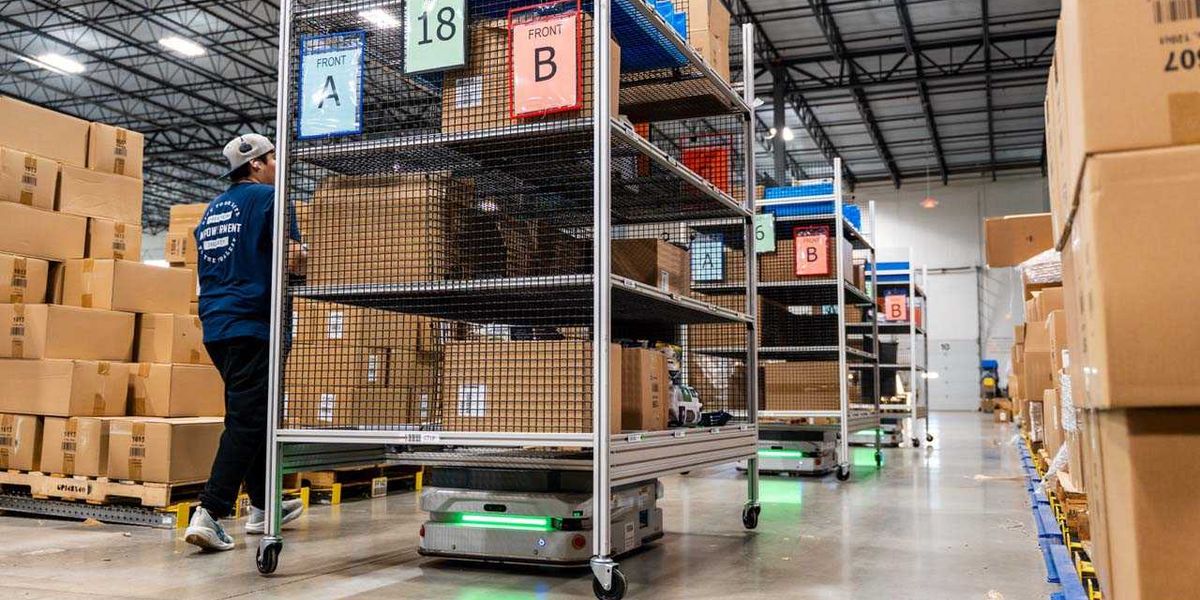
Consumer health-care products company NorthShore Care Supply is responding to increased demand for its products with a single word: robotics. The company recently upgraded its fleet of autonomous mobile robots (AMRs) to fill a growing volume of orders from its suburban Chicago warehouse—a feat that included both software and hardware updates that have yielded labor savings and productivity improvements that company leaders say position the operation well for even more growth down the road.
AN AUTOMATION JOURNEY
NorthShore Care is a direct-to-consumer online retailer of adult incontinence products that provide customers with the confidence and ability to maintain their daily activities as well as a high quality of life, according to the company’s founders. The nature of those products makes quick and accurate delivery a must, so when NorthShore experienced a 30% increase in demand for its items six years ago, managers knew they needed to make some changes. That meant moving to a larger facility and automating key aspects of its fulfillment operations. Demand has continued its upward climb since then, and NorthShore found itself in need of a system upgrade in 2024 that has ushered in even more change.
NorthShore had moved from an approximately 50,000-square-foot facility to a 180,000-square-foot facility in 2020 to accommodate the initial surge in business. At that time, it implemented a fleet of six AMRs to automate picking and fulfillment, which had previously been handled manually: Associates would push heavy carts to picking locations, load orders onto the carts, and then push the carts to a packing area. The new low-profile, cart-moving AMRs worked like this: AMRs would slide underneath and lift the carts, transporting them to the picking aisles, where associates were stationed and ready to pick orders to the carts. When the associates finished, the AMRs would move the carts to the next pick and, ultimately, to the pack station. The AMRs helped speed the picking process and reduce the amount of time workers spent walking throughout the building—a huge gain, but not the only benefit: The customized AMR carts accommodated about four times as many orders as the previous manual versions.
NorthShore worked with systems integrator Numina Group on the project, which included a warehouse execution and control system, conveyors, and other supporting equipment. Ultimately, the system automated the end-to-end outbound side of NorthShore’s operations and more than doubled the amount of product it could ship.
The process worked well until the AMR supplier was acquired by a larger company and began to make changes to the robots that were incompatible with NorthShore’s operations, according to Jared Bell, vice president of operations.
“We were kind of left on an island,” explains NorthShore’s warehouse manager, Taka Takaki. “They supported us for as long as they could. But the robot hardware started to fail, and there were software issues. We were … forced to look elsewhere.”
NorthShore turned once again to Numina Group and began exploring new AMR options in late 2024. After consulting with the integrator, the company quickly contracted with AMR developer Kuka Robotics—and hasn’t looked back.
AN UPGRADE WORTH ITS WEIGHT IN GOLD
The move to Kuka is delivering even greater labor savings and productivity improvements than the initial AMR solution did.
NorthShore ended up replacing its original six AMRs with five KMP 600P mobile platforms from Kuka. The team left the picking protocol largely intact; the key difference was in the equipment. The Kuka AMRs feature lower profiles that allowed the company to add another shelf to its custom pick-and-pack carts—increasing cart capacity by eight orders and bringing the total up to 36 orders per cart. While having one less AMR reduces costs, the key outcome is that the five new AMRs accomplish the work of their six predecessors, according to Bell and Takaki.
The project—which was completed and up and running in late 2025—included software upgrades as well. Numina Group’s RDS Batchbot 2 software controls the AMR tasks and missions, while Kuka’s AMR fleet management software determines which AMR should perform which task and how it should accomplish it. This means that workers are not assigned to a particular AMR; rather, the AMRs move to the pickers and then on to another picker until orders are complete and ready to move to shipping.
“The AMRs know they’re loaded and when to head to the shipping area. One of the best things about how the RDS Batchbot 2 system is deployed is that the [AMRs] and pickers are not connected in any way,” Takaki explains. “This is unlike other systems, where the picker would be connected or tied to a specific cart or zone. Instead, our pickers only pick, and wherever they are doing so, the software sends the AMR to that location, where it positions itself precisely. This operational layout keeps our process flowing without having to continuously shift labor among different zones.”
When an AMR picks up a cart, the software determines the most efficient order pickup route, then scans for order validation. Once picks are completed, the robots head to packing, drop off their cart, and pick up an empty one.
Bell and Takaki point to another technical advantage of the Kuka AMRs: They have a larger platform and higher integrated lift that allows the robots to raise carts off the ground when transporting them. The previous robots lifted carts just enough to drag them, which caused considerable wear and tear on the carts’ caster wheels. Every three to four months, the company would need to replace worn wheels, or they’d lead to misalignment between the AMRs and the carts.
A PLAN FOR THE FUTURE
NorthShore averages about 1,800 shipped orders daily that typically require between 7,000 and 8,000 picks. The updated automated solution allows the company to seamlessly handle that volume, but leaders say it also provides the flexibility they’ll need to accommodate any changes to the business moving forward. As volume grows, they could add more carts or AMRs or establish an additional shift with the same number of carts and robots, Bell explains. The warehouse ships six days per week, Sunday through Friday.
Those advantages also allow NorthShore Care to maintain its steady labor base—which Bell says is one of the major benefits of its automation journey.
“One of the biggest gains we’ve had is a reduction in temporary labor,” he explains, noting that although NorthShore doesn’t experience seasonal spikes in demand, the company would often hire temporary help to manage high-demand days of the week, typically Sunday through Tuesday. “Prior to [switching to the] AMRs, we would bring in temporary labor to help on those days. But with the robots, we can eliminate a lot of that.
“And the AMRs have helped [with] the longevity of our team. We’ve got 16 people in the warehouse and 10 of them have been with us for [more than five] years at this point. Two of us are about to enter 10 years. I think that’s because the robots help the warehouse team tremendously. [And] even when we do bring in new people, they’ve stayed because it’s such an easy environment to work in.”
