


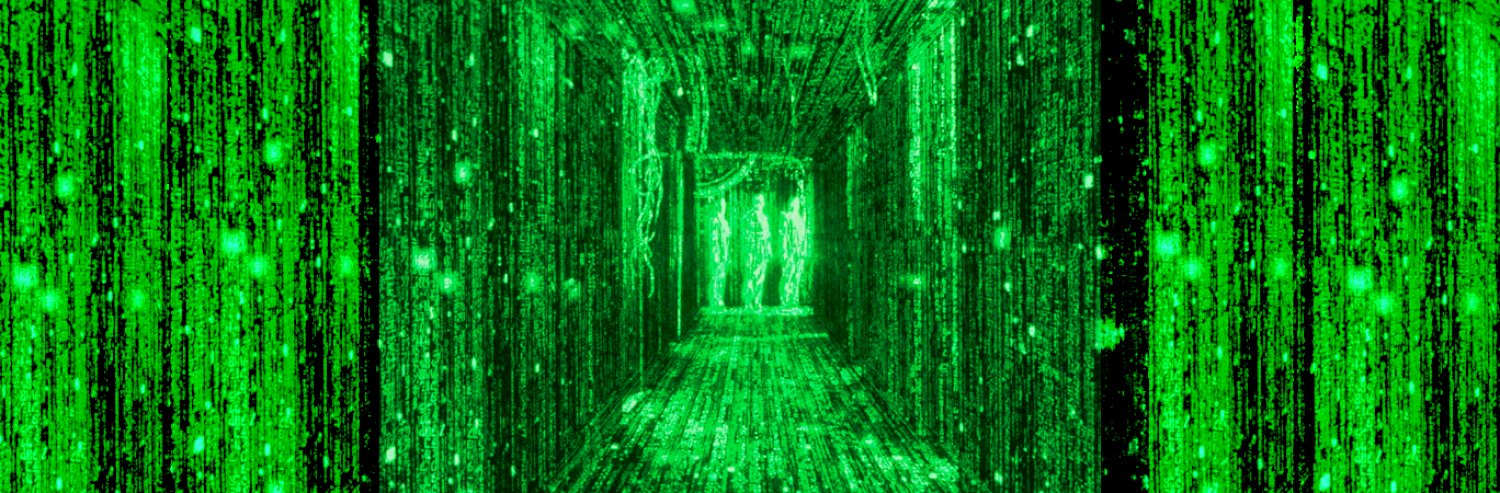
Back a few years ago, when I was teaching a large survey course on moral reasoning, I happened to mention the simulation hypothesis. Immediately, to my surprise, my otherwise sleepy students clocked back in. A dozen hands went up. After hearing from a number of them—and from the widespread head-nodding—it became clear that the simulation hypothesis was for them a serious contender as a theory of reality.
For those unfamiliar with this idea, the simulation hypothesis is the claim that our experience of the world is in fact experience of a virtual, simulated reality. Imagine all of us strapped into immersive virtual-reality headsets, add that we have been strapped in for our whole lives and that until recently we all had no idea—blithely assuming our experiences were of this actual physical world and not simulated. It’s essentially the premise of The Matrix movies. But up until this moment in class, I took it for granted that everyone (outside a few perversely enterprising philosophers and Elon Musk) found the simulation hypothesis to be an amusing but implausible “what if” scenario.
In my experience of teaching philosophy, students tend to have a low tolerance for fanciful hypotheses and abstruse thought experiments. All but the most philosophically inclined roll their eyes at Descartes’s famed “evil demon” scenario in which the reader is meant to reflect on whether any of her beliefs couldn’t have been presented as a deception of a malevolent spirit. David Chalmers’s thought experiment concerning “philosophical zombies”—beings identical to us except lacking conscious experience—appears to many as gratuitously “sci-fi.”11xDavid J. Chalmers, The Conscious Mind: In Search of a Fundamental Theory, rev. ed. (Oxford, England: Oxford University Press, 1997). While they wouldn’t use this phrase, the sentiment is often along the lines of “What does this have to do with the price of cheese?” Yet to my students that day, simulation wasn’t merely a nerdy hypothesis concocted to titillate philosophers; it was a live and compelling option. I was astonished, and, honestly, a bit worried.
So far as I can tell, the intellectual origins of the simulation hypothesis have little to do with its popularity. The contemporary genesis of the view is an argument from analytic philosopher and techno-futurist Nick Bostrom, in 2003.22xNick Bostrom, “Are We Living in a Computer Simulation?” Philosophical Quarterly, vol. 53, no. 211 (2003), 243–255. Simplified and updated a bit, his argument goes as follows: If there is even a low probability that human beings eventually have the technology necessary to simulate the conscious experiences of human minds, then some of these simulation-builders would simulate many billions of minds.
If you’re like me, this will strike you as an odd intuition, but the thinking is that such simulations would have great predictive value, with implications for governance, business, and national defense, among other initiatives. Hence the motivation to greatly multiply simulations. And given this mania for simulation, there would then likely be many more minds in simulations than not. Because simulation is meant to replicate experience of reality, the assumption is that it would be difficult to tell “from the inside” whether or not we are in one. But if our subjective evidence doesn’t enable us to rule out that we are in a simulation, then the objective evidence that most minds are in simulations implies the chances are quite high that you and I are among the minds in simulations.
The reasoning here is somewhat familiar from more mundane cases: If you know that thousands of raffle tickets have been purchased, then the chance that the ticket you bought is the winning ticket is very low. If you can’t find out whose ticket number was selected as winner, then you are stuck with proportioning belief to these low odds of success; you can be pretty sure you didn’t win.
To avoid the conclusion that we are likely in a simulation, you would have to think that it’s all but impossible that human beings would ever simulate many minds—that no other raffle tickets were sold. For techno-futurists like Bostrom, the eventual simulation of minds seems fairly probable; therefore, the simulation hypothesis is compelling.
But none of my students engaged in this sort of reasoning. In fact, reasoned arguments for the view were few and far between. So far as I could tell, the simulation hypothesis simply struck them as plausible. How could this be?
If Simulation Is the Answer, What Is the Question?
In the few intervening years since this moment in class, it’s become a minor avocation of mine to figure out why such an impractical and seemingly recondite view could have become so plausible to many young people. And apparently not only to young people. I haven’t been able to locate any rigorous scientific surveys, but it appears that the view has quietly amassed a substantial following right under our noses. A public opinion poll conducted by NBC in 2019 had 60 percent of about 50,000 respondents leaning toward simulation, and a live amateur polling site with (at the time of my writing) more than nine million responses is evenly split on the question.33xDan Falk, “Are We Living in a Simulated Universe? Here’s What Scientists Say,” NBC Mach, July 9, 2019, https://www.nbcnews.com/mach/science/are-we-living-simulated-universe-here-s-what-scientists-say-ncna1026916; “Let’s Settle This,” neal.fun, https://neal.fun/lets-settle-this/. There is evidence that this latter poll has some validity, since the question about simulation is one of twenty-two overall, and the results on the other questions confirm what one would expect. For example, a majority of respondents think Coke is better than Pepsi and that toilet paper should come off the top of the roll rather than the bottom.
Part of my puzzlement has been how the simulation hypothesis could gain such epistemic traction outside of the nuanced arguments of philosophers and tech entrepreneurs. My students—and, frankly, most people—aren’t reading Bostrom. No doubt many have heard that Elon Musk claims to believe we’re in a simulation, but is his celebrity cachet sufficient to persuade so many of such a revisionary thesis? Neither explicit argument nor influence seems to account for the growing popularity of the view.
Old-school sociologists of knowledge and phenomenologists may be able to guess what I had overlooked thus far: the role of people’s experience. What would it mean for our experience to seem simulated? The very concept of simulation includes the idea of pretense and artificial production. So it stands to reason that one prominent hallmark of a phenomenology of simulation would be that one’s experience feels fake or unreal.44xPhilosophers might object that experience within a simulation is unlikely to seem fake. But this is irrelevant. I am not asking what experience of simulation would be like. I am asking what it is like for our experience to seem simulated.
And indeed, there is evidence that increasing numbers of people find that their experience feels this way. Recent studies have indicated a link between increased time spent using digital media and experiences of derealization—a sense of detachment and dissociation from reality.55xAnna Ciaunica, Luke McEllin, Julian Kiverstein et al., “Zoomed Out: Digital Media Use and Depersonalization Experiences During the COVID-19 Lockdown,” Scientific Reports, vol. 12, 3888 (2022); https://doi.org/10.1038/s41598-022-07657-8. It is plausible that our increased use of digital devices and social media in general promotes a sense of derealization, even when it doesn’t reach pathological levels. Interacting with the world via a smartphone or computer and interacting with other people via social media and text in both cases creates distance between the user and primary reality. These tools increase our reach and immediacy of communication but create a gap that hides the fullness and presence of the world.66xRecent developments in the use of English language also suggest a growing sense of remove from the world itself. See Jay Tolson “Adjacency: Just a Suggestion,” The Hedgehog Review, vol. 25, no. 1 (Spring 2023); https://hedgehogreview.com/issues/by-theory-possessed/articles/adjacency. For those whose interaction with the world is significantly mediated in this way, it may be that this sense of unreality is the norm.
The mediation of experience would seem to increase the plausibility of simulation, but another factor, I believe, is playing an even more significant role: a pervasive sense of meaninglessness. A 2023 survey by the Harvard Graduate School of Education found that 58 percent of Americans ages 18 to 25 reported an absence of meaning in their lives.77xRichard Weissbourd et al., “On Edge: Understanding and Preventing Young Adults’ Mental Health Challenges,” Making Caring Common Project, October 2023; https://mcc.gse.harvard.edu/reports/on-edge. To quote one respondent from the survey: “I have no purpose or meaning in life. I just go to work, do my mundane job, go home, prepare for the next day, scroll on my phone, and repeat.”88xIbid., 14.
Not that we need social-scientific surveys to know that life can be desultory in a morally evacuated consumer culture where labor is increasingly confined to menial screen-based tasks in an information economy where meritocratic ascent is prioritized over conviviality, relationships, and curiosity, let alone sacred traditions. In light of this reality, a prevalent sense of meaninglessness is less of a quirk to be explained than it is a predictable result. As too many of us can attest, the experience of meaninglessness is not unique to younger adults.
What is especially interesting about meaninglessness, however, is that despite its growth and prevalence, we tend to think that it is abnormal in a normative, if not statistical, sense. We tend to think meaninglessness is a problem to be solved rather than an unavoidable mode of human experience. We may not be able to articulate why, but it seems that this is not the way things are supposed to be. This is why we study meaninglessness, try to escape it, talk to pastors and therapists about it, complain to our friends about it, read self-help books about it, and worry when young people increasingly have it. The inveterate human reaction to this phenomenon is that the affliction demands an explanation, in addition to a cure.
We are now in position to see the strange amenability of the simulation hypothesis. The most prominent existential feature of the phenomenology of simulation is that it would seem to amplify the meaninglessness of our experience. The sort of explanatory relationship I have in mind is most easily observed in the experience of playing video games. Video games can be immersive, challenging, and even addicting, providing venues for adventure and accomplishment…of a kind. But the satisfaction brought by these charms is dampened by the sense that the experience is ultimately contrived, reverse engineered to cultivate these responses in the participant. I might score fifty points in a game with my Stephen Curry–styled avatar in the video game NBA 2K, winning it for my team with a last-second three-pointer, but the meaningfulness of this accomplishment is trivial compared to a local high-school student scoring a mundane twelve points in a live competitive basketball game. As entertaining and diverting as playing basketball virtually might be, it is accompanied by a sense of meaninglessness.
I want to be clear: This is not a critique of video games. There is no requirement that every moment of our lives be replete with meaning. And, indeed, part of the very appeal of video games is that they offer an escape from the sometimes oppressively real pressures and expectations of much of ordinary life. The point is just that simulated experience is in general less meaningful than genuine experience, and that the experience feels meaningless because it is simulated.
But if you already feel that your experience is meaningless, then this makes the simulation hypothesis sound not like a far-fetched sci-fi thought experiment but like an explanation. Things aren’t supposed to be meaningless, but they are, and nothing you’ve tried has fixed the problem. What could account for this pervasive blight, this leaching of significance from daily life? Here’s an idea: None of it is real. Perhaps life feels as meaningless as a video game because, essentially, that’s what it is. And this explanation, I believe, is what the simulation hypothesis offers today’s youth.
Justifying the World’s Ways to Man
The existential challenge posed by meaninglessness, if “solved” by acceptance of simulation, leads us into some strange territory. But since some of us appear to be headed there, we should do a little exploring.
I suspect that the deepest question at stake here is one of theodicy. We usually talk about theodicy as the attempt to justify God’s ways to man—why would a good God allow evil to exist? But this may be thought of as one species of response to a prior and more general question, one with a wider range of existential traction: Why is the world bad? After all, even if one doesn’t think God exists, the problem of the bad world persists. Hans Blumenberg, mid-century German philosopher and concentration-camp survivor, interprets the question of the bad world as one of the key choice points that oriented ancient philosophy and theology.99xHans Blumenberg, trans. Robert M. Wallace, The Legitimacy of the Modern Age (Cambridge, MA: The MIT Press, 1983), part II. As he tells it, three basic kinds of response emerged to this question, each of which ramifies out into a comprehensive metaphysic, a grand theory of the world. The three responses are the Gnostic, the Christian, and the Atomistic.
In response to the question “Why is the world bad?” the Gnostic replies that the world is bad because its creators were themselves bad, or, at least, incompetent, and the material of the world they made is inherently corrupt. Human beings are essentially stray sparks of God’s true divine spirit imprisoned in bodies of evil flesh. The world seems bad because it was created bad. The Christian response, on the other hand, is that the world is not inherently bad but was originally created good. It became bad because the human decision to sin—to disobey God—incurred a divine curse. The world seems bad because a good creation is in a fallen, afflicted state. The Atomist, however, replies that the question is premised on a sort of confusion: All that exists is matter in motion, and thus all allegedly immaterial phenomena—including good and evil—are merely conventions of speech and not genuine realities. The world isn’t bad (or good), as Hamlet puts it, “for there is nothing either good or bad, but thinking makes it so.” The explanatory virtue of Blumenberg’s typology is not only that it organizes major understandings of reality into a simple relationship based on responses to a fundamental human question but also that it recognizes the importance of this human factor in the quest for knowledge. We are not dispassionate creatures of science inveterately accumulating facts into a picture of reality. At least, the vast majority of human beings across history have not been so. Far from it—the answers to our questions of meaning and purpose are intimately bound up with our ideas about the nature of reality. We want to know what reality is like because that is where we live.
Perhaps this is noticeable only in hindsight—after the problem emerges—but there is a basic tension inherent in the human relationship to Atomism that arises from the inevitable conflict between the resistance of the material world to human will. If all is matter in motion, then, at least in principle, we should be able to arrange matter as we please. Indeed, this was the original utility of Atomism for Epicurus, one of its founders. Once you realize that there is only the causal play of atoms in the void, you may employ these causal links as levers and pulleys toward making things more endurable for yourself. The more attractive metaphysics tend to come with a proprietary means of consolation.1010xSee Nietzsche’s idea of metaphysical consolation in his The Birth of Tragedy from The Birth of Tragedy and The Case of Wagner, trans. Walter Kaufmann (New York, NY: Vintage, 1967).
The trouble is that the atoms in the void aren’t always so easily manipulated. Sure, you can move a pebble out of your shoe easily enough. You can arrange larger stones to make a structure for shelter. You can even break the pebble down into its basic chemical constituents to considerably broaden your menu of levers and pulleys, but this requires precise instrumentation, a scientific-industrial complex, and a multigenerational research program. At a crude level, the physical environment yields to our will. But as we press closer to the material basis of living processes, the scale of difficulty increases logarithmically. The heady excitement of machine technology in the eighteenth and nineteenth centuries decays into feelings of frustration as we attempt to life-hack or redesign human biology. We struggle to regrow lost hair, lose weight, overcome infertility, calibrate brain chemistry, transition to a new gender, prevent cancer, or delay aging and death. Theoretically, the will is part and parcel of the play of atoms in the void, but experientially, the atoms in the void become adversaries. Nature is all there is; so goes the view. But now nature is also an obstacle, a confinement.
When nature is seen or felt to be a confinement, there is understandably a desire for escape. Dreams of a total surmounting become more common. But once the human reaction to the material world becomes the desire for escape, we have judged the material world to be in some sense bad, and we stand at the threshold of Gnosticism. This isn’t an indictment; this is merely an analysis of intelligible dynamics in the interplay of metaphysics and human longing.
Status Quo Metaphysics
Almost no one now calls himself an “Atomist.” But the view that nature is all that exists, and that physical reality below the level of casual observation is fundamental, is the received view in the guilds of science and technology, and is prominent in the humanities as well. This is the legacy of the scientific metaphysics of the Enlightenment. Today, this view answers to many names, including “materialistic reductionism,” “philosophical naturalism,” or just “naturalism” for short. Naturalism’s persuasive strength is that it posits entities and explanations that can be described only in empirical terms. More expansively, it posits things we can detect only with our senses, or with instruments that extend the reach of our senses, or—at the limit—things whose existence we can infer and then talk about with scientific terminology, even if we cannot detect them instrumentally.
The rational support for naturalism has both an objective philosophical and a uniquely modern historical-social-political inflection. This modern incarnation of Atomism emerged in early-modern Europe amid violent sectarian wars that turned, in part, on issues of theology that were not intersubjectively decidable. While Catholics, Lutherans, and Calvinists were killing each other over imperceptible matters of doctrine in Germany, tinkerers in England and the Netherlands were appealing to the demonstrative proof of empirical experiment to settle old disputes and arrive at new and revisionary understandings of the natural world. This stark contrast between the methods of science and the methods of theology accelerated the appeal of the empirical approach. This, at any rate, is the version of the story that casts naturalism in the best light.
Religious war has waned in the West, but it still casts a shadow on the present, and in matters of disagreement, demands for proof still carry this rhetorical gravity. The discourse of academic metaphysics rarely makes any explicit mention of the Wars of Religion, but the dominant approach is to eschew theories that appeal to indetectable entities. If something is posited that cannot be described in scientifically tractable concepts, it is derided as “spooky” or “mere fantasy.”
But naturalism isn’t merely a maximally cautious approach to identifying what exists. It also relies on the huge explanatory achievements of the Scientific Revolution and early work in astronomy, dynamics, electromagnetism, and chemistry. In these fields, the empirical phenomena turned out to be describable in elegantly rendered mathematical terms. The medieval synthesis of Aristotle’s metaphysics and Christian theology couldn’t compete in these realms. To be sure, empirical explanations in the social sciences, and even biology, have failed to meet with the same kind of success, but naturalism still leans (heavily) on its early-modern successes as evidence of its truth.
Why, then, would people feel that simulation is a more plausible explanation for meaninglessness than naturalism? After all, if everything is supposed to be built up out of basic physical properties, it becomes extremely difficult to see how anything like meaning could even exist. Indeed, some “disenchanted” naturalists have concluded that nothing could matter.1111xSee, for instance, Alex Rosenberg, The Atheist’s Guide to Reality (New York, NY: W.W. Norton, 2011). But it appears to be a basic anthropological fact that humans have expectations of meaningfulness. Unsurprisingly, then, this resolutely reductive interpretation of naturalism appears to be the minority report. Most naturalists today are what you might call “enchanted,” taking mind, meaning, and morality as seriously as these phenomena appear to be.1212xSee James Davison Hunter and Paul Nedelisky, Science and the Good: The Tragic Quest for the Foundations of Morality (New Haven, CT: Yale University Press, 2018), ch. 8. How exactly these phenomena could be explained in scientific terms remains elusive, but it is an article of faith for enchanted naturalists that this will one day be discovered.
Naturalists, then, either deny meaning is possible or deny that their view truly undermines meaning. This is either too strong or too weak as an explanation for meaninglessness. We need an explanation for why experience seems meaningless without making meaning impossible. The simulation hypothesis would seem to provide precisely this, positing, as it does, an enervating veil between the experiencer and genuine reality. The real world of meaning is potentially out there, but the simulation of our experience prevents our access to it.
Intriguingly, however, if naturalism is true, it also makes simulation more likely. If everything is built up from arrangements of matter and energy, then so is consciousness and experience. Hence, the artificial production of experience is merely a technical problem to be solved. We just have to find the right arrangement of matter, and this will produce or constitute mind. And given the progress on virtual reality and artificial intelligence, confidence in achieving simulation is understandably high. For many naturalists who work and think in the tech sector, achieving simulation is inevitable.
This feeling of inevitability is a big part of why Bostrom’s argument has been so influential in certain intellectual circles. He can make a plausible case that if simulation is achievable, then there are likely far more simulated minds than not and thus we ourselves are likely among the simulated minds. It hasn’t always and everywhere been plausible that mental experience could be simulated, even in principle. However, for naturalists with rosy views of technological development, it’s not a matter of “if” but of “how soon.”
Modern Atomism Consumed by Her Offspring
But here lurks a strange involution, the implications of which—so far as I can tell—have gone unnoticed. When we play a video game or watch a CGI movie, there is the appearance of causation between the graphically depicted characters and objects. Elsa and Anna hug each other in the children’s movie Frozen, and there is the appearance of physical contact. Of course, this is merely apparent; the characters are graphic images whose movements are entirely dictated by code, which itself is unobservable within the film. What looks like a warm embrace is in fact the digital manipulation of images by rules and forces inaccessible to the viewer. The apparent causal order is illusory, and the genuine causal order is concealed.
The kicker is that if we are in a simulation, then the entirety of the causal order we observe is in this way like what we observe in a digitally animated movie. My hand seems to hold my coffee mug, I seem to pick up my crying child, the sunlight seems to illuminate the landscape—but really all of this is nothing more than artificially produced images and impressions designed to give the appearance of a physical causal order in which people and things interact via contact and force. The actual causal basis is hidden from us. It may be digital code, as with the movie Frozen; it may be some other kind of manipulation unknown to us and undiscoverable by our science.
Now the problem for naturalism comes into view: To whatever degree it is likely that we are in a simulation, then to that degree we have no rational basis for thinking our experience tells us about the nature of reality. And, by extension, this holds for empirical science. We have centuries of meticulous data-gathering and creatively elegant theoretical explanations of nature, but we might as well have been providing theories to explain the causal order represented in the Alice in Wonderland stories or in a game of Dungeons & Dragons. What we think of as the laws of nature are nothing more than orderly arrangements of fictions and phantasms in the simulation.
Don’t get me wrong—the sciences are still useful for understanding and controlling the regularities of our simulated experience. For whatever reason, there are still fairly predictable sequences of experiences that resemble causal interactions. My hand isn’t really a flesh-and-blood appendage supporting a ceramic mug of a certain mass containing life-giving black coffee, but the inscrutable causal order that underlies our simulation permits my artificially produced hand phantasm to reliably seem to cause my mug phantasm to deliver coffee phantasm to my mouth phantasm. You get the idea. But these rules of interaction are merely functionally adequate for getting around in the world of our experience, and if that world is a simulation, then there’s no reason to think those rules would tell us anything about the genuine nature and causal basis of reality. Belief in simulation, then, undermines the plausibility of naturalism—of modern scientific metaphysics.1313xJames N. Anderson briefly described a similar argument in a 2019 post on his Analogical Thoughts blog; https://www.proginosko.com/2019/04/are-we-living-in-a-computer-simulation/. Because of the way that simulated reality undercuts the support for naturalism, you can accept the simulation hypothesis or you can accept naturalism, but it becomes difficult to rationally accept both.
This is intriguing in part because it was naturalism that made simulation plausible in the first place. Indeed, naturalists may not be able to avoid the undercutting of the evidence for their view by simply rejecting simulation. After all, if you think that mind and consciousness are physical processes, as naturalists tend to do, then artificially producing them is going to seem more achievable than if you think they are sui generis phenomena unexplained by the physical world. To put it crudely: It makes sense that we could build a robot from material parts; it doesn’t make sense that we could build a ghost. So it may be that naturalists—with their materialistic conception of the mind and consciousness—are rationally committed to the achievability of simulation. But if this is right, then they lose one of the primary avenues for rejecting simulation. The person who thinks mind and consciousness are part and parcel of an immaterial soul has a built-in objection to simulation: That person can, in a principled way, deny that the simulation of mind is possible. You cannot build what you cannot control. But it is hard to see how the naturalist can take this position. Naturalists, then, may find it especially difficult to avoid commitment to a view that is especially damaging to their view.
Why, despite there being many hyperintelligent naturalist proponents of simulation, has no one else acknowledged the impending doom loop threatened by the simulation hypothesis? In appropriate humility, perhaps the logic behind the involution and collapse I have described contains an elementary error. Perhaps there are—unknown to me—compelling reasons to think that even though consciousness is just due to arrangements of matter, it couldn’t be simulated. Or perhaps Bostrom’s assumption—that if simulation is achieved, then many times more experiencers will be in simulations than not—is incorrect. Perhaps. But there is another reason, too: Naturalism has become a kind of faith, a secular alternative to traditional supernaturalist religions. We already saw evidence of this faith in the commitments of “enchanted” naturalism. As a result, naturalism often comes with the difficult-to-revise existential implications of any comprehensive worldview and, just as importantly, with tribal allegiances to defend. The psychological staying power of this sort of guiding conviction can insulate it—like any faith—from the occasional logical objection.
A Once and Future Metaphysics?
The synopsis of my argument goes something like this: Belief in naturalism made the simulation of consciousness seem possible. Bostrom pointed out that if simulation were possible, then most minds in world history would likely be in simulations. Bostrom’s influence among tech-oriented intellectuals introduced the idea of simulation into the popular consciousness. Young people struggling with feelings of meaninglessness encounter the simulation hypothesis and—so I surmise—find there an explanation for their experience. The ranks of the simulation-curious swell. But the relationship between simulation and naturalism is unstable, with simulation undermining the evidential support for naturalism. This epistemological problem is thus far unnoticed. What will be the outcome if and when the new simulationists realize they have little reason to accept naturalism?
Probably you’ve already connected the dots leading toward one possible outcome: a return to metaphysical Gnosticism. Recall that in its most basic outlines, Gnosticism as a metaphysical system is the idea that the world of our experience is bad because it was made by creators that were themselves either evil or incompetent. This is a perfect fit for the simulation hypothesis. The recurrent human impulse to resist the constraints of the experiential world finds a new outlet. For our new simulationists, the problem of the bad world is now explicable by appeal to the design of whoever or whatever created the simulation we’re in. The blame for the world’s less-than-ideal features—for the meaninglessness of modern life among other ills—can be laid at this demiurge’s feet.
Assuming it has feet. After all, if the world is a simulation, it isn’t obvious that its creator is human at all. If this strikes you as bizarre, then we agree. But this is only to flag that any development of simulation-based Gnosticism will require addressing many questions about the nature of reality in entirely new ways. Age-old debates over creation, fall, evil, providence, the nature of God, monotheism vs. polytheism, free will, prayer, messianic deliverance, and eschatology re-emerge in a novel register.1414xA few have already begun attempting to sketch answers, including David J. Chalmers, in his book Reality+ (New York, NY: W.W. Norton, 2022), and Ian Huyett, in his article “Religious Parallels to the Simulation Hypothesis: Gnosticism, Mormonism, and Neoplatonism,” Sophia, vol. 63 (2024), 239–257; https://doi.org/10.1007/s11841-023-00955-2. This kind of return to Gnosticism would be more metaphysically robust than that described by some modern analysts who have seen in secular ideologies some structural similarities to the ancient view.1515xI am thinking of Eric Voegelin’s account in The New Science of Politics (Chicago, IL: University of Chicago Press, 1987) as well as Isaac Ariail Reed and Michael Weinman’s “Gnosticism in Modernity, or Why History Refuses to End” in The Hedgehog Review, vol. 24, no. 3 (Fall 2022); https://hedgehogreview.com/issues/hope-itself/articles/gnosticism-in-modernity-or-why-history-refuses-to-end. This would be a return to something akin to a religious perspective, in which people look to superhuman powers to explain the nature of reality.1616xFor this account of religion, see Christian Smith, Religion: What It Is, How It Works, and Why It Matters (Princeton, NJ: Princeton University Press, 2017).
Of course, this sort of inquiry will proceed only if enough people genuinely accept the simulation hypothesis. And perhaps people will not do this. Perhaps simulation is the sort of claim that—at best—warrants mere admission of plausibility. Expressing credulity in class, or responding to an Internet poll, is very far from a religious metaphysic that gives shape and meaning to one’s life. Simulation Gnosticism may be a seed that never sprouts.
But, in closing, just to play demiurge’s advocate for a moment, I must note the ideal conditions for its reappearance. The logic of the simulation hypothesis does emerge out of and undermine naturalism—the currently dominant metaphysic among public institutions and the highly educated. And if the experience of young people becomes sufficiently and painfully meaningless, the existential consolations of simulation may carry more weight than you or I can easily anticipate. The sensation that our experience is mediated and unreal due to overexposure to digital interfaces only intensifies the plausibility of simulation. With naturalism weakened and with Gnosticism idling nearby as a natural fit for the simulation hypothesis, the step into something new may be intellectually easy.1717xI want to thank Brannon McDaniel, Beth Nedelisky, and Jay Tolson for their detailed comments on an early draft of this essay, and an audience for the Emerging Ideas series at the Institute for Advanced Studies in Culture—in particular Martha Bayles, Colin Bird, Talbot Brewer, Joseph E. Davis, James Davison Hunter, Elisabeth Lasch-Quinn, Jay Tolson, Patrick Williamson, and Olivier Zunz—for their searching questions and rejoinders.
Reprinted from The Hedgehog Review 28.1
(Spring 2026). This essay may not be resold, reprinted,
or redistributed for compensation of any kind without prior written permission. Please contact
The Hedgehog Review for further details.
