


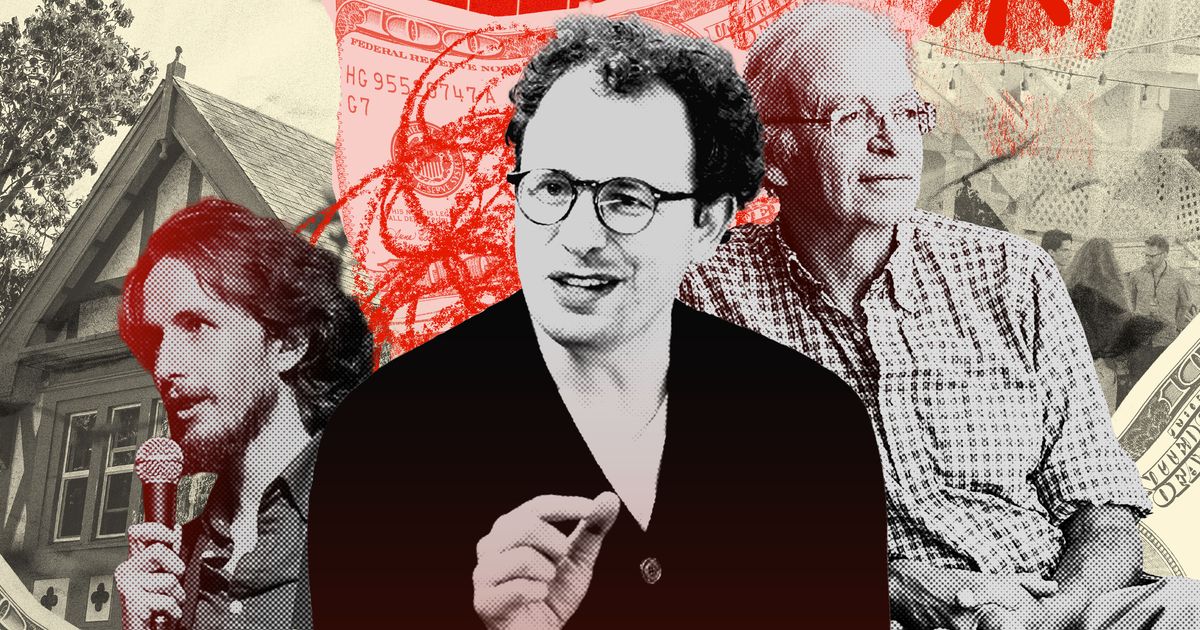
Photo-Illustration: Intelligencer; Photos: Redux, Getty Images, LinkedIn
This article was featured in New York’s One Great Story newsletter. Sign up here.
In 2022, Itsi Weinstock moved to the Bay Area to join a synthetic-cheese start-up. A machine-learning scientist from Sydney, he had long been passionate about animal welfare and hopeful about technology’s capacity to improve it. Fake cheese fit his vision of a better future: a leap forward in the possible instead of merely a fight to preserve the natural. But recently he has taken on a new job. A friend introduced Weinstock to Senterra — a nonprofit that advises the rich on how to spend their wealth on projects that move society away from factory farming — with a unique opportunity. “The job,” he told me over a vegan burrito, is to “go get the Anthropic money.”
In January, when Anthropic CEO Dario Amodei posted a long essay about the potential societal fallout from AI, most commentators focused on his discussion of the risks of the new technology. But philanthropies like Senterra noticed an announcement buried within: Amodei and his six co-founders had pledged to give away 80 percent of their wealth. If staffers promise to donate up to 25 percent of their shares, the company will match their donations. Anthropic’s latest valuation is $965 billion and Forbes estimates that each of its owners is worth $15.5 billion. That means over $86 billion could drop into charitable giving after the IPO — more than 250 times what the now-imprisoned investor, Sam Bankman-Fried, ever claimed to unleash and nearly 15 percent of all philanthropic giving in 2024.
Combine that with the $130 billion controlled by the OpenAI Foundation, said Matt Lerner, the managing director of research for Founders Pledge, which advises entrepreneurs on their charitable giving, and it is clear the “influx of capital from the AI sector is going to significantly change the philanthropic ecosystem.” This is not only because of the massive sums of money but also because of the new rich’s relationship to altruism. “Traditional philanthropic orgs and people won’t cut it,” Stripe’s Nan Ransohoff predicted in a blog on the coming “third wave of American philanthropy.” The AI moneyed will “demand tech-caliber talent and execution.”
Weinstock’s new job is to meet that desire. At Senterra, he spends most days advising people, including the soon-to-be AI rich, on how to spend their wealth on animal-welfare issues. Anthropic was created by defectors from OpenAI as part of a promise to use AI to make the world better (or at least protect us from the technology doing evil). This ethos extends not only to the company’s own work but to the profits it creates. Dario Amodei and his sister, Anthropic president Daniela Amodei, and many other prominent Anthropic employees have long been associated with the effective-altruism movement — a loose group that believes, as Gideon Lewis-Kraus wrote in The New Yorker, “that people ought to do good in the most clear-sighted, ambitious, and unsentimental way possible.”
Dario came across GiveWell, which helped establish the movement’s American wing, in 2008, the year after it was founded. In 2017, Daniela married GiveWell co-founder Holden Karnofsky, who now also works at Anthropic. (“We are both excited about effective altruism,” their wedding site read.) When the Amodeis left OpenAI to found Anthropic in 2021, they were supported by some of effective altruism’s biggest funders: Facebook co-founder Dustin Moskovitz, Skype co-founder Jaan Tallinn, Bankman-Fried. Among those thanked at the bottom of Dario’s essay was Nick Beckstead, who had presided over effective altruism’s first golden age as the head of Bankman-Fried’s FTX Foundation.
Before Bankman-Fried was arrested in December 2022 for misappropriating billions of dollars of customer funds from his crypto exchange, EA had been the rising norm among major givers. (Stripe’s Ransohoff in her blog calls the rise of tech billionaires, and their stringent guardrails for making sure charity was as useful as possible, the “second wave” of philanthropy.) Bankman-Fried had briefly worked at the Centre for Effective Altruism and been convinced as an undergrad at MIT to “earn to give” by Will MacAskill, one of the movement’s founders. As he started promising away tens of millions of dollars, the movement had more money and influence than ever. Glowing articles appeared in prominent publications. With that came extreme adulation for SBF, the boy king, including the proliferation of “WWSBFD” — What Would SBF Do — T-shirts.
Bankman-Fried’s eventual arrest was a moment of profound humiliation for the movement. Higher-ups stepped away from their board seats and leadership roles. (MacAskill even considered stepping away from activism entirely to retrain and work as a DJ.) The broader public came to see EA as, at best, an insular annoyance, and, at worst, responsible for planting the ideas that drove Bankman-Fried’s fraud. Since the scandal, the movement’s organizations have shied away from the limelight and become extremely concerned with PR. For several years, their growth has been severely curtailed. But they survived. And the new AI money has given EA a chance to return and come back larger than ever before.
Many groups have just started thinking in concrete terms about the new AI rich and how to use their money after recent announcements of major IPOs, from SpaceX to Anthropic, and after the AI industry donated in large sums to try to sway primary races in this year’s midterms. But for EA communities the upcoming liquidity boom — and the new influence it will bring — is old news. Weinstock had come to dinner from a historic inn turned compound in Berkeley called Lighthaven where he had been hanging out with a small clutch of people who, for much longer, have been preparing for the tens of billions of dollars set to drop into philanthropy and politics.
Lighthaven was founded in late 2022 by the stewards of LessWrong, the largest forum for the Rationalist movement. The Rationalists have propagated their Bay Area philosophy — which emphasizes probabilistic reasoning above all else — online since the mid-aughts, and Lighthaven is their de facto real life headquarters. Its founders think of it as something like a fin de siècle Vienna coffeehouse, where people from different corners of their broader philosophical ecosystem can mingle. The atmosphere has attracted members of the EA movement. (The two groups are related, but not the same. EAs lean businesslike and professional; Rationalists are a bit stranger and more open to thinking beyond norms.)
“It’s a gathering spot, an events space, a networking space,” Mollie Gleiberman, a researcher who studies rationalist communities, said of Lighthaven, “its role is to keep pushing on that Overton window. I think ASBs” — Anthropic’s soon-to-be-minted billionaires — “see the value of Lighthaven, its role as the space where ideas can bubble up.” (Though, she said, that doesn’t mean funding the space itself would be a priority for the new rich.)
At Lighthaven, the coming gold rush has been discussed with feverish hope. The crowd had gone from merely speculating to strategizing and practically planning. What could they use all the money for? What charities could they fund? What politicians could be helped? What revolutions could they push?
Weinstock explained that our current moment gives certain philanthropic funders a rare opportunity. It is not only that the rich care about EA issues — ending factory farming, stopping nuclear war, halting climate change. But also the sheer amount of money sloshing around means that previously impossible EA moonshots are suddenly imaginable. “There will not be another transformative opportunity for the animal-welfare space,” he told me. “This is it.”
In April, I visited Lighthaven. The former inn’s Victorian buildings on Telegraph Avenue are decorated in Solarpunk style: plants, ersatz and real, are scattered throughout, mingling easily with human life, proposing a less fraught future co-existence between nature and advanced technology. Inside, I found LED lights illuminating neo-Greco trim. When I went to the backyard, I found a vast lawn where sail-like sunshades were strung taut; below them residents plodded barefoot on regularly vacuumed Astroturf between clusters of couches and firepits. The staff scurried silently, earphones in, restocking fridges and picking up empty cans.
The days I spent on the campus were filled with intense conversations. Everywhere you looked were people circled up and trying to arrive at new conclusions from first principles. How did we develop taste? Is there anything to be learned from legal systems in video games? Is the workforce of philanthropic grant-makers large enough to efficiently distribute more than $80 billion? How do you develop the perfect lighting scheme? Pondering these sorts of questions alongside Weinstock were attendees of San Francisco’s pro-billionaire march, writerly sex workers, several sci-fi novelists, and Slate Star Codex blogger Scott Alexander. It was somewhat jarring to hear people who look like they’re late to an Ultimate Frisbee match flaunt their closeness to soon-to-be billionaires. But it wasn’t unusual to wander into a designated shoeless room with a Wirecutter-recommended air purifier in the corner and find funders strategizing about how to pitch the newly moneyed.
Many of the residents were prominent, hobbled soldiers of effective altruism waiting for another shot. There was the editor of the effective-altruist online magazine Asterisk and there was the founder of an effective-altruist donor adviser fund, Longview. After the fall of Sam Bankman-Fried, promised money for many disappeared overnight. Even if the funds were clawed back in the crypto firm’s bankruptcy proceedings, it left the movement adrift.
Now, residents hoped, things were looking better. In March, Matt Reardon, a member of the wider Lighthaven community, published a widely discussed post titled “Effective Altruism Will Be Great Again,” which claimed that the movement could again rise to the heights it had reached during Sam Bankman-Fried’s spending spree in 2022, if it was bold enough to meet the moment. “New projects will launch, ambition will again be the coin of the realm, and no one will be able to deny the underlying reality that a community formed of a commitment to understanding and bettering the world at scale is the reason why,” he wrote. “The only decision to be made is whether this will happen in spite of us or because of us.” The Anthropic money, Reardon said, would be essential to this mission. “I’ve heard many comments just floating around,” Reardon, who hangs out at Lighthaven, told me, “‘When all the Anthropic money gets here, we’ll be able to do X, Y, and Z.’”
At the former inn, the optimism about the good this money could bring is also closely accompanied by ambient panic about the technology’s wider consequences. Ironically, the thing that many effective altruists want to do with their AI wealth to do the most good is fund organizations working to make sure AI is developed responsibly. The progenitor of rationalism, Eliezer Yudkowsky — a frequent presence at Lighthaven whose series of blog posts, “The Sequences,” is the focus of a weekly study group at the campus — thinks the world shouldn’t rule out nuking data centers in order to prevent humanity’s destruction by superintelligence. AI doomsday is an anxiety that looms behind even the most prosaic conversations.
One afternoon, I stepped into a parking lot behind the main campus with a group of temporary residents. We passed an amateurishly rolled cigarette around, chatting amiably. My eye wandered to a rust-stained whiteboard leaning against a wall. Whatever was written on it had been largely erased. The surviving fragments cohered into a dystopian poem: “in a stable oligarchy / empower the AIs / against shutdown / systems are / stop being shutdownable.”
Naturally, then, amid the swirl of goals and causes, the one widely believed to be set to receive the most money was AI safety. PauseAI, which advocates for a moratorium on development, is the only major AI safety organization that doesn’t accept funding from the industry as a matter of policy, but even they haven’t ruled out donations from staffers of the large AI labs. “That would have to be the board’s decision, not just mine,” said Holly Elmore, founder and executive director of PauseAI US. “They might rule that it’s against the interest of the org for me to say, ‘No, I don’t want to be part of this person’s blood money.’”
Organizations whose coffers are willing to welcome support, surprisingly, include the Machine Intelligence Research Institute, which was founded by Yudkowsky. “MIRI would like to applaud and encourage people taking marginal right actions, even within larger systems that are moving in the wrong direction,” said Malo Bourgon, MIRI’s CEO. “A polluting industry that pays for carbon offsets is better than a polluting industry that does not, for instance, even if it would be better overall for the industry to stop polluting entirely.”
On a brutally sunny afternoon at Lighthaven, I scoured the campus for a quiet spot to call Peter Singer, the philosopher whose ideas about real-world utilitarianism in no small part inspired the effective-altruism movement, to ask about what all the money would mean. Amid the excitement over big philanthropic ideas, Weinstock had told me that he’s also found himself empathizing with big tech’s soon-to-be minted funders. “Sometimes they’ll be like, ‘I’m really fucking stressed about this,’” he said. “It is hard to receive ten or 100 million dollars and be someone who has come through the EA ecosystem and be like, ‘You’ve got to spend things in the world to do good things,’ but having never had money before.” I was curious what Singer thought about it all.
I settled on a giant upturned hand — referred to variously as “The Onion of Truth” and “The Claw of Rationality” — crawled in, sat back on the Astroturf lining its palm and fingers, and turned on our video call. Singer has hardly slowed since retiring from Princeton in 2024. When we spoke, he was in Seoul, trying to convince a major Korean company to donate 10 percent of its profits.
Of course, he’s also been thinking about the Anthropic money. “There’s been a bit of buzz going around EA people about how to do our best to ensure that the money that is going to come from Anthropic — which will be very significant — is used in the most effective possible way,” he told me. “It could greatly affect the issues that I’ve been concerned with, which includes trying to reduce extreme poverty in the world and give more people opportunities, and it could have a huge effect on reducing the suffering of animals in factory farming.”
Singer has personally consulted with several effective-altruist organizations about the flood, including The Life You Can Save and Rethink Priorities. Other prominent EA organizations have been thinking about this too. This past November, Open Philanthropy — which had mostly worked on giving away Moskovitz and his wife’s money — changed its name to Coefficient Giving. The organization said the shift was in part to make sure the coming rich realized they could use the organization’s services, too. “If even a fraction of the wealth being generated in AI flows to philanthropy,” its spokesperson said, “that’s a meaningful expansion of the pool of capital for high-impact work.”
Singer thinks a chunk of the money will flow into American politics, too. “It’s certainly extremely influential and heading in a direction that I think most people interested in the movement would not approve of,” he said. Before defecting to tech, Daniela Amodei worked on Capitol Hill in the office of Democratic representative Matt Cartwright. The company’s savvy with D.C. has already been on display. In February, Anthropic announced it was granting $20 million to a new super-PAC to push for “responsible” AI — with the New York Times framing the cash as counter to the spending by its rival OpenAI. Anthropic pouring millions into politics was framed as not just about power for itself but safety for others.
In D.C., until very recently, conversations about how the AI rich will spend their new wealth had not filtered beyond effective-altruist circles. The obscurity is partly deliberate. EAs remember the grifters who superficially adopted their frameworks when the FTX money started flowing. They want to avoid that this time. “You really don’t want to say to a bunch of people, ‘Hey, there’s going to be a bunch of money in this space very soon,’” said Keller Scholl, a longtime effective altruist and contractor with effective-altruist organizations. “The longer you can put that off, the safer you are from some of those corrosive effects.” But their efforts haven’t been entirely successful. “I can definitely see a certain schmooziness showing up again, where it’s like, ‘Oh yes, I think very seriously about AI,’” said former effective altruism D.C. head Andy Masley. “I know that that’s a signal for, ‘Fund me.’”
There’s a version of the future where the massive influx of funding for effective-altruist organizations never materializes. A good chunk of the money may just flow into the sorts of things wealthy people have always spent their money on: property, stocks, college endowments. “There’s probably going to be a mad scramble to appeal to the new rich, but I also think a lot of that capital is going to go into stuff — into housing, into companies, into charitable trusts,” said Samuel Hammond, the director of Artificial Intelligence Policy and chief economist at the Foundation for American Innovation in D.C.
As Anthropic’s prominence has grown, its leaders have drawn closer to more traditional sources of legitimacy and away from places like Lighthaven. At Cannes this year, Dario Amodei was set to co-host a party with former Vanity Fair editor Graydon Carter. At the last minute, he was not able to attend but other Anthropic executives did. At the same time, the Amodeis have also distanced themselves from the EA movement. “I’m not the expert on effective altruism,” Daniela told Wired last year. “I don’t identify with that terminology. My impression is that it’s a bit of an outdated term.”
But when I asked people at Lighthaven, no one really thinks this rhetoric means that Anthropic’s soon-to-be rich will ignore EA causes. “It’s such a poignant example of people being too calculating in the way that they present themselves,” Reardon told me of Amodei’s comment. He isn’t sure who the money will specifically go to but doesn’t doubt that much of it will be channeled through EA circles.
One evening, I chatted with Oliver Habryka, who built the Effective Altruism Forum, LessWrong, and Lighthaven. Bundled up in a knock-off Snuggie by the fire, he was telling me why he was conflicted about the many conversations his campus has hosted about how Anthropic’s money should be spent. Then, he abruptly stopped. “Sorry, I almost set myself on fire,” he said, in a nearly British accent, with traces of his native German, before recovering and rambling on. Many rationalists worried about larger things, but he seemed focused on the local.
“Inasmuch as there’s a scene here at Lighthaven, that scene will be very drastically disrupted. It will be like a major force of nature that will suddenly change a lot of the vibes … attracting an infinitely large pool of grifters,” he said. “People trying to come to terms with that — somehow — I’m pretty in favor. I’m less excited by the people who are just going through the motions of how can I position myself in front of the infinite money spigot, which is a kind of thinking that, I think, will ultimately be responsible for a lot of the damage.”
Habryka almost drowned in effective altruism’s last funding blitz. In 2022, Bankman-Fried contributed a little over $4 million to his organization. That was clawed back in the FTX bankruptcy, and Habryka had to scramble to finish renovations for the campus. In the aftermath, like many others, he drifted from EA Some in the movement had moved further left. Others, like Habryka, moved toward libertarianism, at times flirting with the far right. In certain contexts, he’ll still call himself an EA. “I’m not going to be like I have no relationship,” he said. “I did indeed, within the last month, see Will MacAskill at one of my community parties.”
Still, Coefficient Giving cut off funding to Lighthaven in the summer of 2024 after it hosted the Manifest conference, which featured Richard Hanania. (Hanania had previously argued for eugenics and white nationalism in posts under the pseudonym Richard Hoste. He has since apologized for the writings.) And after, Habryka put up his own money to keep the project going.
Habryka doesn’t envy those about to get billions who intend to give it away. “The default thing for billionaires to do is to dip their toe into trying to give away their money,” he said. “After a while, you become cynical and are like, ‘Fuck this. I don’t know how to have relationships, because everyone is clearly trying to hang around with me to see whether that results in them getting $10 million.’” He worries that as more money comes in from the AI companies, it will only make the problem worse at Lighthaven. “I do think my environment will end up being very heavily selected for Anthropic sycophancy,” he said. “I’m not looking forward to it.”
