


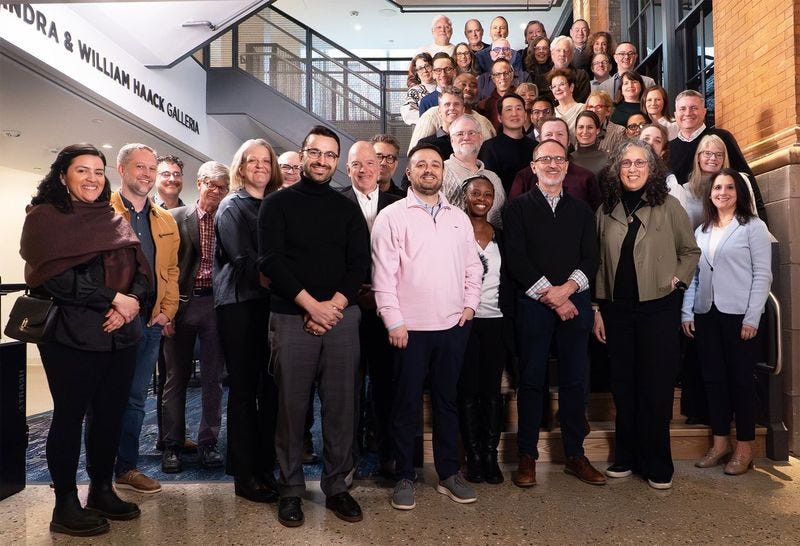
Earlier this month, more than sixty artistic and executive leaders from theaters across North America gathered at Milwaukee Repertory Theater. The purpose of the convening was clear from its title: From Crisis to Catalyst: Transforming the Regional Theatre Landscape.
No one in the room pretended the crisis wasn’t real. Attendance remains significantly below pre-pandemic levels, costs continue to rise, and philanthropic priorities are shifting. Since the pandemic, more than thirty nonprofit theaters has closed. For those working in the field, these realities are no longer abstract statistics; they shape the daily work of running institutions, supporting artists, and serving communities.
But what made the gathering notable was that it was not organized around lamentation. Instead, it centered on a harder—and ultimately more hopeful—question: what if this moment is not simply a crisis to be endured, but a catalyst for transformation?
One of the most striking ideas raised during the conference came from playwright and novelist Ayad Akhtar, who pointed out something that initially feels counterintuitive. At the same time theater attendance has struggled, the broader “experience economy” is thriving. Concerts are booming, live comedy tours are filling arenas, and companies like Netflix—once synonymous with staying home—are now investing heavily in physical spaces designed for shared live entertainment.
People clearly still want to gather. They want to leave their homes, share moments with others, and participate in experiences that feel alive. Yet they are not doing so for theater at the same rate.
That observation suggests that the challenge facing theater may not simply be financial. It may be relational. Theater has always depended on a living relationship between artists, institutions, and audiences. When that relationship weakens, even vibrant artistic work can struggle to find its community.
Akhtar also highlighted that looking back at the most influential theater institutions of the past century reveals something important. They were not simply producers of plays; they were builders of ecosystems.
The Group Theatre cultivated a collaborative acting company that transformed American performance. The Royal Court in London nurtured a generation of playwrights who reshaped British theater. Joe Papp’s Public Theater reimagined the audience itself, radically expanding access through free Shakespeare in Central Park and programs designed to welcome people who had never set foot inside a theater.
Each of these institutions understood something fundamental: theater thrives when organizations build relationships strong enough to support artistic risk.
To view segments from Akhtar’s speech, please click the image below.

Financial sustainability was another central theme of the conversations in Milwaukee. Many theaters still rely heavily on philanthropic support and public funding, both of which have become increasingly competitive. As traditional funding streams tighten, leaders across the field are exploring new approaches to capital.
Some proposed experimenting with hybrid models that combine philanthropy with investment capital or entrepreneurial partnerships designed to support the development of new work. These approaches challenge long-standing assumptions about how nonprofit arts organizations operate, but they reflect a growing recognition that the current financial structures may no longer be sufficient on their own.
Theaters cannot simply reduce expenses and expect to find long-term stability. At some point, the conversation must include new ways of thinking about revenue, capital, and value.
Some of the boldest ideas discussed during the convening reflected a willingness to think beyond immediate survival. One proposal explored the creation of a Collaborative Fund for the Performing Arts, envisioned as a long-term national initiative capable of raising billions of dollars to support performing arts organizations as essential civic infrastructure.
The concept remains in its early stages and raises many practical questions. Yet the ambition of the idea itself was instructive. It reflects a shift in thinking from viewing theater as a collection of individual institutions competing for limited resources to imagining it as part of the broader civic fabric of American life.
When the field begins imagining solutions at that scale, it changes the conversation from survival to possibility.
Among the most practical insights shared at the conference came from the Alliance Theatre in Atlanta. After conducting a seven-year study on the impact of its early childhood theater programs, the organization found measurable outcomes: students who participated showed improved literacy, stronger focus in school, and greater empathy. Perhaps most significantly, they reported an increased sense of hope.
Those findings reshaped the theater’s approach to funding. Instead of relying solely on traditional arts philanthropy, the organization began engaging foundations focused on education, youth development, and mental health.
In doing so, the Alliance reframed theater not simply as an artistic endeavor but as a contributor to community well-being and an institution capable of advancing educational outcomes, strengthening civic life, and supporting the social fabric of a city.
Another theme threaded through the conversations in Milwaukee: the role theater can play in a deeply polarized society.
Several leaders spoke about the responsibility—and the privilege—of creating spaces where people with differing perspectives can encounter one another through shared stories. In an era shaped by algorithmic media bubbles and fragmented public discourse, the simple act of gathering in a room together to grapple with ideas has become surprisingly rare.
Theater has always been intertwined with civic life. From its origins in democratic Athens to the regional theater movement of the twentieth century, the art form has offered communities a place to reflect on who they are and what they believe. That civic function may be more relevant now than it has been in decades.
Collaboration also emerged as one of the most practical pathways forward. Across the country, theaters are experimenting with shared infrastructure and mergers by integrating administrative functions, co-producing work, and forming partnerships that allow institutions to pool resources while preserving their distinct artistic identities.
In Seattle, for example, Seattle Rep and Seattle Children’s Theatre have begun combining several operational departments while exploring deeper forms of collaboration. In Pennsylvania, the Pittsburgh Public Theater and CLO have spent a couple of years examining combined operations and are set to vote on a new operating model soon.
These efforts are not simply about efficiency. They reflect a growing recognition that the future of the field may depend on growing networks of cooperation rather than isolated institutions operating independently.
Despite the seriousness of the challenges discussed over the three days, the tone of the convening was not pessimistic. If anything, it was quietly optimistic. The word that surfaced repeatedly in conversation was HOPE.
Not the easy kind of hope, but the harder version—the kind that requires acknowledging the depth of the challenges while still believing that the work matters.
Theater has always been an improbable art form. It resists scale, depends on fragile economics, and requires extraordinary human effort to create something that exists only in the moment it is performed. Yet for centuries people have continued gathering in rooms together to experience stories told live.
No technology has replaced that experience. No algorithm has replicated the electricity that arises when actors and audiences share a moment of discovery. Perhaps live theater performance will actually thrive in the advancing world of artificial intelligence.
The leaders who gathered in Milwaukee did not leave with a single solution. What they carried with them instead was a shared recognition that the future of theater will not be shaped by any one institution acting alone. It will emerge through collaboration, experimentation, and the courage to rethink systems that no longer serve the field.
Many of the ideas and conversations that emerged from the gathering are captured in a new report, Only Connect: Growing Together in Regional Theater, which offers a deeper look at the themes explored during the convening, from new financial models and collaborative structures to the evolving relationship between theaters and their communities.
If the conversations in Milwaukee are any indication, the crisis confronting theater today may ultimately become a turning point. Not because it forced the field to reflect, but because it compelled those who care about it most to ask a different question—one that looks beyond preservation toward reinvention.
And in an art form built on imagination, that shift in perspective may prove to be the most powerful catalyst of all.
